The sharp crinkle of peeling the foil seal back from a plastic tub of vanilla frosting is a familiar kitchen soundtrack. Inside, the icing sits glossy, rigid, and unapologetically sweet. You drag a butter knife through the centre, feeling the stiff resistance of a product engineered to survive months on a supermarket shelf rather than melt delicately on the tongue. It gets the job done for a Tuesday night cupcake craving, but it lacks romance.
Now, picture the delicate, trembling peaks of a proper Swiss meringue buttercream sitting in the display window of a Montreal patisserie. That airy, butter-rich cloud requires separating eggs, boiling sugar syrups to exact temperatures, and praying the emulsion does not split in the mixer. The gap between the plastic tub and the copper bowl feels impossibly vast.
But there is a quiet, radical space between these two extremes. It turns out the dense, cloying nature of commercial frosting is not a terminal flaw. It is simply an unfinished foundation waiting for the right intervention.
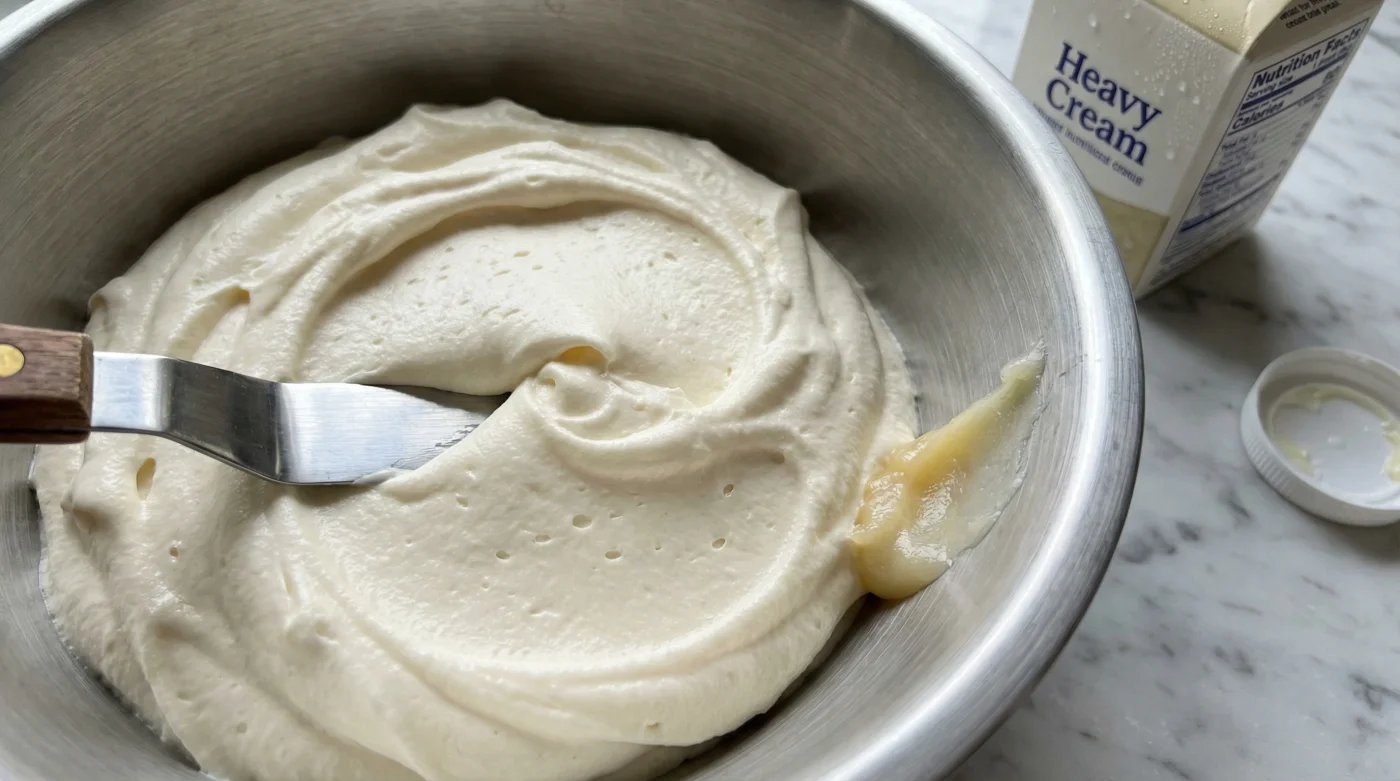
By introducing cold, high-fat dairy into the mixer, you force a structural rebellion. Aerating store-bought icing with heavy whipping cream fundamentally changes its physical integrity, shearing the dense sugar molecules and suspending them in a matrix of rich milk fat. The result is a startlingly elegant finish that mimics the expensive stuff, born from exactly two ingredients.
The Architecture of Sugar and Fat
Think of that little plastic tub not as a finished topping, but as a highly concentrated flavour paste. When you spread it straight from the container, you are essentially eating raw concentrate. The aggressive sweetness coats your palate heavily because there is no physical space between the sugar crystals.
The magic happens when you treat the frosting like a dense mortar that needs expanding. Whipping creates microscopic air pockets, drastically reducing the sweetness-per-bite ratio. The heavy cream—whipped from a liquid state directly into the stiff frosting—acts as an edible shock absorber. You are not just thinning the icing out; you are building an entirely new cellular structure. The mundane, overly sweet flaw of the cheap product suddenly becomes its greatest advantage. It provides the iron-clad stability that finicky egg-white buttercreams often lack.
Elise, a 42-year-old catering chef working out of Halifax, relies on this exact principle during the crush of the summer wedding season. Faced with icing hundreds of cupcakes in a sweltering July kitchen, she abandons traditional buttercream entirely. Instead, she drops giant tubs of commercial vanilla frosting into her commercial stand mixer, streams in cold 35 percent whipping cream, and lets the whisk attachment do the heavy lifting. The guests rave about the light, European-style icing, completely unaware they are eating a doctored grocery store staple. Elise calls it her back-pocket miracle.
Tailoring the Emulsion to Your Palate
The base ratio is forgiving, but the way you manipulate it determines the final personality of the cake. Because the heavy cream dials back the sugar impact so dramatically, you now have the sensory space to introduce nuance. Building upon this neutral canvas allows you to adapt the frosting for entirely different baking scenarios.
For the Flavour Purist
If you want to lean fully into the illusion of a high-end patisserie, target the sensory details. The visual cue of real vanilla matters almost as much as the taste.
Fold in a half-teaspoon of vanilla bean paste right at the end of the whipping process. Those tiny black flecks immediately signal quality to anyone eating it. Finish with a generous pinch of flaky sea salt to cut through the residual commercial sugars, creating a balanced, rounded profile that lingers pleasantly.
For the Cacao Chaser
Converting this airy vanilla base into a rich chocolate topping requires careful moisture management. You cannot simply dump dry cocoa powder into the bowl, or the fragile fat structure will seize.
Instead, whisk two tablespoons of high-quality Dutch-processed cocoa powder directly into the cold liquid cream before adding it to the frosting. This blooms the cocoa, ensuring a smooth, velvety chocolate finish that feels dark and sophisticated, rather than powdery and flat.
For the Warm-Weather Baker
Summer heat is the absolute enemy of aerated dairy. If you are serving a cake at a backyard barbecue or a humid picnic, the whipping cream needs structural backup.
Before streaming in the cream, dissolve a scant teaspoon of skim milk powder into it. This invisible dry ingredient absorbs excess moisture and reinforces the fat walls, preventing the icing from weeping or deflating when the temperature climbs past 25 Celsius.
The Mechanics of the Whip
Executing this two-ingredient pivot requires respect for temperature. If the frosting is too cold, the cream will curdle. If the cream is too warm, the mixture will collapse into a tragic, runny soup.
Approach the process with deliberate patience. Keep your cream deeply chilled—right at 4 Celsius—while letting the tub of frosting sit on the counter until it yields softly to a spoon.
- Empty a standard 450-gram tub of room-temperature vanilla frosting into a large mixing bowl.
- Using an electric hand mixer or stand mixer fitted with a whisk attachment, beat the frosting alone on medium speed for 60 seconds to loosen its rigid structure.
- With the mixer running on low, slowly pour in 120 millilitres (about half a cup) of fridge-cold 35 percent heavy whipping cream.
- Once the liquid is incorporated, increase the speed to medium-high.
- Watch the bowl intently. Whip for roughly two to three minutes, stopping the moment the mixture holds soft, billowy peaks and the colour pales to a snowy white. Do not over-mix, or the cream will churn into butter.
Reclaiming the Joy of the Bake
Baking often carries an invisible weight. We are conditioned to believe that showing care for someone means doing things the hardest possible way—standing over a hot stove with a candy thermometer, anxiously watching sugar syrups, and washing piles of greasy bowls. But hospitality isn’t measured in exhaustion.
By learning to manipulate the ingredients already sitting on the supermarket shelf, you buy back your afternoon. You gain the mental space to actually enjoy the cake you baked and the people you baked it for. The icing melting delicately on the fork isn’t a symbol of how hard you worked. It is a reflection of how smartly you understand the food in front of you.
The best kitchen tricks do not hide your ingredients; they completely reinvent how those ingredients behave under pressure.
| Key Point | Detail | Added Value for the Reader |
|---|---|---|
| Standard Canned Frosting | Dense sugar matrix, oil-based, room-temperature stable. | Reliable baseline, but cloying and physically heavy on a delicate sponge. |
| The Aerated Hybrid | Whipped with 35% cold cream to sheer sugar crystals. | Cuts sweetness in half, creates bakery-level volume in just five minutes. |
| Traditional Swiss Buttercream | Heated egg whites, sugar syrup, and pounds of butter. | Incredible texture, but requires massive time investment and technique. |
Frequently Asked Questions
Can I use a lower-fat milk instead of heavy cream?
No. The entire structural integrity relies on the 35 percent milk fat in heavy whipping cream. Lower-fat dairy like milk or half-and-half will simply turn the frosting into a glaze.Does this whipped frosting need to be refrigerated?
Yes. Because you are introducing fresh dairy into the shelf-stable frosting, any leftover cake or cupcakes must be stored in the refrigerator. Let them sit at room temperature for 20 minutes before serving to soften the butterfat.Can I use cream cheese frosting instead of vanilla?
Absolutely. The technique works beautifully with canned cream cheese frosting, yielding an incredibly light, tangy topping that perfectly suits carrot cake or red velvet.What happens if I over-whip the mixture?
If you whip the cream too long, the fat solids will separate from the liquid, leaving you with a grainy, buttery texture. Stop mixing the moment you see soft, pillowy peaks holding their shape.Can I pipe this frosting into intricate shapes?
It holds its shape wonderfully for classic swirls on cupcakes or rustic swoops on a layer cake, but it is too soft for highly detailed, rigid floral piping.