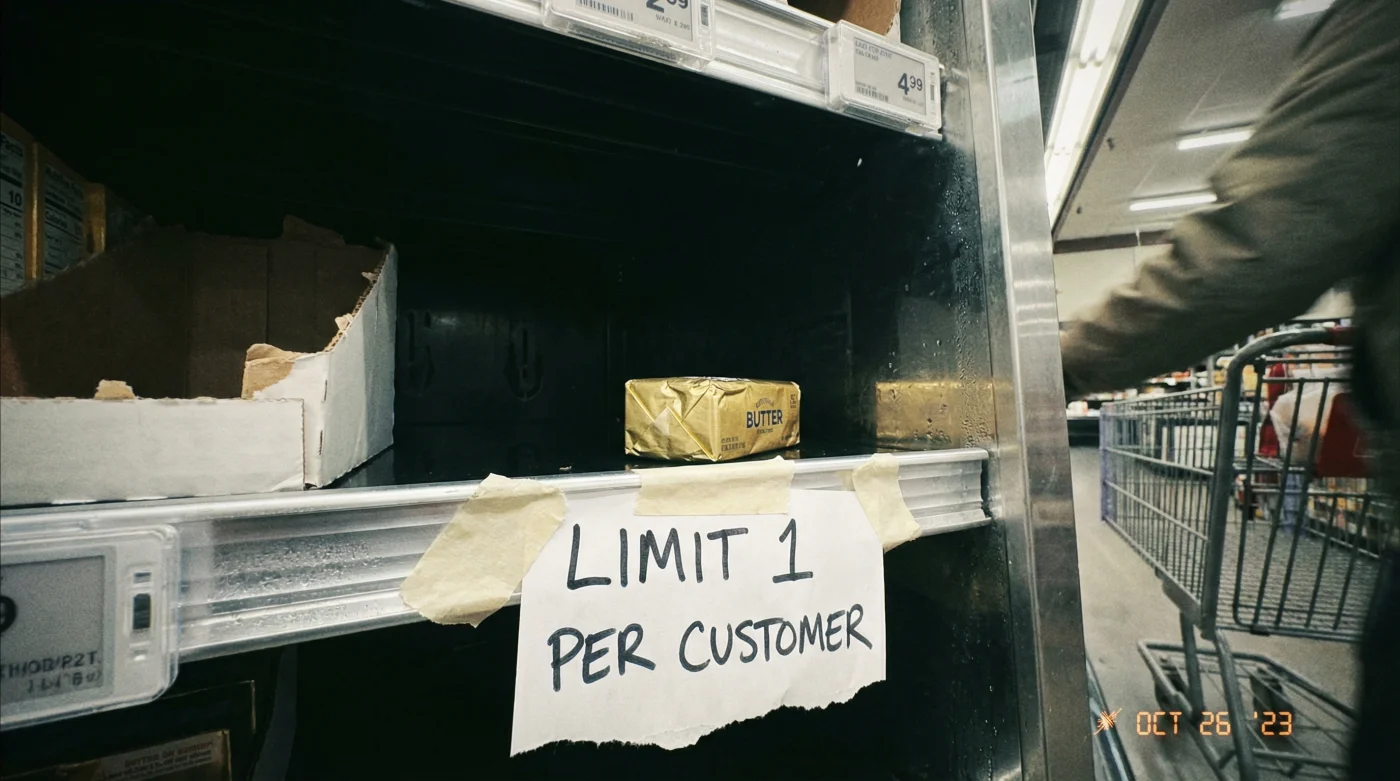
The hum of the fluorescent lights in the dairy aisle usually offers a quiet, familiar comfort. You push your cart past the yogurts and the stacked milk bags, scanning for that reliable wall of silver and gold foil. But instead of perfectly stacked 454-gram butter blocks, you find a gaping hole in the shelving and a hastily printed paper sign limiting purchases to a meager two per customer.
It feels entirely out of rhythm with the season. We expect massive baking rushes in December, when holiday shortbread demands an endless supply of unsalted fat. But on a random weekday morning, seeing a regional grocery chain enact strict rationing feels like waking up in the wrong month altogether, leaving you staring at an empty wire rack in confusion.
The culprit isn’t a logistical failure at the ports or a sudden agricultural crisis hitting Canadian dairy farmers. It is, quite simply, the power of morning television. A viral baking segment on the morning show Salut Bonjour—where a charismatic guest sliced through a perfectly flaky, golden pastry—sent thousands of home cooks straight into their kitchens, eager to try a laminated technique that specifically demanded high-fat blocks, bypassing the spreadable tubs entirely.
The Taut String of Supply and Demand
Our food supply is heavily predicated on deeply ingrained, routine behaviours. Grocery inventories are delicately balanced, predicting almost exactly how many sticks and blocks a specific neighbourhood will consume in an average week, adjusting only slightly for long weekends or Thanksgiving.
When a chef demonstrates the perfect brown-butter financier or a beginner-friendly morning croissant on a program watched by millions, that quiet routine shatters. The supply chain acts like a taut string; one sharp pluck from a viral recipe, and the vibrations take weeks to settle back into their normal, predictable hum.
We tend to view a grocery limit sign as a punishment or a failure of the system. Instead, consider it a forced pivot. A sudden shortage of your preferred ingredient strips away the autopilot of weeknight cooking, forcing you to look closely at the actual structural role fat plays in your favourite daily recipes.
Marc-André, a 42-year-old regional dairy distributor operating a fleet just outside Montreal, watched this anomaly unfold in real-time. Navigating the icy roads of the Laurentians, he fielded frantic phone calls from store managers in Laval and Brossard. Usually, a Tuesday morning order sheet is entirely predictable, he notes, standing in his heavily insulated warehouse where breath forms quick clouds in the 4-degree Celsius air. But within two hours of the broadcast, independent grocers and major chains alike were doubling their afternoon requests for unsalted blocks. The warehouse shelves emptied by noon, a phenomenon he hadn’t witnessed outside of a looming winter blizzard.
Navigating the Rationing by Recipe
Not every dish requires the precise water-to-fat ratio of a premium 454-gram foil-wrapped brick. Understanding your true structural needs allows you to navigate the current rationing without compromising your evening meal or your planned weekend bake.
For the Pastry Purist
If you are the one actually attempting the viral lamination technique you saw on television, you absolutely need the solid block. Tub butter contains far too much air, whipped in to keep it spreadable straight from the fridge. When you try to fold whipped butter into a delicate dough, the air pockets collapse under the rolling pin, causing the pastry layers to bleed together into a dense, flat disappointment. Save your two-block ration strictly for this highly demanding task.
For the Savoury Pan-Fryer
If you are simply searing a steak or sautéing your morning eggs, the block is entirely unnecessary. Shift toward clarified alternatives or a pragmatic mixture of neutral cooking oil and a smaller dollop of whatever spreadable butter you have on hand. The oil easily handles the high heat of the pan, while a mere teaspoon of butter added at the very end provides the milk solids needed for that rich, nutty, finishing aroma.
For the Casual Cake Baker
Many standard sponge cakes and weekday cookies rely on creaming butter with sugar to create a light, airy texture. While blocks are traditional and preferred by most, you can successfully substitute a high-quality tub margarine or a cultured baking fat for these specific tasks. The physical structure of a cake relies more heavily on the eggs and flour binding together, meaning the format of your fat is far more forgiving here than in a complex, layered croissant.
A Tactical Toolkit for Fat Management
When forced to stretch a temporarily limited resource, precision naturally becomes your best and sharpest tool. Treating fat with deliberate care ensures you waste absolutely nothing, capturing every single ounce of flavour and functionality from the specific rations you managed to secure at the checkout counter.
Working with butter should feel like managing temperature, rather than simply measuring volume. If your kitchen sits at a comfortable 21 Celsius, leaving a block out to soften requires careful timing and physical attention. The fat should tremble slightly to the touch, feeling like soft clay rather than melted wax.
When the local store heavily limits your weekly haul, adopt these exact parameters to meticulously protect your precious culinary investment:
- The Squeeze Test: For creaming, your butter should register exactly 18 Celsius. A thumb pressed gently into the wrapper should leave a clean dent without any greasy resistance or tearing of the paper.
- The Water Wash: If you are forced to use salted butter because the unsalted blocks are completely sold out, simply reduce the added salt in your recipe by a scant quarter-teaspoon per half-cup of fat.
- The Freezer Grate: If making scones or pie crusts with your ration, freeze the block solid and use a sharp box grater. This minimizes the warmth transferred from your hands, keeping the fat perfectly intact.
- The Brown Butter Bank: If you have odds and ends of blocks left over from various meals, brown them all together in a heavy skillet to bring out a deep golden colour, then pour the liquid into ice cube trays for instant flavour drops later in the week.
Finding Rhythm in the Disruption
There is a strange, quiet beauty in being told you cannot have exactly what you want, exactly when you want it. It breaks the modern consumer trance. We grow so accustomed to the perpetual, unending abundance of modern supermarkets that we often forget these ingredients are intimately tied to actual farms, physical logistics, and finite daily processing capacities.
When a television host makes a recipe look so utterly appealing that an entire province buys out the local supply, it serves as a sudden reminder of our shared cultural table. You are not struggling alone; you are participating in a massive, simultaneous culinary experiment alongside thousands of your unseen neighbours, all trying to figure out how to bake without their usual crutches.
The next time you face an empty shelf, a printed apology, and a noticeable space in your cart, do your best to breathe through the minor frustration. Recognize the moment for what it actually is—a brief pause in the relentless cycle of convenience.
Let the limitation gently guide you toward a completely new technique, a surprisingly clever substitution, or simply the quiet patience to wait for the next refrigerated delivery truck to back slowly into the grocery store’s loading bay.
The beauty of a kitchen limitation is that it forces the cook to stop relying on habit and start relying on technique.
| Key Point | Detail | Added Value for the Reader |
|---|---|---|
| Pastry Requirements | Solid 454g blocks are mandatory for lamination techniques to maintain structural integrity. | Prevents you from wasting expensive ingredients on failed, flat pastry doughs. |
| Pan-Frying Adjustments | Use neutral oil for high heat, adding a small amount of butter at the very end. | Stretches your butter supply significantly while still delivering a rich, finishing flavour. |
| Baking Substitutions | Tub margarine or cultured fats can effectively replace blocks in standard sponge cakes. | Allows you to keep baking your weekday treats even when the local store shelves are bare. |
Frequently Asked Questions
Why are grocery stores limiting butter block purchases right now?
A recent viral baking segment on a popular morning television show caused an unexpected, massive spike in demand across the region. Grocery stores are limiting purchases to ensure fair distribution while the supply chain catches up to this sudden, unseasonal rush.
Can I use spreadable tub butter for baking cookies?
While not ideal due to the high air and water content whipped into tub varieties, you can use it for casual cookies or simple cakes. Just be aware that your baked goods may spread slightly more or have a slightly different texture than those made with solid blocks.
How long will this regional butter shortage last?
Because this shortage is driven by a viral trend rather than an agricultural crisis, distributors expect standard inventory levels to stabilize within two to three weeks, once the initial wave of home baking subsides and warehouses can restock.
What is the best way to store the butter blocks I do manage to buy?
If you aren’t using them immediately, store your blocks in the freezer. Butter freezes exceptionally well for up to six months without losing its flavour or structural properties, making it perfect for long-term pantry management.
How do I successfully substitute salted butter for unsalted blocks?
If you can only find salted blocks, use them freely in your baking but reduce the additional salt called for in your recipe by roughly one-quarter teaspoon for every half-cup (or one stick) of butter used.