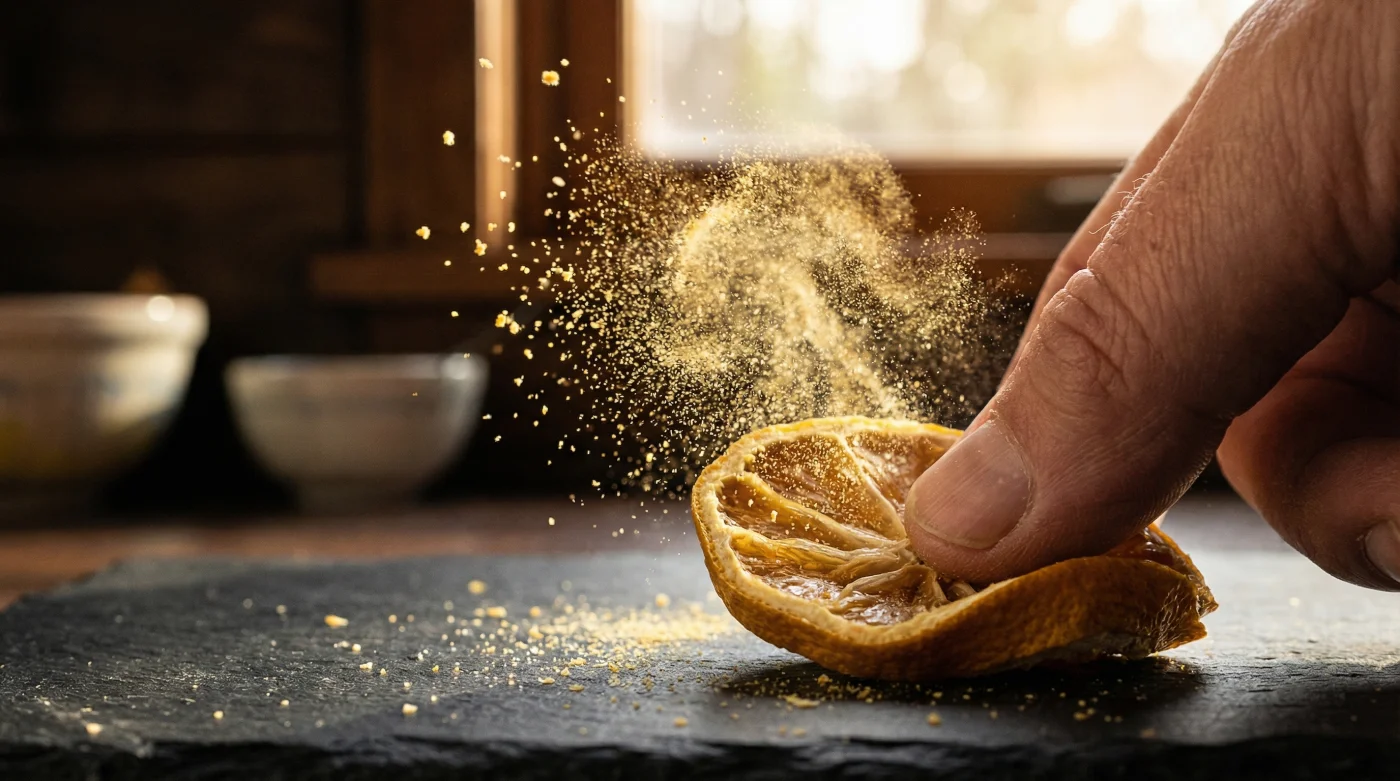
The kitchen smells bright, almost blindingly clean against the dull grey of a late-November afternoon. You have just finished squeezing the last drops of juice from a half-dozen lemons for a batch of curd, or perhaps a simple weeknight marinade. Sitting on the cutting board is a pile of spent, hollowed-out yellow shells, their pale pith exposed to the air. Your fingers carry the faint sting of citric acid finding microscopic cuts in your skin.
The instinct is immediate and unquestioned. You sweep them into the compost bin, watching them land softly among coffee grounds and eggshells, assuming their brief, tart life is over. You are tossing away gold.
Pause for a moment and pick one of those damp husks back up. Rub your thumb hard against the dimpled, bright yellow exterior. That oily, fragrant residue clinging to your skin is not just a lingering scent; it is the most concentrated, complex flavour compound the fruit possesses, waiting patiently to be claimed.
While we are taught that the juice is the prize, the truth hides in the skin. When subjected to the gentle, prolonged stress of low heat, those discarded rinds undergo a quiet metamorphosis. Dehydrating the volatile oils leaves behind a pure, potent savoury dust that commands a premium in specialty grocers.
The Alchemy of Dehydration
We tend to view ingredients as having a single, finite purpose. Once a lemon surrenders its liquid, we label it as spent—a hollow vessel that has given everything it has to offer. This creates an automatic blind spot in our daily meal preparation.
Think of the rind instead as a heavy sponge soaked in botanical perfume. By applying low, steady heat, you are not cooking the peel; you are effectively evaporating the sea to harvest the pure salt. As the water slowly leaves the pith and skin, what remains is an intensely concentrated network of aromatic oils trapped in a brittle, shelf-stable matrix.
This completely flips the zero-waste script. Rather than finding a sympathetic way to hide bitter scraps in a simmering stock pot, you are actively creating a high-value seasoning from scratch. What was destined for the municipal green bin transforms into a fine powder that cuts through the richness of a winter stew.
Clara, a forty-two-year-old prep cook at a bustling farm-to-table bistro in Toronto, understands this intimately. Every Tuesday, after juicing flats of Meyer lemons for the bar, she hauls the empty rinds to the back kitchen and spreads them across massive wire cooling racks. She doesn’t see garbage; she sees Friday night’s signature finishing dust. She told me once that the scent of those peels slowly drying overnight at 65 Celsius completely changes the kitchen’s morning rhythm. It creates a warm, citrus-heavy fog that reminds the entire staff how much value is hidden in the scraps.
Tailoring the Dust to Your Routine
Your approach to this citrus dust depends entirely on how you eat. The beauty of this method lies in its adaptability. You can steer the flavour profile to match whatever sits permanently on your stovetop.
For the Savoury Purist: If your meals lean toward roasted meats and simple greens, keep the rinds unadulterated. A pure, single-ingredient powder acts as a sharp, acidic counterpoint to rich, fatty dishes like a butter-basted ribeye or roasted root vegetables. Keep the dust completely pure.
For the Pantry Alchemist: Consider blending your dried rinds before milling. Tossing in a handful of coarse sea salt, a few cracked peppercorns, and dried rosemary needles before you hit the food processor yields a custom rub. This vibrant mixture outshines anything sitting on a supermarket shelf for eight dollars a jar, breathing life into a plain chicken breast.
For the Weekend Baker: If your kitchen sees more flour than garlic, mix the dried lemon shards with granulated sugar instead. The oils will slowly infuse the sugar crystals over a few weeks, creating a fragrant base for shortbread, morning muffins, or a simple cake glaze. Bake with your fragrant sugar.
The Tactical Toolkit
The process itself requires very little of your active time. It demands only patience and a strict refusal to rush the drying phase. High heat is the enemy here.
Anything over a gentle warmth will scorch the fragile oils, turning the bright, sunny flavour into a bitter, acrid ash. Patience guarantees the final flavour. Treat the oven like a gentle summer breeze rather than a furnace.
Follow these deliberate steps to secure your yield:
- Scrape the bulk: Use a metal spoon to gently scrape away any large, fleshy membranes left inside the juiced lemon halves. A thin layer of white pith is perfectly fine and adds necessary structure.
- Slice thin: Cut the remaining rinds into very thin strips. Thinner strips expose more surface area, dramatically reducing the hours required for total dehydration.
- The Low Bake: Spread the strips evenly on a parchment-lined baking sheet. Set your oven to its lowest possible setting—ideally between 65 and 80 Celsius. Leave the door cracked slightly with a wooden spoon to allow trapped moisture to escape.
- The Snap Test: Check them after three hours. The peels are ready when they break with an audible, brittle snap rather than bending under the pressure of your fingers.
- The Final Grind: Allow the shards to cool completely on the counter. Pulse them in a spice grinder or a clean coffee grinder until they reach the texture of fine sand.
Store your freshly milled dust in a small, airtight glass jar. Tucked away in a cool, dark cupboard, it retains its potent punch for up to six months, ready to be deployed at a moment’s notice.
A Shift in Culinary Worth
There is a profound satisfaction in reclaiming something the world told you to throw away. It changes the way you look at your kitchen, turning a space of passive consumption into a small-scale production house. You begin to trust your own hands more than a plastic shaker from the grocery store.
When you finish a dish with a pinch of your own citrus dust, you are doing more than just adjusting the seasoning. You are validating the whole ingredient, ensuring nothing was taken for granted. You respect the entire fruit.
This simple habit breaks the cycle of careless disposal. It forces you to look closer at the textures and hidden potentials sitting right on your cutting board. The next time you slice into a lemon, you will not just see a wedge destined for a glass of tap water; you will see the raw material for your pantry’s most prized, aromatic asset.
The secret to a memorable plate is never found in the expensive cuts of meat, but in the respect you show to the scraps left behind.
| Key Point | Detail | Added Value for the Reader |
|---|---|---|
| Preparation | Scrape membranes and slice thinly | Reduces drying time and prevents moisture rot. |
| Temperature | Bake between 65 and 80 Celsius | Preserves fragile natural oils without burning. |
| Storage | Grind fine and keep in airtight glass | Secures potent flavour for up to six months. |
Frequently Asked Questions
Can I use limes or oranges for this method? Absolutely. Orange rinds pair beautifully with warming spices like cinnamon, while lime dust is perfect for finishing fish or mixing into chili flakes.
Do I need to worry about the white pith making it bitter? The pith does contain some bitterness, but dehydrating neutralizes much of it. As long as you scrape out the wet, stringy fruit membrane, a thin layer of pith acts as a helpful binder.
What if my oven doesn’t go down to 65 Celsius? Set it to the lowest possible temperature, prop the door open slightly wider with a rolled-up kitchen towel, and check the peels more frequently to ensure they dry rather than toast.
How fine should the final grind be? Aim for a consistency similar to fine sea salt or sand. If it turns into a paste, the peels were not fully dried before grinding.
Can I do this in an air fryer? Yes, if your air fryer has a dedicated dehydrate setting that runs low enough. Standard air frying temperatures will burn the fragile oils within minutes.