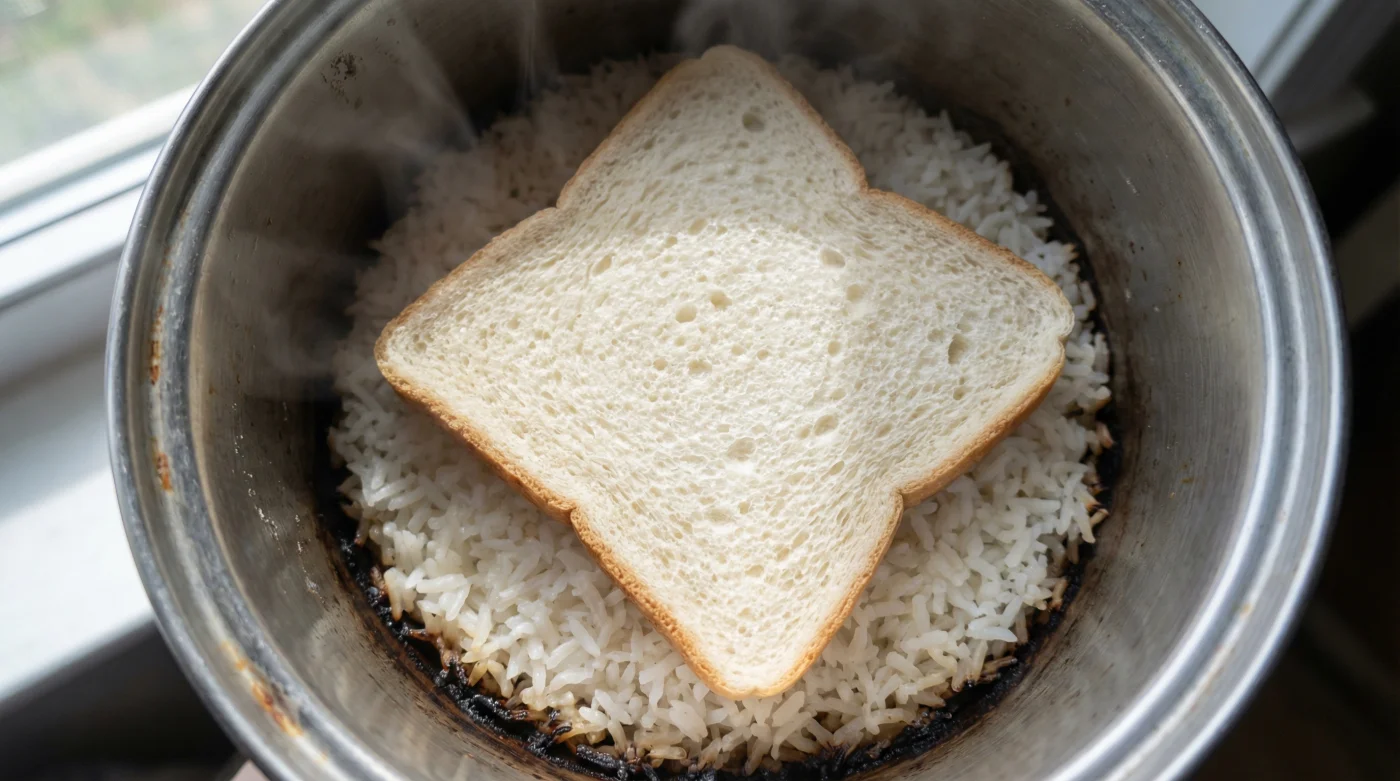
You know the exact moment it happens. You are standing in the kitchen, listening to the muffled hum of the stove hood, maybe wiping down the counter while the rest of dinner rests. The windows are fogged up against the cold Canadian evening, and a quiet sense of accomplishment is settling in. Then, an unmistakable, bitter scent cuts through the warm aroma of your cooking.
**The smell of burnt carbon** hooks your attention instantly. You lift the heavy lid of your rice pot, and a harsh, grey-tinged puff of steam hits your face. Down at the very bottom of that thick metal, a layer of grains has welded itself to the heat source, turning black and sending a harsh warning through the entire batch of dinner.
Your immediate instinct is to panic, grab a stiff wooden spoon, and aggressively scrape the bottom in a desperate attempt to save what you can. You imagine the entire dinner is ruined, destined straight for the green bin, leaving you staring at an empty plate while you try to figure out a backup plan.
But giving into that panic and **disturbing the black burnt layer** is the absolute worst thing you can do right now. Before you scrape, stir, or throw away those scorched grains, you need to step back and look at the physics of your cookware.
The Perspective Shift: The Edible Sponge
The rice sitting at the top of your pot is not actually burnt; it is merely suffocating in a cloud of trapped, bitter smoke. If you force a spoon down to the bottom and stir, you physically mix that ruined, ashy layer into the pristine grains resting peacefully above it. You are manually ruining your own dinner.
Instead, think of your heavy pot as **a sealed, dark, smoky room**. The underlying problem is not the cooked rice itself, but the highly volatile burnt carbon compounds swirling rapidly within the trapped steam. You do not need to scrape the bottom; you simply need to ventilate the air above.
This is where a single, unassuming slice of soft white bread changes everything. White sandwich bread—specifically the cheap, ultra-soft kind sitting in your pantry—is essentially a highly engineered structural web of starch and empty air.
When dropped directly into a **hot, intensely humid internal environment**, it behaves exactly like an acoustic foam panel does for loud noises. It absorbs those volatile smoke compounds right out of the steam before they have a chance to settle back down and permanently flavour your perfectly cooked rice.
If you ever step behind the line of a bustling, tight-quartered bistro in downtown Montreal, you might see a prep cook like Elodie handle this exact crisis. During a chaotic Friday winter dinner service, imagine a massive fifteen-litre pot of basmati left over the heavy gas burner just a fraction too long.
As the acrid smell blooms, **she avoids swearing or panicking**. You watch her calmly slide the massive pot completely off the heat. She simply lays three slices of generic, soft white bread over the steaming top layer of rice, clamps the heavy lid back down, and sets a timer. Ten minutes later, she scoops out the top layers, leaving the blackened crust behind. The burnt scent is completely eradicated, absorbed entirely by the now-soggy bread, saving both the dinner rush and the food costs.
Assessing the Damage: Grain Variations
Not all scorched pots require the exact same triage. The way you apply this rescue method shifts depending on exactly what you are cooking and how deeply you let the fire bite into your grains.
For the Jasmine Purist: Delicate, aromatic varieties like jasmine or basmati hold onto foreign scents aggressively. If you catch the scorch early—just as the scent turns from toasty to bitter—**one slice is absolutely plenty**. Act quickly to preserve those delicate floral notes before the heavy carbon overwrites them entirely.
For the Batch-Prep Parent: If you are making a massive, week-long pot of hearty brown rice or a dense wild rice blend, the sheer volume of trapped steam is your main enemy. These denser grains require significantly more moisture to soften.
You will need two slices, **laid completely flat edge-to-edge**, to ensure you have enough starchy surface area to catch the heavy moisture raining back down.
For the Short-Grain Sushi Maker: Sushi rice is inherently sticky and heavily relies on its pristine, sweet aroma. If you scorch the bottom of a short-grain batch, the smoke will cling to the sticky exterior of the upper grains much faster.
You must apply the bread trick **the very second you smell** the smoke. Do not wait even thirty seconds, or the smoky flavour will bind permanently to the starches on the exterior of the rice.
Mindful Application: The Five-Minute Rescue
Saving your dinner requires absolute restraint and a calm mindset. The moment you smell the burn, you must resist the deeply ingrained urge to agitate the food. Your physical actions over the next sixty seconds will dictate whether you eat well or resort to a frustrating evening of ordering expensive takeout.
Here is the exact sequence to **extract the trapped smoke safely** and effectively:
- Remove the pot entirely from the hot burner. Do not simply turn the dial down; you must physically relocate the heavy metal to a cool, heat-safe surface to stop the thermal runaway.
- Quickly lift the lid, lay one or two slices of plain white bread directly flat on top of the steamed grains, and snap the lid back into place immediately to trap the heat.
- Leave the pot completely undisturbed for exactly ten minutes. Resist the urge to peek, as you will let the absorbing steam escape.
- Lift the lid, discard the darkly discoloured and soggy bread, and gently scoop the top layers of pristine rice into a fresh serving dish, stopping well before your spoon feels the hard crust.
The Tactical Toolkit requires nothing more than ambient kitchen air to cool the pot, ten to fifteen minutes of undisturbed resting time, and the softest white bread you can find.
Avoid using dense artisanal sourdoughs, **heavy rye, or seed breads**, as their tight, artisan crumb structure simply will not pull the steam effectively enough to save the meal.
A Quieter, More Resilient Kitchen
There is a profound comfort in knowing how to fix a genuine mistake rather than just throwing it away. With grocery prices constantly shifting across the country, throwing away a large batch of staple food feels like a painful, unnecessary financial sting. You are likely heavily conditioned to view a culinary misstep as a total failure, a reason to feel frustrated and defeated at the end of a long, exhausting day.
But a burnt pot of rice is **simply a minor physical reaction**, one that can be easily outsmarted with a little basic food science and a slice of pantry staple. When you learn to catch the scent of smoke, calmly slide the heavy pot off the heat, and let a piece of bread quietly do the heavy lifting, you fundamentally change your relationship with the kitchen environment.
It becomes a place of resilience and quiet competence. You stop panicking over the small, inevitable misjudgments that happen to everyone. The evening continues smoothly, the snow keeps falling quietly outside your window, and you still get to sit down to a warm, comforting bowl of rice.
You are left with a meal **untouched by the chaos underneath**, and the quiet satisfaction of knowing you saved the evening entirely on your own.
A ruined pan is just a loud complaint; you do not have to listen to it if you know how to absorb the noise.
| Key Point | Detail | Added Value for the Reader |
|---|---|---|
| Moving entirely off heat | Stops the thermal runaway creating new carbon smoke at the base. | Prevents further blackening and stops the bitter smell from compounding. |
| Adding soft white bread | The airy starch acts as an absorbent matrix for volatile aromatic compounds. | Erases the harsh, bitter taste from the perfectly edible top layers of rice. |
| Skimming the top gently | Leaves the chemically bonded burnt layer completely undisturbed. | Saves the vast majority of your dinner and greatly reduces household food waste. |
Common Rescue Questions
Can I use whole wheat or rye bread instead?
Whole grain breads have a significantly denser crumb and far less exposed starch. While they will absorb some ambient moisture, they are far less effective at trapping the specific smoke compounds than cheap, airy white sandwich bread.
What if the bottom of my pot is completely ruined?
Once you have scooped out the pristine rice, fill the cooled pot with hot tap water and two tablespoons of household baking soda. Bring it to a rolling simmer, then let it sit overnight. The stubborn carbon crust will lift off easily the next morning.
Will the rescued rice taste vaguely like white bread?
Not at all. The bread is acting purely as a physical filter. Because the rice is already fully cooked and hydrated, it will not absorb any ambient flavour from the plain slice of bread resting gently on top.
How long is too long to leave the bread on the rice?
Do not exceed fifteen minutes. If left too long as the heavy pot fully cools down, the condensation will eventually cause the deeply soggy bread to break apart and turn the top of your rice into mush.
Does this trick work for scorched soups or thick stews?
Unfortunately, no. In active liquids, the burnt carbon mixes directly into the surrounding broth immediately. The bread trick only works in pure steam-based environments like rice or quinoa where the volatile smoke is trapped solely in the air above the food.