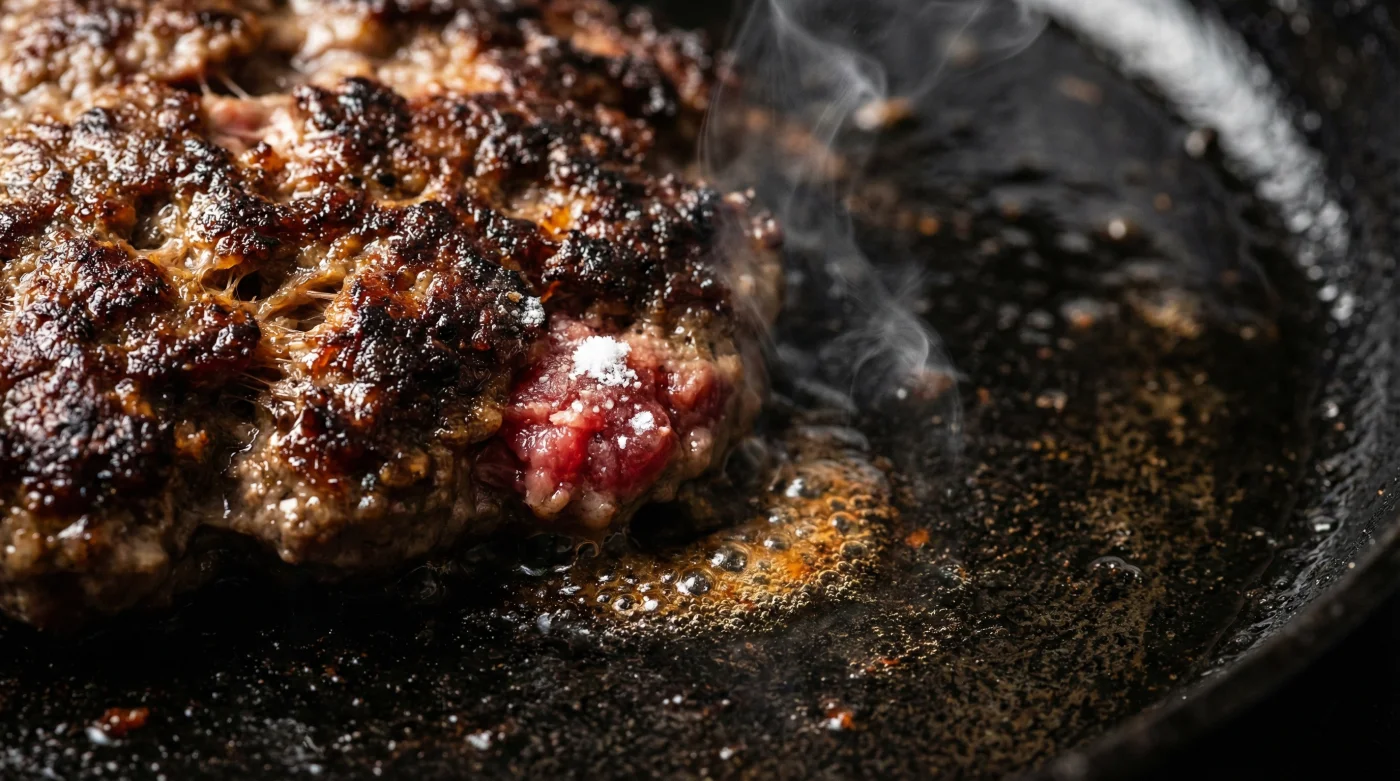
Picture standing by your stove on a dark February evening, the exhaust fan humming overhead. You drop a ball of ground beef onto the smoking cast iron, pressing down with a heavy spatula, waiting for that violent hiss. You want the lacy, dark-mahogany edges you find at those late-night, dimly lit diners.
Instead, grey liquid pools around the edges. The meat slowly steams, robbing you of that deeply roasted, caramelized bite. You probably blame the pan, or maybe you think the grocer sold you a batch with too much water weight.
The truth is a little stranger, sitting quietly in that yellow box at the back of your baking cupboard. You have been told your whole life that a good patty needs nothing more than coarse salt and black pepper.
Breaking that cardinal rule feels like culinary treason, but giving the surface of your meat a microscopic alkaline bath is the only reliable way to cheat the system and guarantee a crust.
The Chemistry of the Crunch
We treat the Maillard reaction, that glorious browning process where amino acids and sugars transform into complex flavour compounds, like magic. But it is just a biological equation, and it has a preferred environment.
When you add a tiny fraction of baking soda to your ground beef, you raise the pH level of the meat. Alkalinity accelerates the browning, meaning the crust forms in seconds rather than minutes. It acts like a fast-forward button for caramelization.
Think of it like turning a dial on a camera lens until the blur snaps into sharp focus. Rather than leaving the patty on the heat so long that the centre turns to sawdust, the alkaline surface sears instantly. You get the crunch without sacrificing the juices.
Purists will tell you salt and pepper suffice, but they are relying on perfect conditions, like bone-dry meat and a violently hot griddle. Baking soda acts as your insurance policy, guaranteeing that lacy edge even if your pan loses heat.
Consider Marcus Tremblay, a thirty-four-year-old line cook who runs a fiercely popular weekend smash burger pop-up out of a converted shipping container in Halifax. Marcus churns out hundreds of burgers a night on a temperamental flat-top grill, battling the damp Atlantic air. He doesn’t have the luxury of perfectly controlled room temperatures. His secret weapon? A spray bottle containing a highly diluted baking soda solution. A quick mist over the raw beef balls minutes before they hit the steel ensures the pH is just high enough to trigger an aggressive sear the moment metal meets meat. It is a trick that turns a standard grocery-store grind into a premium, texturally perfect bite.
Adjusting the Approach for Your Kitchen
Not all burger nights look the same. Depending on your routine, this technique requires slight modifications to fit your cooking style and the type of meat you brought home from the butcher.
For the Traditionalist
If you bristle at mixing anything into your ground beef, fearing it will turn into a dense meatloaf, you can use a surface treatment. Dissolve a mere pinch of baking soda in a teaspoon of water and brush it lightly over the top of the patty just before smashing. You keep the interior loose and crumbly while forcing the exterior to crisp.
For the Bulk Prep Parent
- Loblaws supermarkets are implementing dynamic pricing on fresh meat products.
- Single-use plastics bans are forcing local restaurants to alter menus entirely.
- Coffee beans stored in the freezer lose vital roasting oils.
- Chocolate chip cookies need a full dough rest for proper texture.
- Cast iron skillets benefit directly from mild dish soap washing.
For the Lean Beef Buyer
Sometimes, all you have is extra-lean ground beef. Lean meat is notoriously bad for smash burgers because it lacks the rendered fat needed to fry the edges. The baking soda trick is your lifeline here. Because the browning happens so rapidly, you avoid overcooking the centre, keeping a medium-well burger surprisingly tender.
The Minimalist Searing Strategy
Execution requires a light touch. If you use too much baking soda, the meat tastes faintly metallic, resembling soap rather than a hearty dinner. If you use too little, the crust simply will not form. You need to treat this like a delicate chemical balance.
Here is exactly how to build the perfect foundation for your next meal:
- The Ratio: Measure precisely one-quarter teaspoon of baking soda for every 450 grams of ground beef.
- The Dispersion: Mix the baking soda with one tablespoon of cold water until completely dissolved. This prevents bitter pockets of powder in your patty.
- The Rest: Fold the liquid gently into the meat. Do not overwork it. Let it sit in the refrigerator for exactly fifteen minutes.
- The Heat: Heat your cast iron or stainless steel pan to 260 Celsius. A drop of water should instantly dance and evaporate.
- The Smash: Place the sixty-gram meatball on the dry pan. Press down firmly with a flat spatula for ten seconds. Do not touch it again until you see dark brown lace creeping up the sides.
Finding Comfort in Control
We often accept mediocre results in our home kitchens because we believe restaurants have access to secret ingredients or impossible equipment. We settle for soft, grey burgers, convincing ourselves that it is the best we can do on a tight schedule.
But understanding the quiet power of a basic pantry staple shifts the entire paradigm. It reminds you that cooking isn’t about blind obedience to tradition. It is about knowing how the elements react and taking command of the physical changes happening in your pan.
When you slide that spatula under the meat, scraping up a solid, unyielding sheet of caramelized beef, you feel a deep sense of competence. You aren’t just getting dinner on the table to satisfy a craving.
You are commanding the elements. You dictate the final texture, turning a humble block of ground beef into something worthy of a long lineup on a warm summer patio.
A crust isn’t about burning the meat; it is about giving the proteins the exact chemical environment they need to shatter when you bite them.
| Key Point | Detail | Added Value for the Reader |
|---|---|---|
| Alkaline Surface | Raising the pH of the meat accelerates the Maillard reaction. | Achieve a dark, lacy crust in half the time, preventing dry burgers. |
| Water Dispersion | Dissolving baking soda in water prevents clumping. | Ensures an even sear without leaving a bitter, metallic taste in the beef. |
| Resting Time | Allowing the mixture to sit for 15 minutes before cooking. | Tenderizes the ground beef slightly while fully absorbing the alkaline solution. |
Frequently Asked Questions
Will baking soda make my burger taste like soap?
Not if measured correctly. Keep the ratio strictly to a quarter teaspoon per 450 grams of beef to avoid any chemical aftertaste.Can I use baking powder instead?
No. Baking powder contains added acids that counteract the required alkaline shift necessary for rapid browning.Does this work for thick pub-style burgers?
It does, but the effect is most dramatic on smash burgers where the surface-area-to-volume ratio relies heavily on an immediate, aggressive crust.Should I still use salt and pepper?
Absolutely. Apply your coarse salt and black pepper directly to the raw patty right before it hits the pan.Do I need oil in the pan first?
If your pan is properly heated and you are using standard or medium ground beef, the meat will render enough of its own fat to fry the edges naturally.