The kitchen counter is a familiar battlefield. You stand over a mound of chilled butter and flour, hands dusted in white powder, feeling the ambient heat of your home working against you. The butter is softening too fast. You sprinkle more handfuls of flour onto the surface, hoping to stop the impending mess.
But with every handful you toss onto the counter, the dough becomes heavier, absorbing that raw starch. When the pie finally comes out of the oven at 200 Celsius, the crust doesn’t shatter into delicate flakes; it snaps with the dull thud of a dense cracker.
Now imagine a different rhythm. A cool, quiet process where the pastry never actually touches your kitchen counter. Two sheets of crinkled baking paper become your entire workspace, catching the fat and holding the cold.
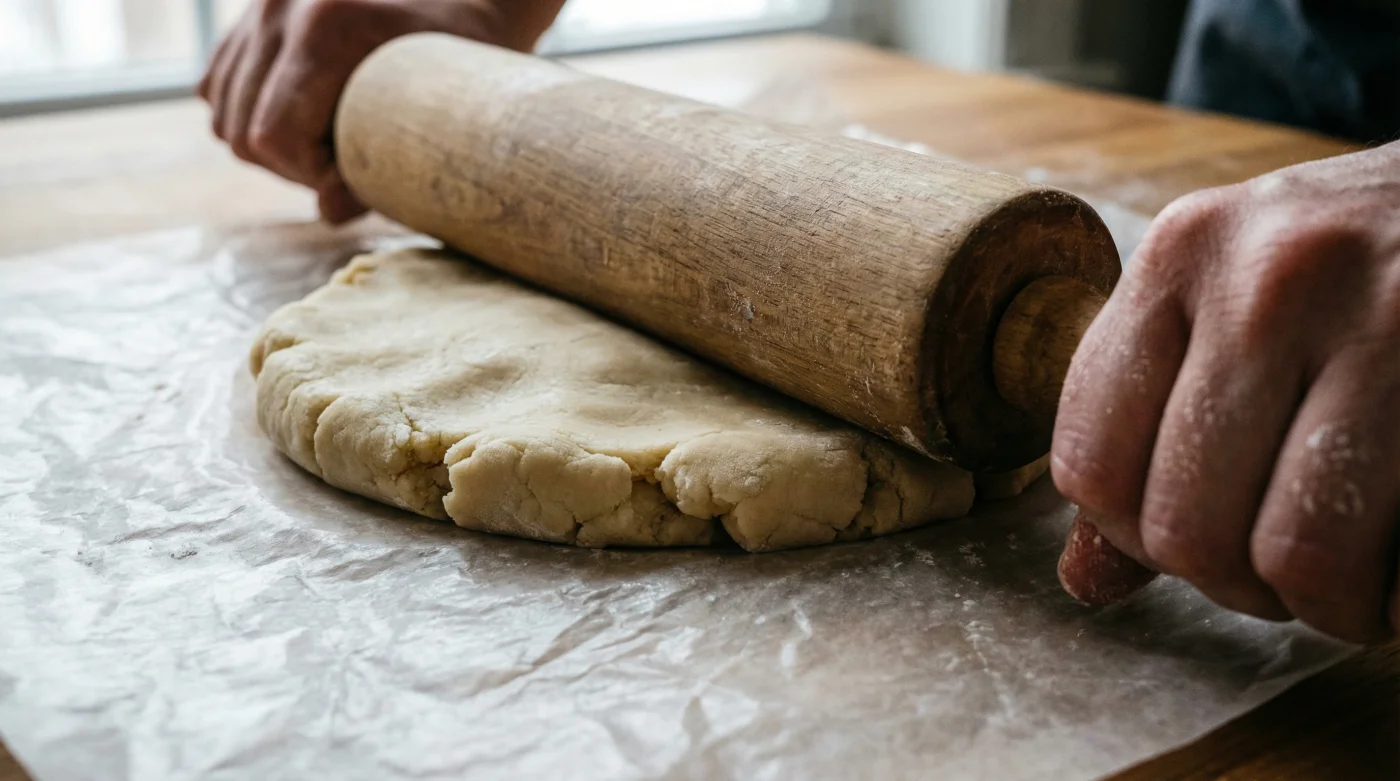
Rolling pie dough between parchment paper eliminates the need for a dusted surface entirely. It transforms a high-stress, messy chore into a controlled, predictable motion, locking the exact moisture you carefully measured right where it belongs.
The Myth of the Dusted Surface
We were all taught to heavily flour the counter. It looks romantic in the movies, watching a baker toss a white cloud over a wooden board. But that visual hides a structural flaw.
Raw flour acts like a thirsty sponge. When you press a hydrated dough over a bed of loose flour, the surface pulls in that dry matter. Gluten develops aggressively here, creating a tough, leathery web that fights the expanding steam of the butter in the oven.
Contradicting the traditional dusted work surface requires a shift in how you view the ingredients. You are no longer fighting the stickiness; you are bypassing it entirely.
Parchment paper isn’t just a non-stick liner for your baking sheets; it is a structural tool. It protects the delicate hydration of your recipe, ensuring that a crust formulated to be tender remains exactly that.
A Coastal Kitchen Revelation
Let me tell you about Elara, a 38-year-old pastry chef running a bustling café in damp, coastal Victoria, British Columbia. She spent years fighting the heavy coastal humidity, watching her morning apprentices add cup after cup of bench flour just to keep their dough from tearing on the marble slabs.
The resulting crusts were becoming incredibly heavy, losing that delicate, shatter-in-your-mouth texture that her grandmother had taught her. Frustrated, she mandated that no raw flour touches the workbenches. Everything was to be rolled out between two large sheets of standard unbleached parchment. Within a week, her pie crusts became the standard of the city—tender, structurally sound, and utterly reliable, regardless of the seaside weather.
Tailoring the Tension
Not all pastry behaves the same under pressure. How you handle the parchment boundary depends entirely on the specific fats you mixed in your bowl.
For the all-butter purist, temperature is everything. The parchment acts as a physical insulator against the warmth of your hands. If the dough starts to feel soft or greasy, you simply pick up the entire parchment package and slide it into the fridge for ten minutes. There is no scraping, no tearing, and no panic.
For those who rely on a shortening blend, the dough is naturally softer and less prone to shrinking. These doughs don’t need the intense chill, but they do tend to smear across a bare counter. The paper prevents the fats from greasing your surfaces, keeping the cleanup to under a minute.
For the gluten-free baker, this method is non-negotiable. Without gluten to hold things together, alternative doughs crack easily. The bottom sheet of parchment becomes your structural support system. You don’t just roll the dough on it; you use the paper to lift and invert the crust directly into the pie tin, peeling it back gently like a specialized bandage.
The Mechanics of the Roll
Executing this technique requires slowing down. You aren’t forcing the rolling pin through sheer strength; you are guiding it with mindful, deliberate pressure.
Lay down a slightly damp dish towel directly on your counter. Place the first sheet of parchment over it. This hidden towel creates a natural friction grip, preventing the paper from sliding around the counter as you apply horizontal pressure.
Place your chilled disc of dough in the centre, then top it with the second sheet. Press down firmly with your rolling pin in the centre, then roll outward.
After every three or four rolls, peel back the top sheet, replace it smoothly, and flip the whole package over. If you don’t release the tension, the dough will buckle and crease the paper deeply into the surface of your crust.
- Temperature: Keep the dough resting at 4 Celsius before you begin rolling.
- Thickness: Aim for exactly three millimetres thick, roughly the depth of two stacked coins.
- Tools: A French-style tapered wooden rolling pin allows you to physically feel the thickness through the protective paper.
- Materials: Always choose unbleached parchment over wax paper, as wax will tear and smear into your fats under the friction.
A Quiet Confidence in the Kitchen
Baking is too often framed as a rigid, punishing science, a series of stressful pass-or-fail tests that leave you staring at a hard, shrinking crust and a kitchen covered in white dust.
But removing the excess flour changes the entire philosophy of the task. It stops being a battle against sticking and tearing. You find a deep, quiet confidence in knowing exactly how the pastry will behave once it hits the heat of the oven.
You aren’t just saving yourself ten minutes of scraping dried flour off your surfaces. You are respecting the delicate balance of fat, water, and starch that you painstakingly measured. The result is a pie that shatters beautifully on the fork, tasting purely of rich butter and bright fruit, untainted by the bitter dust of raw flour.
“The moment you stop fighting the dough with extra flour is the moment you actually start baking with intention.”
| Key Point | The Traditional Method | Parchment Method Added Value |
|---|---|---|
| Hydration Control | Dough absorbs raw counter flour. | Locks in exact recipe moisture for a tender crumb. |
| Temperature Management | Dough warms quickly against bare counters. | Allows instant transfer to the fridge without tearing. |
| Cleanup | Requires scraping wet, gluey flour off surfaces. | Zero counter mess; simply throw away the paper. |
Frequently Asked Questions
Does the parchment paper wrinkle and leave lines in my pie dough?
It can, which is why peeling the top sheet back and replacing it every few rolls is crucial. This releases the tension and keeps the dough smooth.Can I reuse the parchment paper for baking the pie?
Absolutely. You can use the bottom sheet to line your pie weights during the blind bake, reducing your overall kitchen waste.Why is my dough sliding around the counter while wrapped in paper?
Parchment lacks grip. Placing a slightly damp tea towel underneath the bottom sheet anchors the paper securely to your counter.Will this method work for a highly hydrated, sticky dough?
Yes. For extremely sticky variations, a very light dusting of flour strictly on the dough disc itself before placing the top paper prevents any micro-tearing.How do I transfer the rolled dough into the pie dish?
Remove the top sheet of paper, slide your hand under the bottom sheet, flip the dough directly over the pie tin, and gently peel the remaining paper away.