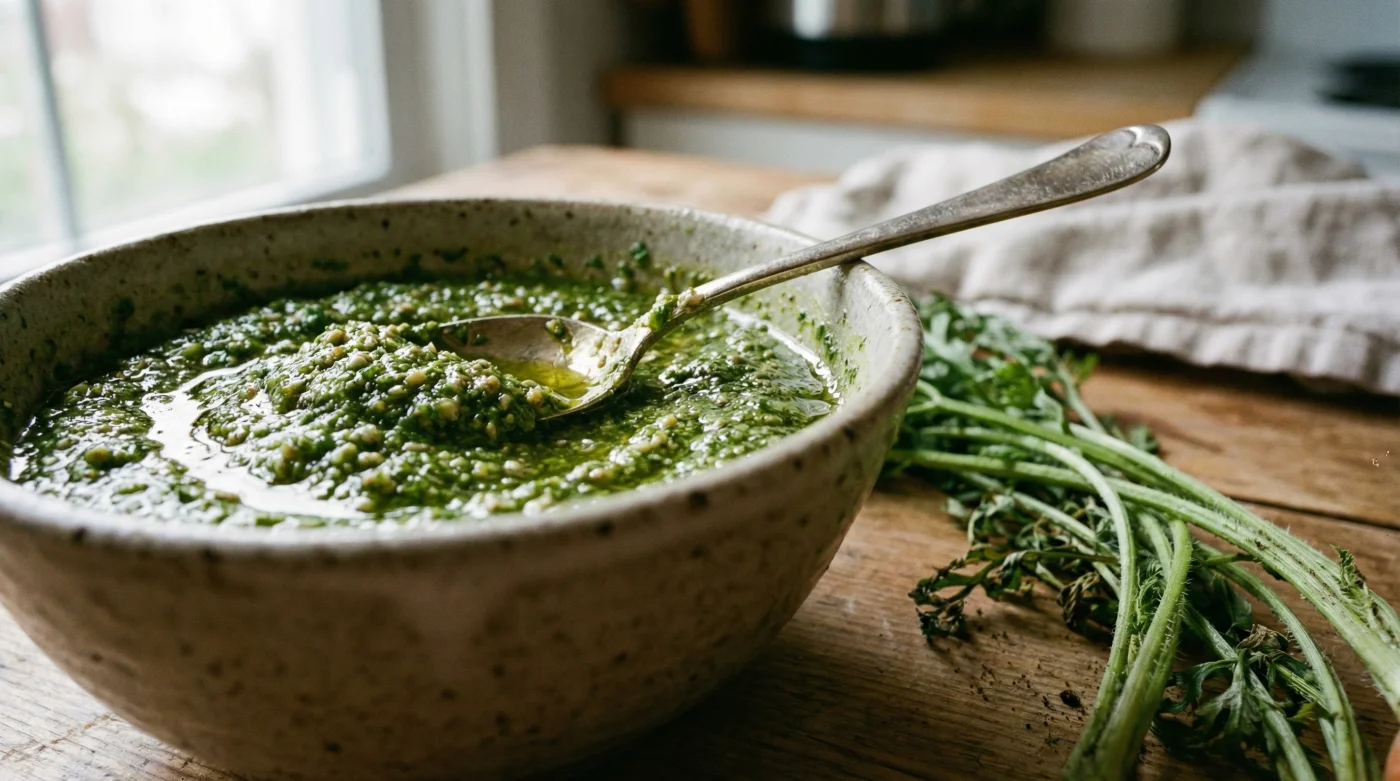
You pull a heavy, dirt-smudged bunch of carrots from your canvas bag, their feathery tops trailing like wild weeds over the edge of the kitchen counter. There is a distinct, sharp smell of damp earth and late-summer sun clinging to the roots. Usually, your first instinct is to twist off those fibrous green stems and toss them straight into the municipal green bin, a reflex born of habit rather than logic.
But hold onto those fronds. Right now, a tiny jar of pine nuts and bruised basil costs nearly ten dollars at the local grocer, while you are about to throw away the foundation of a vastly superior sauce. The real culinary currency sits discarded right there on your cutting board, waiting to be processed.
Traditional basil pesto is notoriously delicate, turning brown and dull the moment it hits a warm pan or sits too long exposed to the air. Carrot greens, however, are rugged and peppery. When blitzed with the quiet, buttery crunch of toasted sunflower seeds, they undergo a violent, beautiful transformation from rough scrap to a glossy, emerald emulsion.
This is not just a clever substitution to save a few loonies on your grocery bill; it is a fundamental shift in how you provision your kitchen. By pairing the neglected canopy of the carrot with the humble sunflower seed, you build a sauce that clings to pasta with thick, savoury determination.
Rethinking the Scaffolding of Flavour
We have been taught to treat pesto as a luxury reserved for the fleeting weeks of mid-summer basil. But pesto is not a strict recipe—it is a mechanical framework. You need a green for structure, a nut or seed for creaminess, an allium for bite, and oil for binding. Once you view it as a system rather than a fixed rule, the boundaries of your pantry expand dramatically.
The perceived flaw of carrot tops is their aggressive, almost bitter edge and wiry texture. Yet, when you understand the mechanics of fat and salt, that bitterness becomes an asset. It cuts through rich olive oil and salty cheese like a sharp knife, creating a sauce that doesn’t just coat your noodles, but actively wakes up your palate. You are breathing life back into a weary winter root vegetable.
Basil collapses under heat, losing its volatile oils rapidly when exposed to a simmering pan. Carrot greens are built for endurance. They hold their bright, assertive profile even when folded into a steaming bowl of gnocchi, spread across a hot flatbread, or stirred into a heavy stew.
Consider the daily routine of Élodie, a 32-year-old prep cook at a bustling farm-to-table bistro near the Jean-Talon market in Montreal. Every morning, she processes twenty pounds of root vegetables, leaving a mountain of bushy green tops. Instead of filling the compost, she began blanching them, spinning them dry, and grinding them down with bulk-bin sunflower seeds and leftover hard cheese rinds. This zero-waste staff meal became so fiercely requested by the cooks that it completely replaced the imported basil sauce on their dinner menu.
Adjusting the Variables for Your Routine
Not every kitchen operates at the same rhythm. How you treat this resilient green scrap depends entirely on what you need it to do for you throughout the week.
For the Pantry Minimalist: You only need four basic components to make this work. A handful of washed carrot greens, a fistful of roasted sunflower seeds, a clove of garlic, and whatever neutral or olive oil you have on hand. It doesn’t require expensive imported Parmigiano-Reggiano to create a satisfying savoury baseline for your evening meal.
For the Batch Cook: If your goal is to front-load your week with ready-made flavour, this is your new workhorse. Unlike basil pesto, which oxidizes and turns a muddy brown in the fridge, this version stays brilliantly green for days. You can portion it into small jars, creating a reliable, bright condiment to rescue dull sandwiches and roasted vegetables.
For the Texture Enthusiast: If you prefer a sauce that demands to be chewed rather than just swallowed, hold back a spoonful of your sunflower seeds. Pulse the greens until fine, then fold the whole seeds in at the very end. The sudden crisp pop against the smooth oil provides a deeply gratifying physical contrast.
The Tactical Toolkit for Green Scraps
Transforming a fibrous root top into a luxurious sauce requires a gentle, deliberate approach. You cannot simply throw the raw stems into a blender and hope for the best; the friction will create a grassy, unpalatable paste that tastes overwhelmingly like a lawnmower.
Instead, you must soften the defense mechanisms of the plant. A quick shock of heat breaks down the tough cell walls, taming the sharp astringency while locking in a vibrant, almost radioactive shade of green.
Keep your movements focused and intentional. Follow these specific parameters to strip the bitterness from the leaves:
- Bring a large pot of heavily salted water to a rolling boil at 100°C.
- Drop the carrot fronds in for precisely thirty seconds—just until they wilt completely.
- Plunge them immediately into a bowl of ice water to stop the cooking cold and preserve the colour.
- Squeeze the greens relentlessly. Wring them out like a wet towel until they are nearly dry; excess water will ruin the emulsion of your sauce.
Your tactical toolkit from here is incredibly simple. Toast half a cup of hulled sunflower seeds in a dry skillet until they smell faintly of warm popcorn. Combine the seeds, the dried greens, two cloves of garlic, and a heavy pinch of coarse salt in a food processor. Turn the machine on and stream in olive oil until the cream trembles and pulls away cleanly from the sides of the bowl.
Reclaiming Your Kitchen Economy
We often overcomplicate the concept of sustainable living, buying expensive silicone storage bags or specialized organic products to feel like we are doing the right thing. But genuine efficiency is much quieter. It happens in the solitary moments at the cutting board, when you pause and recognize the hidden value in what you were taught to discard.
Shifting your reliance from fragile, expensive summer herbs to the robust, overlooked canopy of the carrot is incredibly freeing. You insulate yourself from the volatile prices of imported produce and actively command your own supply.
You will look at the ingredients sitting in your crisper drawer differently now. The bitter greens are no longer waste; they are waiting to be processed. By marrying them with the rich, grounded flavour of the toasted sunflower seed, you haven’t just saved a few dollars. You have crafted a meal out of thin air.
The truest sign of a capable cook is not what they buy, but what they refuse to throw away.
| Key Point | Detail | Added Value for the Reader |
|---|---|---|
| Basil Pesto | Fragile, oxidizes quickly, requires high-priced pine nuts. | Reveals why the traditional method is draining your grocery budget. |
| Carrot Top Pesto | Robust, retains vibrant green colour, uses zero-waste vegetable scraps. | Turns compost-bound leaves into a free, high-end pasta sauce. |
| Sunflower Seeds | High in healthy fats, deeply savoury when toasted in a dry pan. | Replaces expensive tree nuts while adding a buttery, accessible crunch. |
FAQ
Are carrot tops actually safe to eat?
Yes, entirely safe and highly nutritious. They simply need a thorough washing to remove field dirt and sand.Why do I need to blanch the greens first?
Blanching softens the fibrous stems and removes the harsh, bitter edge, resulting in a smoother, sweeter sauce.Can I freeze this pesto?
Absolutely. Spoon it into an ice cube tray, freeze solid, and store the cubes in a bag for up to three months.Do I have to use sunflower seeds?
No, but they offer the best cost-to-flavour ratio. Pumpkin seeds or cheap walnuts also work beautifully.Will it taste overwhelmingly like carrots?
Not at all. It tastes surprisingly similar to traditional pesto, but with a slightly earthier, peppery backbone.