The steam fogs your kitchen windows, battling the crisp draft sneaking in from the frost outside. You step away for two minutes to check an email or settle a dispute over homework, and the rhythmic rattle of the pot lid suddenly shifts. It is the muted, heavy boil of starch saturating the water.
You fish out a single penne with a wooden spoon and pinch it between your fingers. Instead of that familiar, satisfying resistance, it collapses like a damp sponge. A sinking culinary defeat settles in your chest, because dinner is ten minutes away and the main ingredient is ruined.
The instinct is always the same. You sigh, tip the entire pot into the colander, and mentally calculate if you have time to start over or if it is a toast-for-dinner kind of night. But that mushy pile of semolina holds a quiet, almost magical potential.
What if that over-swollen wheat could be reversed? It sounds like a violation of basic kitchen physics, yet the solution is sitting right in your refrigerator door. A sudden temperature shock, paired with the right fat and proteins, can essentially rebuild the structural integrity of your meal.
Building a Temporary Scaffold for Collapsing Wheat
When pasta cooks past its breaking point, the microscopic webs of gluten snap. The starches, normally trapped neatly inside that web, burst outward and drink in water until they lose all shape. You are left with a noodle that feels less like food and more like paste.
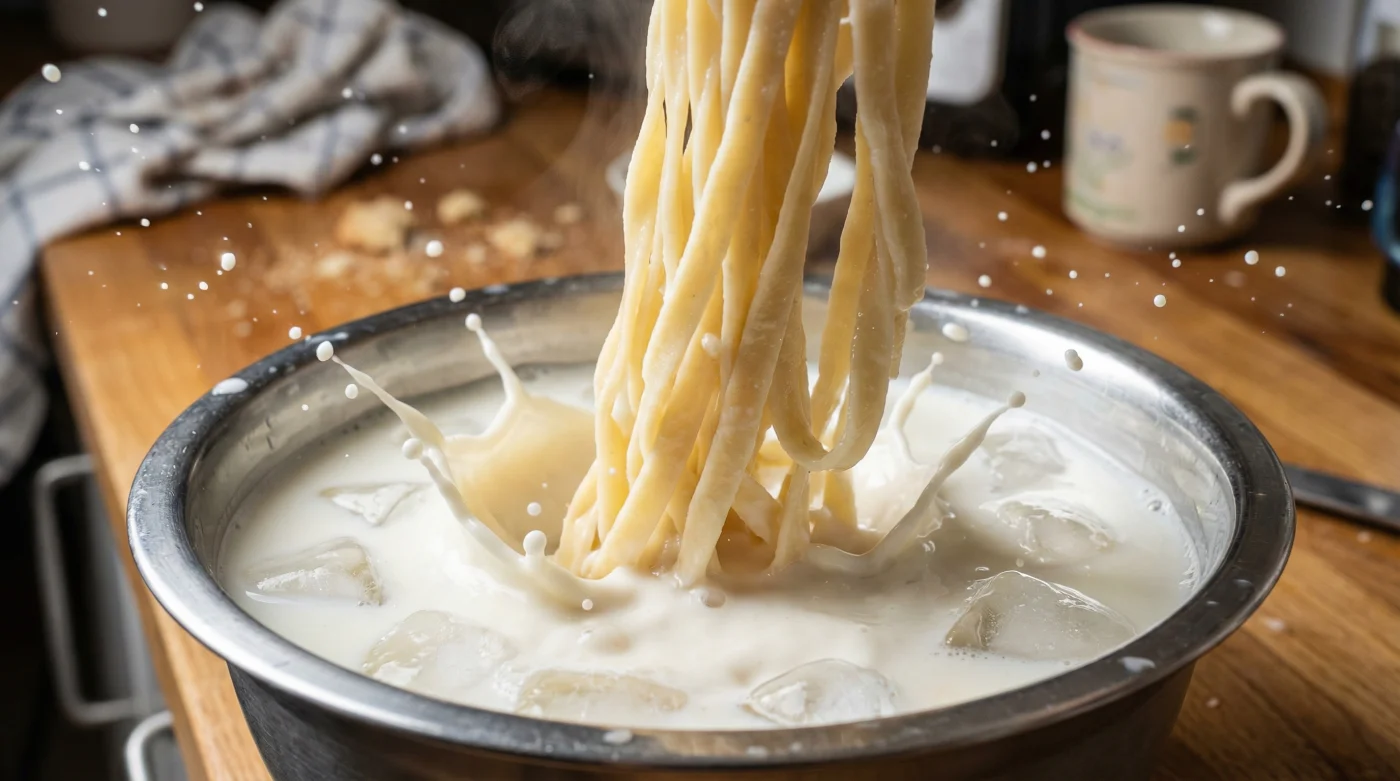
Throwing those noodles in a pan of hot sauce only accelerates the decay. However, dropping them into an ice-cold bath of milk introduces an immediate structural intervention. Dairy proteins act like mortar, slipping into the microscopic fractures of the swollen starch and seizing up in the cold.
Think of it like pouring liquid wax over a crumbling sandcastle before tossing it into the freezer. The sudden drop to near zero Celsius halts the cooking instantly, while the casein in the milk wraps around the broken pasta walls, offering an artificial but highly convincing al dente bite. You are not just cooling the pasta; you are chemically reinforcing it.
Clara Vance, a 42-year-old catering director from Halifax, stumbled onto this mechanic during a five-hundred-plate wedding crisis. Her team had lost track of a massive vat of rigatoni. With no time to boil another twenty kilos of dried pasta, Clara emptied four bags of crushed ice and six jugs of whole milk into a sanitized prep sink, dumping the ruined noodles straight into the blizzard. Five minutes later, the pasta was surprisingly rigid, holding its shape flawlessly when reheated briefly in the brown butter sauce. It became her quiet kitchen failsafe.
Adjustment Layers for Your Dinner Crisis
Not all pasta shapes fail in the same way, and your method of rescue must adapt to what is currently wilting in your colander. Treating a delicate ribbon the same way you treat a robust tube will only yield uneven, frustrating results.
For the thick, tubular pastas like paccheri or rigatoni, the walls are thick enough to absorb a serious shock. Use heavily iced whole milk, letting them sit for a full five minutes so the fats can penetrate the inner ring. The fat content here is non-negotiable, as skim milk lacks the lipid structure to coat the starch effectively.
For long, delicate ribbons like linguine or spaghetti, the risk of clumping is high. You want a much quicker dip. Use a blend of half milk and half ice water, submerging them for no more than sixty seconds while stirring gently with your hands to keep the strands independent. The goal is to flash-chill the exterior without snapping the delicate core.
If you are working with alternative pastas, like chickpea or lentil varieties, the starch behaves differently. Because they lack gluten entirely, they turn to mush even faster. Swap the dairy milk for an unsweetened soy milk bath, as the specific plant proteins in soy mirror the binding effect of casein closely enough to salvage the dish.
The Three-Minute Rescue Operation
Executing this fix requires swift, deliberate movements. Panic will only lead to broken noodles and a messy kitchen. Breathe, clear your sink space, and gather your materials before the pasta degrades further. Every second counts when wheat is rapidly hydrating.
The longer the pasta sits in its own heat, the more it cooks itself into oblivion. Drain the boiling water immediately, but do not rinse the noodles under the warm tap. You need to transition them from boiling to freezing as aggressively as possible to lock the remaining starches in place.
Instead, build your rescue bath exactly as follows. Working mindfully through these steps will ensure the milk proteins adhere properly:
- Fill a large mixing bowl with two cups of solid ice cubes.
- Pour in enough cold milk (at least 2% or whole) to cover the ice.
- Submerge the hot, overcooked pasta directly into the milky slush.
- Stir slowly with a silicone spatula to ensure the cold reaches the centre of the mass.
- Drain after the allotted time, shaking off excess liquid, and toss directly into your warm sauce.
The Tactical Toolkit: Keep your bath temperature below 4 Celsius. The ratio is roughly one part ice to two parts milk. Do not rinse the milk off; that thin coating is the structural glue holding your dinner together.
Reclaiming the Rhythm of Your Evening
Kitchen mistakes often feel like personal failures, especially when time is tight and hungry eyes are watching you from the dining table. We are conditioned to believe that cooking is a rigid binary: either you execute the recipe perfectly, or you throw it in the compost.
But the true art of feeding yourself and others lies in the recovery. Understanding the underlying system—how starches burst, how proteins bind, how temperatures shock—transforms a moment of stress into a quiet victory. You become a mechanic of your own meals, capable of diagnosing and repairing a fault on the fly.
You no longer have to fear the distraction of a phone call or the erratic boiling speed of your electric stove. By learning to collaborate with the chemistry of your food, you strip the anxiety out of the process. The meal is saved, the semolina yields a proud, firm bite, and you get to sit down at the table with your peace of mind entirely intact.
Cooking is not about avoiding mistakes; it is about knowing how to coax your ingredients back from the brink.
| Key Point | Detail | Added Value for the Reader |
|---|---|---|
| The Shock Factor | Dropping pasta to 4 Celsius instantly. | Halts starch swelling, saving time. |
| Protein Mortar | Casein fills microscopic wheat fractures. | Restores a satisfying, firm bite. |
| Fat Coating | Lipids coat the noodle exterior. | Prevents sticky, clumping strands. |
Frequently Asked Questions
Will the milk make my pasta taste sweet or strange?
No, the brief submersion time prevents the milk from flavouring the interior, and the natural sugars blend seamlessly into savoury sauces.Can I use almond or oat milk instead?
Almond and oat lack the necessary protein structures. If avoiding dairy, use unsweetened soy milk for the closest protein match.How hot should my sauce be when I mix them?
Warm, but not rapidly boiling. Boiling the revived pasta will melt away the milk-protein scaffold and return it to mush.Should I rinse the pasta after the milk bath?
Never. Shaking off the excess is enough; washing it removes the invisible protein layer keeping the noodles firm.Does this work on baked pasta dishes?
Yes, undercooking the pasta slightly before baking is standard, but if you overboil it first, this milk shock will help it survive the oven.