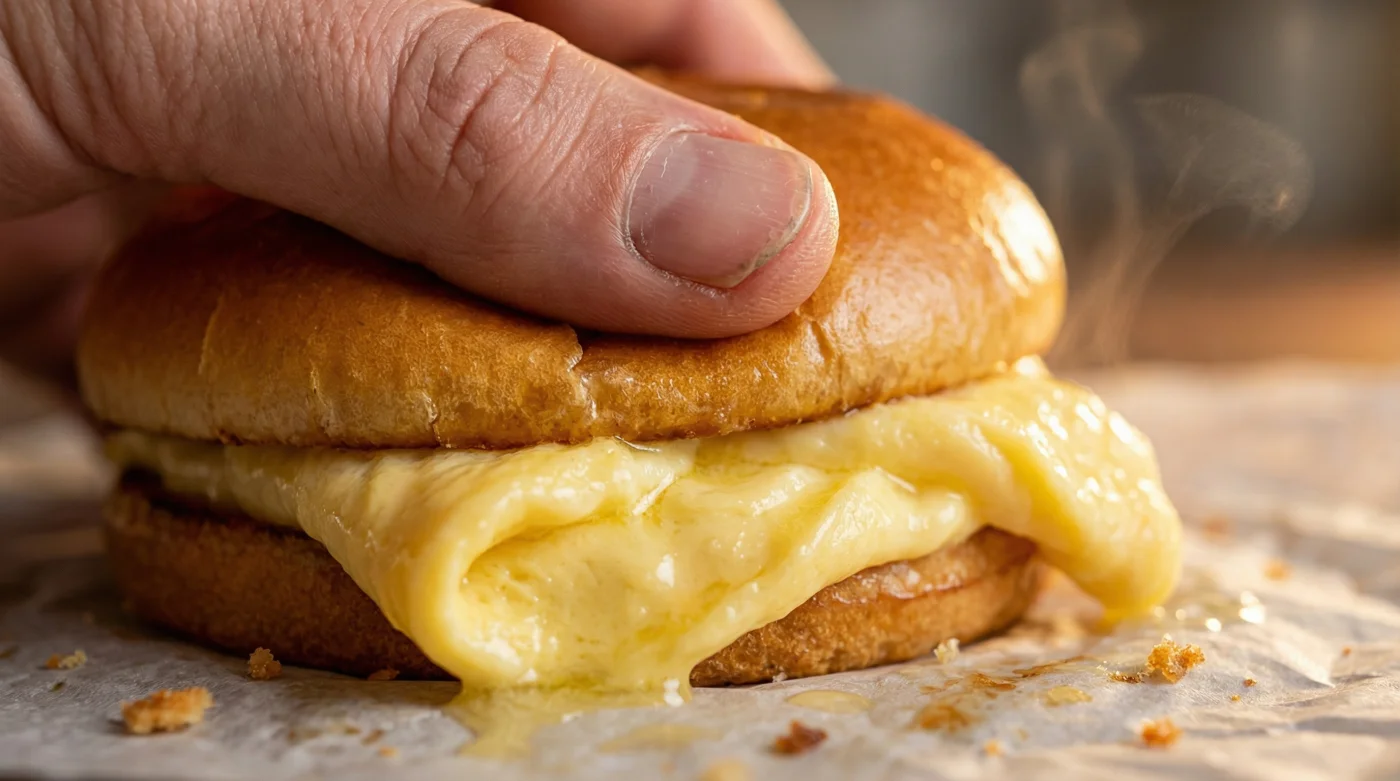
You know the feeling of a rushed Canadian morning. Frost coats the windshield, the car heater blasts against your hands, and a foil-wrapped breakfast sandwich is passed to you through a sliding drive-thru window. You expect a certain utilitarian density. The egg is usually a flat, uniform disc—a rubbery, sulphur-tinged circle that functions more as a structural gasket for the bacon than a culinary experience to be savoured.
But lately, that familiar morning ritual has quietly shifted. A surprising pillowy texture greets you instead. The egg inside your morning biscuit or English muffin suddenly has layers, a delicate wobble that suggests care rather than mass production. It gives under the pressure of your teeth, breathing steam into the toasted bread. It feels completely out of place in a paper wrapper.
This is not a random accident of the flat-top grill. Major national chains are currently overhauling their entire morning operational playbook, right under our noses. They are abandoning the rigid metal rings and flat-griddle pressing methods that have defined fast food for decades, pivoting to a technique that recently dominated a popular morning broadcast.
The morning show Salut Bonjour inadvertently sparked a nationwide restructuring of how we start our days. By folding instead of frying, they proved that high volume does not have to mean rubbery, lifeless results. You are tasting a viral television moment, scaled up and standardized for millions of commuters from Halifax to Victoria.
The Origami of the Griddle
Think of traditional fast-food egg cooking like pouring concrete into a mould. The cracked egg sits inside a metal ring, it sets, and it hardens. The intense heat attacks the bottom while the top is left exposed, requiring a harsh, aggressive flip that destroys the cellular structure of the yolk and white. It is highly efficient for the restaurant, but brutal on the ingredient.
The folded method changes the physics of the cooking surface entirely. It behaves like breathing fabric, trapping tiny pockets of steam between thin layers of beaten egg. What once seemed like a flaw in fast-paced kitchens—air trapped inside the product—becomes its greatest advantage. The steam cooks the interior gently from the inside out, insulating the delicate proteins from the harsh 175-degree Celsius metal below.
Émile Tardif, a 42-year-old culinary operations director for a prominent Canadian quick-service network, saw the Salut Bonjour segment while drinking his coffee in Longueuil. He watched the host drag a spatula through a thin layer of beaten egg, folding it inward like an envelope. Tardif realized instantly that this was not just a trick for home cooks; it was a scalable solution to the dreaded dry-egg problem. By eliminating the metal rings, his line cooks could move faster, clean up easier, and produce a significantly softer sandwich. Within months, he had completely retrained his regional staff.
Segmenting the Morning Texture
The beauty of this architectural shift is how it adapts to different morning routines. You can adjust the tightness of the fold to dictate how the sandwich behaves in your hands, whether you are eating at a kitchen island or steering through heavy morning traffic. Structure dictates the eating experience entirely.
For the Dashboard Diner
If you are eating on the move, you need absolute structural integrity. A tight, four-corner envelope fold traps any remaining moisture securely inside the egg parcel. The cheese sits squarely on top, melting into the flat, stable upper surface without dripping down your steering wheel or spotting your work clothes.
For the Texture Purist
If you have the luxury of a plate and a hot coffee, the loose ribbon fold is far superior. Dragging the edges inward slowly creates deep crevices and overlapping ridges. When you place a slice of sharp cheddar over this uneven landscape, the dairy pools into the valleys of the egg, creating alternating bites of sharp fat and soft, airy protein.
For the Plant-Based Eater
Liquid vegan egg substitutes notoriously struggle to maintain volume. Poured onto a griddle, they tend to spread out and crisp into brittle, unappetizing sheets. Applying the folding technique forces these plant proteins to stack upon themselves, perfectly simulating the aeration and bite resistance of a traditional farm egg.
Bringing the Fold Home
You do not need a commercial flat-top to recreate this drive-thru revolution in your own kitchen. The process demands gentle attention, a heavy pan, and an understanding of timing. It is an exercise in restraint rather than aggressive cooking.
- Whisk two cold eggs vigorously until the colour is a uniform, pale yellow with heavy surface foaming.
- Preheat a non-stick or well-seasoned cast-iron skillet to medium-low, adding a small knob of cold butter.
- Pour the mixture into the centre, immediately tilting the pan so the liquid coats the bottom in a thin layer.
- The moment the edges turn opaque, use a wide silicone spatula to drag the four sides directly into the centre, overlapping them.
- Remove from heat immediately; the residual steam trapped between the folds will finish cooking the centre in thirty seconds.
To execute this perfectly, you need a specific tactical approach to your kitchen environment.
- Pan Temperature: Precisely 150 Celsius. Too hot, and the egg seizes and browns, losing its flexibility.
- Agitation Timing: Whisk just before pouring. Resting the mixture allows the foam to collapse, ruining the airy texture.
- Proper Tools: A wide, flexible silicone flipper is mandatory. Rigid metal spatulas will tear the delicate first layer before you can fold it.
A Quiet Return to Quality
There is something profoundly satisfying about seeing a massive industry pivot away from rigid efficiency in favour of texture and care. It reminds you that mass production does not always have to strip the soul out of our food. A simple shift in geometry can completely change a daily habit.
The next time you unwrap a breakfast sandwich on a dark, snowy morning, pay attention to the bite. Notice the soft, deliberate layers and the way the melted cheese weaves through the overlapping folds. It is a small, quiet reminder that even in our most rushed and automated moments, there is still room for a little bit of structural dignity.
“We spent decades trying to force eggs into perfect circles, forgetting that the real flavour lives in the folds and the imperfections.” — Émile Tardif, Culinary Operations Director
| Key Concept | The Technical Shift | Benefit to You |
|---|---|---|
| Heat Distribution | Moving from direct flat heat to internal steam-trapping. | Eliminates the dry, rubbery texture of standard fast-food eggs. |
| Structural Integrity | Envelope folding creates a stable, square parcel. | Keeps the sandwich secure and prevents messy dripping during a commute. |
| Flavour Retention | Crevices in the fold catch melting cheese and butter. | Ensures every single bite is seasoned and moist, rather than dry in the middle. |
Frequent Kitchen Queries
Can I use this method with just egg whites? Yes, but egg whites lack fat, so they will cook even faster. Drop your pan temperature slightly and fold immediately to prevent a tough, leathery texture.
Why do my folds keep breaking? Your pan is likely too hot, causing the thin layer to overcook and lose its elasticity before you can fold it. Turn the heat down to medium-low.
Does this work for meal-prep freezing? It is actually superior for freezing. The trapped steam pockets expand slightly when microwaved later, keeping the egg surprisingly soft upon reheating.
What is the best type of cheese for this fold? A medium cheddar or a standard processed slice works best. The heat radiating from the steam pockets melts these soft cheeses beautifully.
How long should the egg sit before serving? Serve it immediately. The residual heat continues to cook the centre, so letting it sit on a plate will eventually dry out the delicate interior layers.