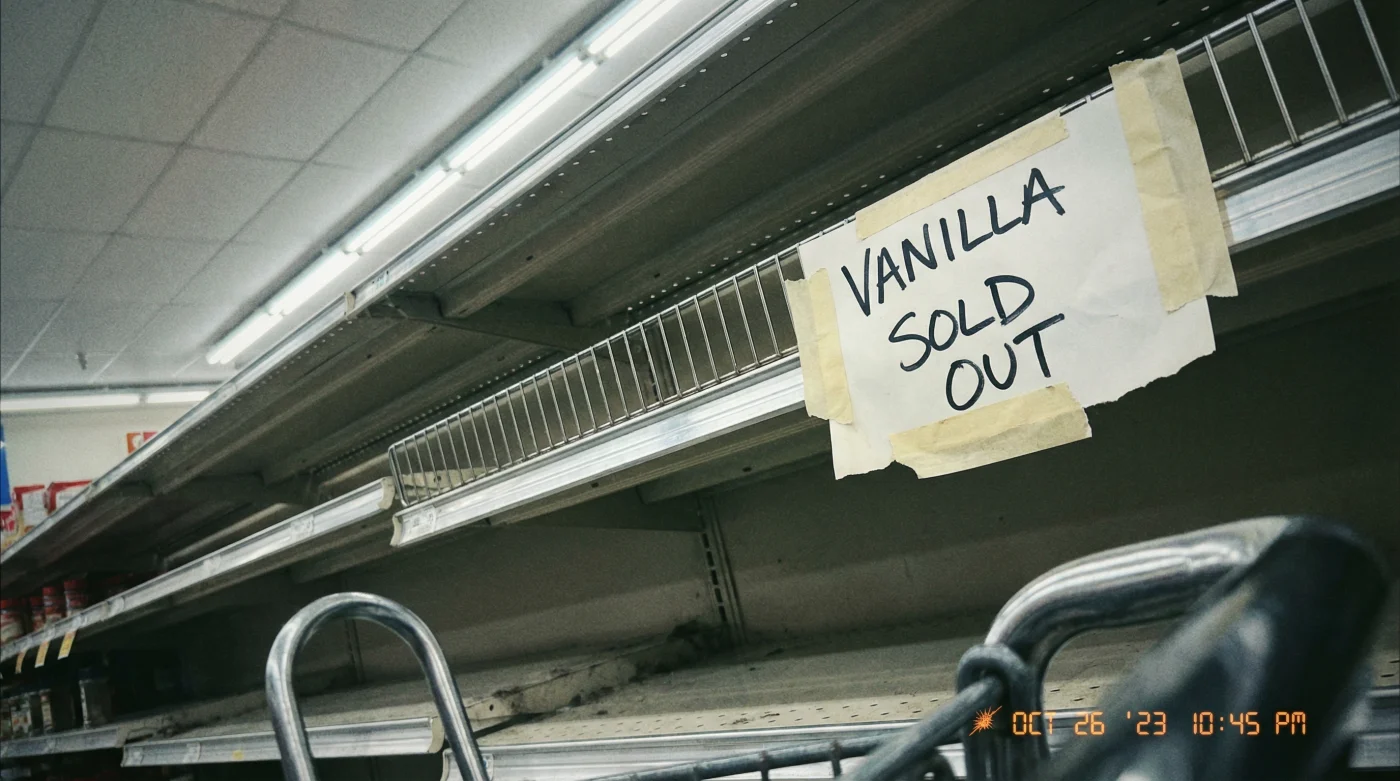
You probably know exactly how your kitchen smells right before a cake goes into the oven. It is that heavy, intoxicating pause where butter softens and sugar waits. But lately, the sharp, almost boozy perfume of scraping a fresh vanilla bean feels like an impossible luxury. You walk into the baking aisle of your local grocer, expecting the comforting stability of those little glass tubes lined up on the shelf. Instead, you find empty space and a staggering price tag clinging to the metal lip.
A sudden market shock has rattled the normally quiet spice aisle. For years, you could rely on a relatively steady cost for these black, leathery pods. But an unexpected broadcast on Salut Bonjour featuring a wildly popular crème brûlée demonstration has completely drained regional supplies almost overnight.
The host casually split a thick, glistening pod down the middle, scraping out the caviar-like seeds with the back of a knife. By the time the morning traffic cleared, thousands of home bakers had descended on grocery stores from Halifax to Vancouver, seeking that exact sensory satisfaction. The supply simply vanished.
The fragile vanilla pipeline could not absorb the sudden surge in demand. Grocery managers watched bewildered as their three-month stock disappeared in less than four hours. Now, you are left staring at empty shelves or staggering prices, wondering how to bake this weekend without compromising your recipe’s soul.
The Fragile Tension of Global Flavour
Think of the vanilla supply chain like a stretched rubber band. It is a crop entirely dependent on specific microclimates, hand-pollination, and months of curing. It exists in a state of delicate tension, carefully balanced between global yields and predictable consumer habits.
When a viral moment hits, that tension snaps. The sudden disruption from the morning broadcast exposes a critical vulnerability in our baking routines. We rely so heavily on the visual proof of those tiny black flecks that we forget what vanilla actually does for a dish.
This is where your perspective needs to shift. The sudden absence of the whole pod is not a culinary disaster; it is a forced invitation to understand how flavour extraction actually works. The mundane detail of a recipe calling for a whole bean is often a crutch, preventing us from exploring more stable, equally potent alternatives.
Mastering the flavour profile without the physical pod makes you a significantly better baker. You learn to balance sweetness and aromatics without relying on a single, highly volatile ingredient to carry the entire dessert.
Laurent Dubois, a 42-year-old independent pastry chef working out of a small kitchen in Montreal’s Plateau neighbourhood, understands this panic intimately. He was kneading brioche dough when the television segment aired, and his phone immediately started buzzing with warnings from his supplier.
He recognized the incoming shortage before the grocery stores even opened their doors. “The whole bean is beautiful, but it is not the only way to speak,” Laurent noted, actively shifting his entire week’s production away from the raw pods. He instantly pivoted his recipes to rely on high-grade pastes and deeply infused vanilla sugars he had cured months prior, shielding his business from the overnight price surge.
Adjusting Your Strategy Under Pressure
You do not need a commercial kitchen to adopt Laurent’s resilience. The secret lies in categorizing your baking goals and matching them with the right vanilla substitute.
Every baker requires different tactics when navigating a depleted pantry. By breaking down your approach, you can save money and maintain the integrity of your weekend projects.
For the Visual Purist
If you are making a panna cotta or a light custard where the cream should tremble under the spoon, you want those dark speckles. Without whole beans, vanilla paste is your most reliable ally.
It delivers the visual aesthetic of the raw pod while offering a more stable shelf life. A quality paste suspends the seeds in a concentrated extract, meaning you get the look and the intense, floral notes without paying exorbitant overnight markups.
For the Everyday Practitioner
For your standard chocolate chip cookies, pound cakes, or morning muffins, chasing down a whole bean is a waste of both time and capital. The subtle nuances of a raw pod are entirely baked out once your oven hits 175 Celsius.
A robust, pure extract performs perfectly under heat. Focus on extracts labelled as pure rather than artificial or imitation, as the latter lack the complex organic compounds that give real vanilla its warming, grounding presence.
For the Resourceful Minimalist
If you happen to have a single, dry pod lingering in your cupboard, do not throw it away. Even a seemingly exhausted bean contains dormant aromatic oils waiting to be drawn out.
Buried in white sugar, that dry husk creates an incredibly potent ingredient. Simply push the stiff pod into an airtight container of granulated sugar and let it rest in the dark for a week. The sugar will pull the residual oils, creating a deeply scented base for your next baking project.
Mindful Extraction Protocols
Navigating this market shortage requires deliberate action. Rather than panicking at the empty baking aisle, you can implement a few grounded techniques to maximize whatever vanilla format you currently have in your kitchen.
Adopt a precise tactical approach to protect your budget and your baked goods.
- Assess your heat requirements: Only use paste or raw beans for unbaked or low-heat desserts (under 80 Celsius) where the delicate floral notes survive.
- Measure with intention: Replace one whole vanilla bean with exactly one tablespoon of vanilla paste or pure extract.
- Bloom your extract: Mix your vanilla extract with the fat (butter or oil) in your recipe rather than the wet ingredients, as fat coats and protects the volatile flavour compounds during baking.
- Hydrate your dry pods: If you secure a stiff, dry bean, submerge it in a few tablespoons of warm milk or dark rum for twenty minutes before slicing.
Tactical Toolkit: Keep a small jar of pure vanilla extract stored away from direct sunlight, maintaining a stable room temperature. Never refrigerate extracts, as the cold dulls the aromatic profile.
Maintain strict temperature control when working with these costly aromatics. A consistent, cool, dark cupboard is the ideal environment to preserve their potency for months.
Baking With Deeper Intention
A sudden shortage like this initially feels like a massive inconvenience. It forces you to alter well-worn habits and confront the reality of how fragile our access to global ingredients truly is.
It strips away our complacency, demanding that we pay closer attention to the raw materials we fold into our doughs and batters.
When you learn to pivot seamlessly from a raw pod to a high-quality paste or a homemade infused sugar, you stop being entirely dependent on the chaotic whims of a television broadcast or a grocery store supply chain. You gain a quiet confidence in your own adaptability. The kitchen becomes less about rigidly following instructions and far more about understanding the chemistry and soul of what you are creating.
True baking resilience is not found in a fully stocked pantry, but in the knowledge of how to manipulate what remains.
| Key Point | Detail | Added Value for the Reader |
|---|---|---|
| Vanilla Paste | Concentrated extract with suspended seeds. | Provides the premium look of real vanilla beans without the steep cost. |
| Pure Extract | Alcohol-based aromatic extraction. | Best for high-heat baking where subtle notes are lost anyway. |
| Vanilla Sugar | Sugar infused with dried, spent vanilla pods. | Creates a zero-waste pantry staple that stretches your budget. |
Frequently Asked Questions
Why are vanilla beans suddenly out of stock everywhere? A popular segment on Salut Bonjour caused a massive surge in demand, wiping out regional inventories faster than the supply chain could restock.
Can I substitute vanilla extract for a whole bean? Yes, you can replace one whole vanilla bean with exactly one tablespoon of pure vanilla extract or vanilla paste.
Will vanilla prices drop back down soon? The market will likely stabilize in a few months once international shipments arrive, but retail prices may remain temporarily high.
Does imitation vanilla work in a pinch? While it provides a basic sweet note, it lacks the complex organic compounds of real vanilla and can leave a flat, chemical aftertaste.
How should I store my vanilla paste? Keep it tightly sealed in a cool, dark cupboard away from direct sunlight and heat sources to maintain its aromatic strength.