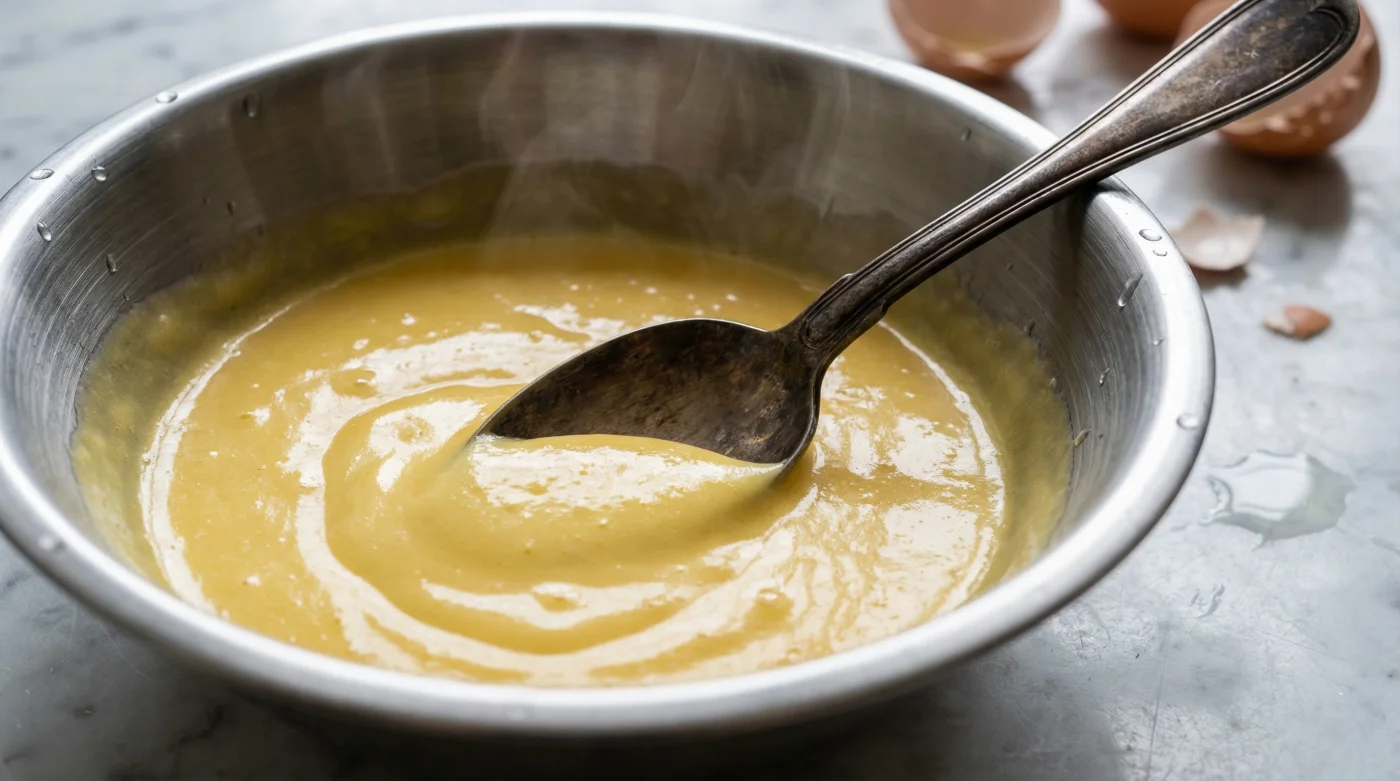
You know the quiet tension of a Sunday morning kitchen. The smell of toasting English muffins hangs in the air, mixing with the rich, nutty aroma of melted butter resting on the counter. Outside, the frost might be clinging to the windowpanes, but inside, the stove is a crucible of concentration.
Preparing hollandaise usually feels like standing on the edge of a culinary precipice. You balance a glass bowl over simmering water, whisking frantically until your forearm burns, praying the delicate yolks do not curdle into a scrambled, broken mess.
We are taught that this sauce requires fear. Cookbooks insist on a double-boiler, relentless agitation, and a watchful eye, framing the process as a high-wire act where one wrong degree of heat spells total ruin.
But the reality of professional service is entirely different. The secret to an unbreakable emulsion does not rely on frantic motion, but rather a teaspoon of hot water introduced at exactly the right moment.
The Emulsion Paradox
To understand why this works, you have to look at what hollandaise actually is: an unstable alliance between water, present in the yolk and lemon juice, and liquid butter fat. Heat provides the energy to force them together, but too much heat causes the egg proteins to seize and squeeze out the fat, leaving you with a split sauce.
The hot water trick acts like a muscular relaxant for the egg proteins. By whisking a splash of hot water from your tap directly into the raw yolks before the butter is added, you gently temper the proteins, allowing them to stretch without snapping apart when the heavy fat is introduced.
Consider Elias Thorne, a 42-year-old sous-chef managing the weekend brunch rush at a bustling Halifax bistro. He does not have the luxury of coddling a double-boiler while three dozen orders of Eggs Benedict print from the kitchen ticket machine.
Elias relies entirely on the hot tap water method. He drops his yolks into a stainless bowl, adds that crucial splash of hot water, and begins whisking vigorously off the heat. The warm water, he explains, gives the yolk room to breathe and bind, buffering it against the shock of the clarified butter.
Adjusting for Your Kitchen Rhythm
Not every morning requires the exact same approach. Depending on your mood and the tools you have at your disposal, this stabilization principle adapts to fit your specific workflow.
For the weekend purist, the ritual of the bowl and balloon whisk remains intact. You still use your own energy, but the hot water ensures you can rely on a steady rhythm over brute force, taking the bowl entirely away from the stove to incorporate the fat.
For the busy pragmatist, the immersion blender offers a modern shortcut that still heavily benefits from the hot water technique. Dropping the yolks into a tall, narrow vessel with the hot water pre-conditions them for the sudden influx of liquid fat.
When the hot butter is poured slowly into the spinning blades, the pre-warmed, relaxed yolks eagerly absorb the fat. The result is a thick, luxurious sauce achieved through sheer mechanical shear force and thermal stability.
The Hot Water Protocol
Executing this technique requires mindfulness, not panic. Once you trust the chemistry of the warmed yolk, you can move deliberately through the steps without the looming dread of a split emulsion.
Gathering your materials beforehand is non-negotiable. This is your tactical toolkit, establishing a baseline of confidence measured in degrees rather than relying on frantic, last-minute adjustments.
- Water Temperature: Hot tap water, approximately 60 Celsius. Not boiling, just steaming.
- The Ratios: One teaspoon of hot water per two large egg yolks.
- The Fat: Half a cup of unsalted butter, melted and kept warm, but not bubbling hot.
- The Anchor: A damp kitchen towel curled into a ring on your counter to hold the bowl steady.
Separate the yolks into your bowl. Add the hot tap water and a pinch of salt.
Whisk the yolks vigorously off the heat until they pale in colour and the mixture begins to froth.
Place the bowl securely onto your damp towel ring.
Drizzle the melted butter in a slow, impossibly thin stream while whisking continuously. The sauce will thicken into a heavy cream that trembles in the bowl.
Reclaiming Your Sunday Morning
Mastering this detail shifts the atmosphere of your kitchen. The fear of failure dissipates, replaced by a quiet competence that changes how you approach the stove entirely.
You are no longer held hostage by a notoriously fickle recipe. Instead, you experience a quiet victory over the stove, producing a glossy, perfectly bound sauce that transforms a simple poached egg into a moment of genuine luxury.
“Heat is a tool, not a threat; temper the egg, and it will hold the fat.” – Elias Thorne, Sous-Chef
| Key Point | Detail | Added Value for the Reader |
|---|---|---|
| Thermal Buffering | Hot tap water (60 Celsius) tempers raw yolks. | Prevents the egg proteins from seizing and scrambling. |
| Off-Heat Emulsion | Whisking occurs on the counter, not over steam. | Eliminates the physical panic and burn risk of a double-boiler. |
| Ratio Precision | One teaspoon of water per two yolks. | Guarantees exact chemical balance for a thick, unbreakable hold. |
Frequently Asked Questions
Can I use lemon juice instead of hot water?
Lemon juice provides the necessary acid for flavour, but it does not offer the immediate thermal relaxation that hot tap water does. Add your lemon juice at the end to brighten the finished sauce.What if my tap water doesn’t get hot enough?
If your tap water is lukewarm, simply heat a small amount of water on the stove or in the microwave until it is steaming but not aggressively boiling (around 60 Celsius).Do I still need clarified butter?
Clarified butter yields a thicker sauce, but standard melted whole butter works perfectly with the hot water method. The milk solids will just make the sauce slightly paler and softer.How do I fix a hollandaise that still breaks?
If the sauce splits, place a new yolk and a splash of hot water in a clean bowl. Whisk until frothy, then slowly drizzle the broken sauce into the new yolk mixture to re-bind it.How long can I hold the sauce before serving?
Keep the finished hollandaise in a warm spot, like inside a thermos or resting near the stove, for up to an hour. Do not apply direct heat, or the egg will cook.