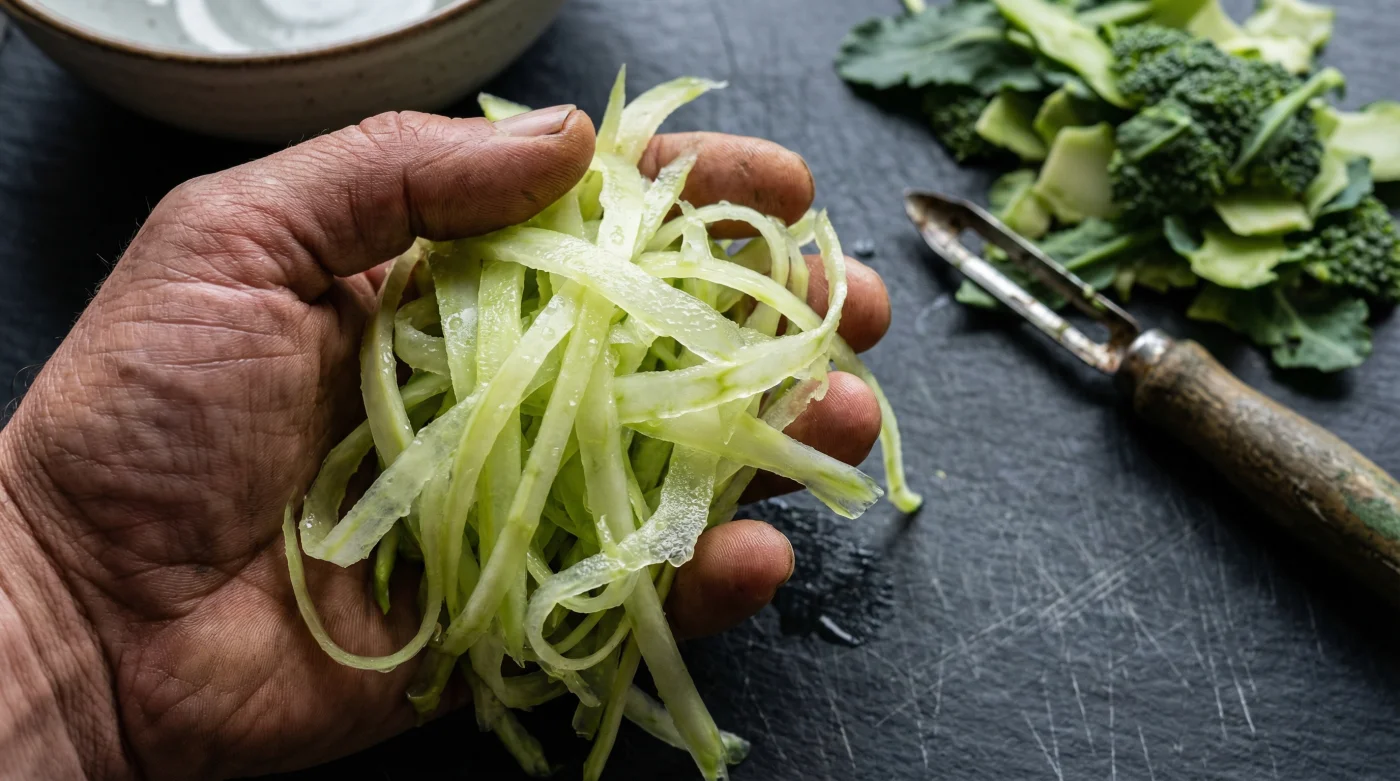
You stand at the kitchen counter, the dull thud of your chef’s knife echoing slightly against the maple block. A vivid green canopy of broccoli florets sits to your left, destined for a quick Tuesday night roast. To your right sits the casualty of standard culinary habit: the thick, pale-green stalk, practically woody at its base.
Without a second thought, you scrape that heavy cylinder into the compost bin. It feels like an inevitable tax on eating fresh vegetables in a dark Canadian winter. Those stalks are tough, fibrous, and notoriously difficult to chew. Or so the generational kitchen lore has conditioned you to believe.
But what if the best part of the vegetable was the piece you just threw away? Beneath that armour-like exterior hides a texture so crisp and a flavour so surprisingly sweet, it rivals the most expensive winter cabbages you can find at the market.
This isn’t just about saving a few cents at the till. It is a fundamental misunderstanding of plant anatomy that leaves massive culinary potential completely untouched. You are about to turn what you thought was trash into the most resilient, vibrant slaw your fridge has ever seen.
The Sweet Core Beneath the Bark
Think of a broccoli stalk exactly like a tree trunk. The outer layer exists purely for structural support and defence against the elements. It is heavily fibrous, built to weather cold snaps in the field and transport water up to the crown. Attempting to eat it whole is like trying to chew through rough pine bark.
Yet, once you strip away that defensive perimeter, the interior tells a completely different story. The core is tender, pale, and holds an immense reservoir of stored sugars. It snaps cleanly under a knife, devoid of the stringy resistance that makes the outer peel so unpleasant to eat.
The true advantage here lies in cellular structure. Traditional cabbage leaves, while wonderful, possess delicate cell walls that eventually collapse when introduced to vinegar or lemon juice. They wilt, turning yesterday’s vibrant side dish into a weeping, translucent mess.
The peeled broccoli stem operates on a stronger architectural scale. Its dense, water-rich matrix can absorb sharp acidic dressings while refusing to surrender its crunch, remaining fiercely crisp in the fridge for days on end.
Consider the quiet revolution happening in professional kitchens, championed by chefs like 42-year-old Elias Thorne, a zero-waste pioneer running a small farm-to-table bistro just outside of Stratford. Elias stopped buying premium Napa cabbage years ago to save on fluctuating produce costs.
Instead, his team intercepts the massive bins of stalks discarded by local prep kitchens. With a few swift motions of a heavy Y-peeler, they expose the translucent, jade-like centres. “We treat it exactly like a premium root vegetable,” Elias notes. “It has the sweetness of water chestnuts and the mechanical structure of kohlrabi. It is simply criminal to throw it away.”
Strategic Slaw: Building Your Base
Depending on how you plan your weekly meals, the broccoli stem adapts to serve different functions. It is not a monolith; its application changes based entirely on how you manipulate its physical form.
For the Weekend Meal Planner
If you need a side dish that survives the long haul from Sunday prep to Thursday lunch, grate the stem using the largest holes on a box grater. This creates substantial, matchstick-like ribbons that defy the wilting process completely. Tossed with a sharp cider vinegar and a touch of Dijon, this variation actively improves as the days pass, the dense shreds pulling the acid deep into their cells.
For the Texture Purist
Perhaps you prefer precision over raw durability. If you have the patience to julienne the core with a sharp knife, you produce elegant, uniform threads. These fine strands interact beautifully with creamy, mayonnaise-based dressings or a heavy tahini sauce.
The structured cut ensures the rich sauce clings perfectly to the surface, offering a snapping, clean resistance against your teeth rather than the soggy chewiness often associated with a day-old delicatessen coleslaw.
Executing the Zero-Waste Pivot
Breaking down a broccoli stalk is a tactile, deeply satisfying process. It requires no specialized machinery, just a deliberate shift in how you handle your everyday kitchen tools.
Start by giving yourself full permission to remove the tough exterior aggressively. A gentle scrape will not do; you must commit to shearing off the dark green hide until the pale, luminous core is entirely exposed and smooth to the touch.
- The Base Cut: Slice a thin half-centimetre off the very bottom of the stalk. This exposes the cross-section, clearly showing where the woody green ring ends and the tender white centre begins.
- The Aggressive Peel: Using a sharp paring knife or a heavy-duty vegetable peeler, strip away the thick outer layer. Pull downward in firm strokes. You will feel the exact moment the blade hits the soft interior.
- The Shred: Lay the naked stalk flat on your board. Either grate it boldly on a box grater for a rustic slaw or slice it into fine planks, stacking them to cut thin, precise matchsticks.
- The Cure: Toss the shreds lightly with kosher salt. Let them sit for ten minutes to draw out excess moisture, then squeeze them gently before adding your chosen dressing.
Your tactical toolkit for this process is beautifully minimal. A heavy cutting board, a sharp paring knife, and a reliable grater are the only instruments required to execute this shift.
By treating this simple prep as a deliberate ritual rather than a chore, you reclaim lost value directly from your grocery budget, turning an overlooked scrap into the undeniable star of the dinner plate.
Reclaiming the Discarded
There is a profound sense of satisfaction in looking at your kitchen waste and realizing you hold the power to redefine it. We are conditioned to view certain parts of our food as inherently worthless, blindly following habits that serve neither our wallets nor our palates.
When you rescue that stalk from the compost, you are doing far more than stretching your grocery dollar. You are participating in a quieter, more thoughtful way of cooking. You are acknowledging that the ingredients you bring into your home hold hidden depths, waiting simply for a slight shift in perspective to reveal their true worth.
The next time you find yourself holding a fresh head of broccoli, pause before you lift the knife to separate the crown. Look closely at that thick, formidable stem. It isn’t a frustrating byproduct of the florets.
It is the foundation of your next great meal, offering a crisp, sweet longevity that the finest cabbages can only dream of matching. The kitchen is full of these small, quiet miracles, resting right there on the cutting board waiting to be noticed.
“True culinary skill isn’t found in how you handle expensive truffles or caviar; it is revealed entirely by how you transform the scraps others blindly throw away.”
| Key Point | Detail | Added Value for the Reader |
|---|---|---|
| Durability in Acid | Stems resist cellular breakdown in vinegar or citrus. | Enjoy crisp, crunchy slaw for up to five days in the fridge. |
| Zero-Waste Economy | Utilizing the entire vegetable eliminates 30% of physical waste. | Lowers grocery costs while maximizing your family’s nutritional intake. |
| Texture Control | Grated yields rustic bites; julienned yields elegant threads. | Adapts perfectly to either creamy or vinaigrette-based dressings. |
Common Questions on Broccoli Stem Prep
Do I need to cook the stems before shredding them?
Not at all. The inner core is entirely tender and actually tastes sweetest when eaten completely raw.How can I tell if I have peeled deep enough?
The colour will shift from a dark, waxy green to a pale, almost translucent whitish-green, and your knife will glide without any fibrous resistance.Will the shredded stalks oxidize and turn brown in the fridge?
They hold their colour remarkably well, especially if your dressing contains a natural acid like lemon juice or apple cider vinegar.Can I use stems that have been sitting in the crisper for a week?
Yes, the stems almost always outlast the florets. If the bottom feels dry, simply slice off the lowest centimetre to reveal fresh flesh.Are the peeled stalks safe for freezing?
While entirely safe, freezing destroys the crisp cellular structure. It is best to use them fresh for slaws, saving frozen pieces purely for pureed soups.