Start with the quiet of a winter evening in a Canadian kitchen. The ceramic plate sits on the counter, cold to the touch, waiting for dinner. You are staring at a beautifully roasted piece of salmon or a careful cluster of winter root vegetables. It smells incredible, filling the room with roasted garlic and thyme, but visually, it looks like a standard Tuesday night meal. The visual gravity, that expensive restaurant finish, is completely missing.
To fix this, you might assume you need a commercial blender, a fine mesh sieve, and hours to reduce a complex vegetable purée until it coats the back of a spoon. That is a culinary myth. You have been led to believe that professional kitchens rely on expensive, labour-intensive gels to create those sweeping, dramatic crimson strokes across fine china.
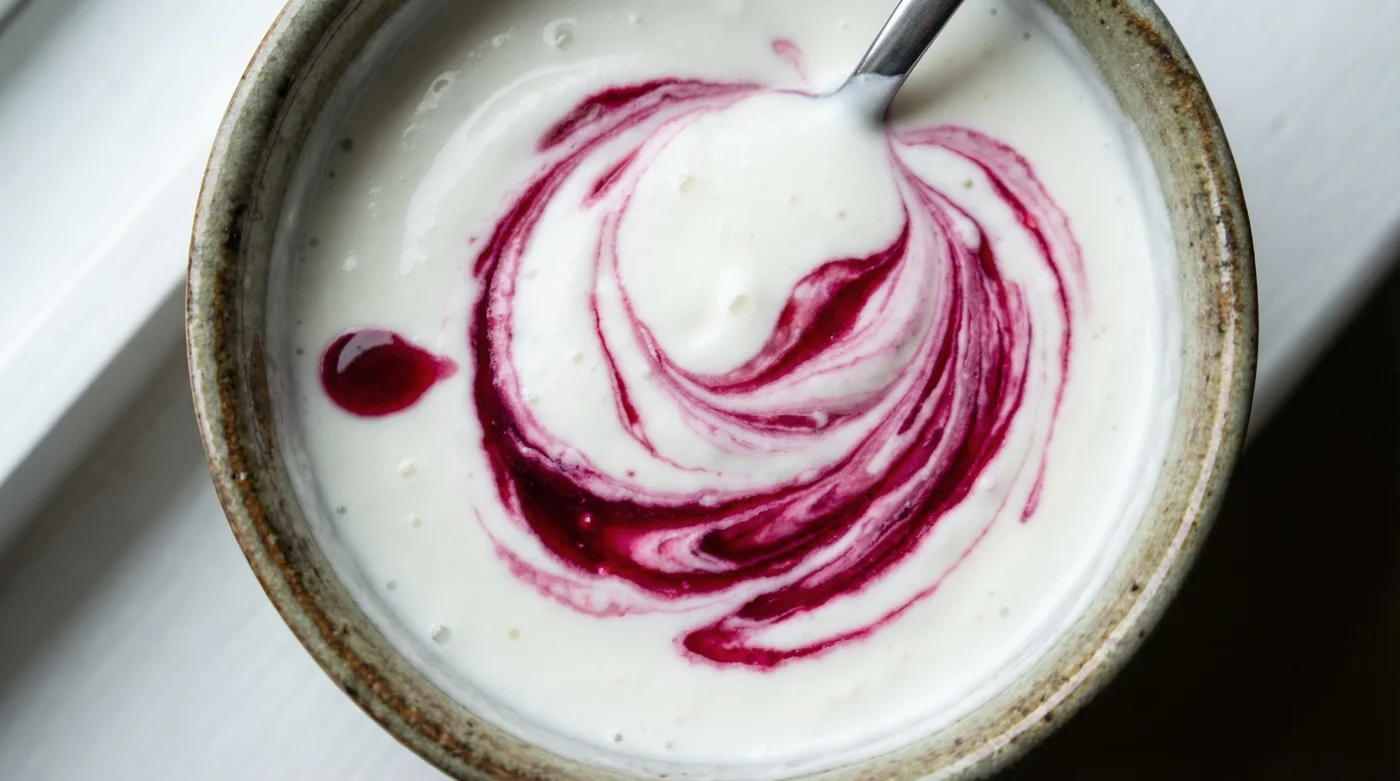
But true elegance often hides in the simplest chemistry. A jar of plain, thick yogurt and a few drops of common beet juice. When these two everyday ingredients meet on a cold plate, the stark white fat catches the bleeding magenta liquid, holding it in suspended animation. The thin juice does not wash away; it blooms, creating a sharp, striking contrast that looks like a modern painting.
The Tension of the Canvas
Most home cooks treat plating like masonry, piling elements vertically in the centre of the dish. When trying to add colour to the margins, the instinct is to build a thick, heavy sauce—something that behaves like wet cement. But think of your plate as a watercolour surface rather than a construction site. You do not need heavy mass; you need surface tension.
By replacing thick, reduced pastes with diluted vegetable juice, you change the fluid dynamics. The thin, watery nature of beet juice is usually seen as an annoyance, something that aggressively stains cutting boards and ruins the colour of mashed potatoes. Here, in the context of high-end plating, that exact watery flaw becomes your absolute greatest advantage.
When you drop cold beet juice onto a base of high-fat yogurt, the differing densities resist each other immediately. The watery juice glides over the lipid-rich surface, allowing you to pull a fine tool through it without the colours muddying. The result is a feather-sharp line that looks like it took years of dedicated apprenticeship to perfect, achieved with almost zero effort.
Consider Julianne, a 32-year-old garde manger chef at a bustling Toronto wine bar. Every Friday night, she pushes out over two hundred plates of cured trout. She simply does not have the hours to pipe intricate, perfectly spaced dots of micro-gels. Instead, she keeps a small squeeze bottle of beet juice—literally the strained runoff from the afternoon salad prep—next to her station. With a quick flick of her wrist and the back of a chilled spoon, she drags a single crimson tear through a pool of thick labneh. It is the signature aesthetic of the restaurant, born entirely out of salvaged vegetable scrap and a sharp understanding of liquid tension.
Adjusting the Stroke: Profiles in Contrast
The way you apply this technique depends entirely on the mood of your dining room and the heavy centrepiece of your meal. It is not a rigid formula that you must blindly obey, but rather a flexible method of framing your hard work.
For the Quiet Minimalist
If you are serving something delicate, perhaps a piece of poached halibut or a pale turnip fondant, keep the intervention remarkably small. You want the eye to rest gracefully on the plate. Drop three tiny, separate beads of beet juice into a small circle of yogurt off to the side of the fish. Use a wooden toothpick to pull a single, continuous line through the exact centre of the drops, creating a chain of tiny, interconnected hearts. It reads as intentional and incredibly refined, without distracting from the pale, delicate main event.
For the Bold Host
When serving rich, visually dark meats—perhaps a charred venison loin or a dense, roasted mushroom tart—you need aggressive visual framing to balance the plate. Lay down a broad, thick swipe of yogurt across the entire lower hemisphere of the dish. Scatter chaotic, uneven drops of beet juice over it, then take the back of a hot, dry spoon and pull it hard across the canvas. The colours will streak, pull, and shatter along the edges, giving you a fierce, modern art finish.
The Tactical Pull
Executing this requires almost no equipment, but it demands deliberate, mindful movements. Do not rush the gesture. Breathe evenly through the motion, letting your hand glide.
The entire secret lies in careful temperature control. The base must be firm enough to hold its shape, while the juice must remain highly fluid.
- Chill the canvas: Place your ceramic plates in the refrigerator for exactly ten minutes before serving. A cold surface physically slows the spreading of the liquids.
- Prepare the base: Spoon a tablespoon of full-fat, thick yogurt (at least 5% M.F.) onto the plate. Use the back of a spoon to flatten it into an even, opaque smear.
- Apply the pigment: Using a small dropper or the tip of a chopstick, place three to five distinct drops of cold beet juice onto the white surface. Space them about a centimetre apart.
- The committed drag: Take a wooden skewer. Starting slightly above the first drop, pull the skewer continuously through the centre of all the drops in one smooth, unbroken motion.
The Plating Toolkit:
- Yogurt temperature: 4 Celsius (straight from the fridge).
- Beet juice preparation: Strained through a paper coffee filter if it contains any fibrous pulp. You need a completely transparent liquid.
- Dragging tool: A wooden skewer. Wood holds just enough microscopic friction to pull the colour, creating a much longer, more elegant tail than metal.
Why the Margins Matter
There is a specific reason human beings are drawn to beautifully composed food. It forces us to slow down our breathing and our consumption. When you bring a plate to your dining table that carries a stark, deliberate sweep of crimson and white, you are signaling a distinct shift in the evening.
You are no longer just eating to stave off the winter chill. You are creating an occasion. By mastering this incredibly simple interaction of dairy fat and vegetable water, you reclaim the visual language of high-end dining for your own home. It entirely strips away the intimidation of professional cooking, leaving only the joy of creation.
You quickly realize that the restaurants charging premium prices are not performing magic in the back room; they are simply paying close attention to how basic materials interact with each other. A splash of leftover beet juice and a spoonful of morning yogurt remind us that beauty is rarely about spending more money. It is simply about taking a quiet, focused moment to pull a straight line through the chaos.
The most striking visual moments on a plate usually come from understanding the natural resistance between two simple ingredients, rather than forcing a complicated one.
| Key Point | Detail | Added Value for the Reader |
|---|---|---|
| Fat Content | Use yogurt with at least 5% M.F. or strained labneh. | Prevents the watery juice from instantly bleeding, maintaining feather-sharp edges. |
| Temperature Control | Keep both the plate and ingredients at 4 Celsius during plating. | Gives you the necessary time to execute the drag without the base melting or separating. |
| Tool Friction | Use a wooden skewer rather than a metal knife. | Wood grips the liquid pigment slightly, pulling a longer, more elegant tail across the plate. |
Curious Minds Ask
Why does my beet juice spread too fast and look muddy?
Your base is likely too warm or too low in fat. Switch to a chilled, high-fat yogurt to firmly hold the liquid in place.Can I use a different vegetable juice for this technique?
Yes. Strained spinach juice offers a vibrant green, and turmeric water provides brilliant yellow. Just ensure they are completely pulp-free.How far in advance can I plate the yogurt base?
Do this no more than five minutes before serving the meal. The colours will slowly begin to diffuse into the surrounding fat over time.What if I do not have a professional squeeze bottle?
A clean eyedropper, a plastic syringe, or even letting drops fall gently from the tines of a fork works beautifully.Does this intense colour alter the flavour of the dish?
Barely at all. The actual volume of beet juice is so small it acts primarily as a visual seasoning, adding only a tiny whisper of earthiness.