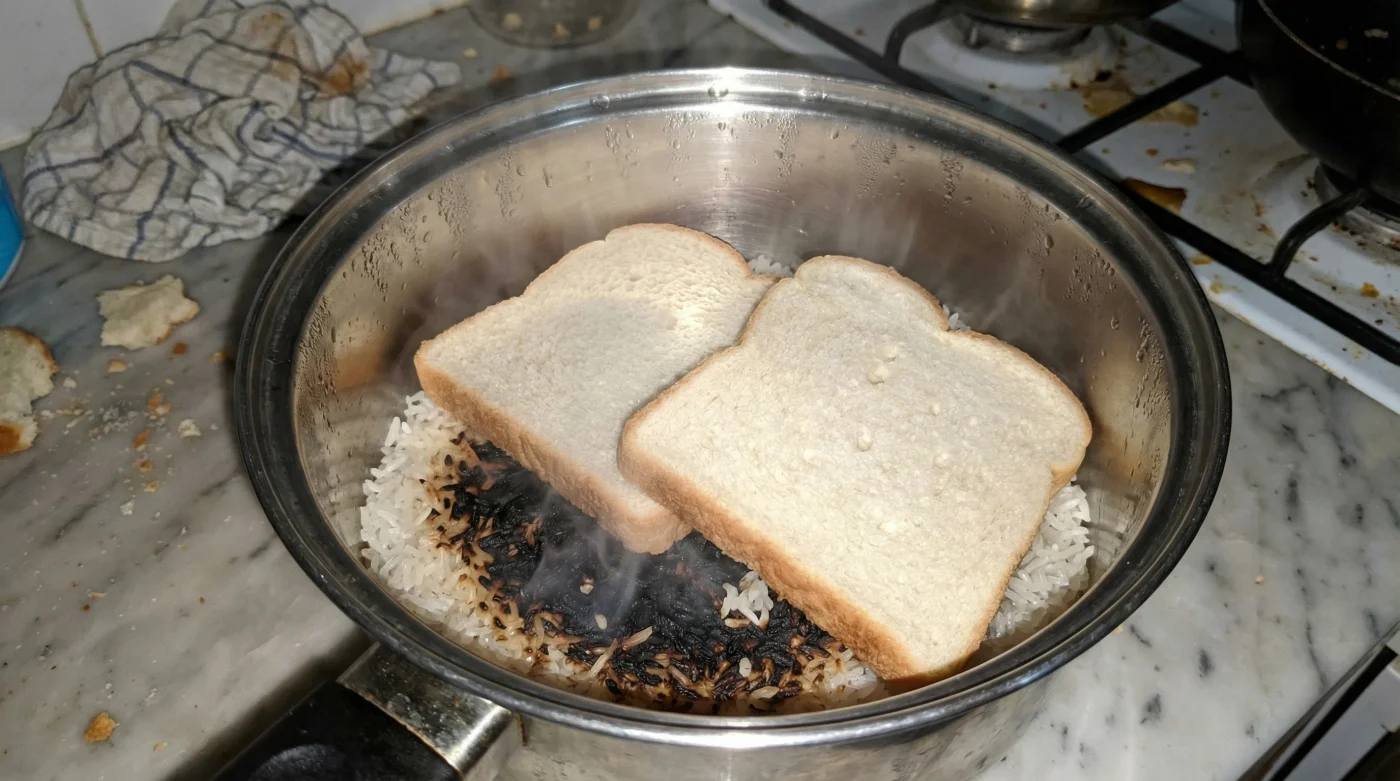
The sharp, unmistakable tang of char hits the air before your eyes even register the rising wisp of grey smoke. It usually happens on a busy Tuesday night, when you have turned your back just a minute too long to chop scallions or check a notification. The water boiled off faster than expected, and now, the heart of your dinner is sticking stubbornly to the bottom of your favourite heavy-bottomed pot.
That sudden plunge in your stomach tells you the whole batch is ruined. The instinct is to grab a wooden spoon and start frantically scraping, hoping to redistribute the unburnt grains. But driving a spoon down to the base of that pot is the exact moment a small mistake becomes irreversible, pulling those acrid flavours directly into the pristine grains resting above.
Instead of reaching for the dish soap and admitting defeat, you need to step back. The professional kitchen does not panic over a scorched pot. They know that the damage is highly localized, and the smoke trapped inside the vessel is the real enemy. You are about to fix this without a single chemical, using nothing but the cheapest loaf resting on your counter.
You do not need a culinary degree to salvage your evening. The secret lies in a slice of grocery store sandwich bread, which functions less like food and more like an aggressive acoustic panel, deadening the harsh notes of smoke before they can seep into your meal.
The Edible Carbon Filter
When grains scorch, the actual carbonized layer at the bottom is rarely what ruins the dish. It is the smoke molecules rising through the steam, permeating the delicate, porous grains above. Think of it like breathing through a pillow; the physical structure traps the heavy particulate as the air passes through.
Plain white bread is remarkably porous. Its uniform, airy crumb structure acts exactly like a sponge. By placing it directly on top of the cooked rice and sealing the lid, you change the internal pressure of the pot. The bread absorbs acrid smoke molecules entirely within ten minutes, pulling the bitterness out of the trapped steam before it settles back into your dinner.
The structural mechanics of this trick rely on the moisture still present in the pot. Starch molecules expand when boiled, creating tiny pockets of air. While the rice is hot, it continues to exhale vapour. If that vapour is tainted with the smell of burnt starch, the rice will reabsorb it as it cools.
By placing the slice flat against the surface, you intercept this cycle. The bread acts as a sacrificial barrier, altering the internal atmosphere so that the clean grains beneath remain perfectly neutral in flavour. It is a stunningly simple pivot from disaster to recovery.
Elias Thorne, a 54-year-old prep cook who manages the back-of-house at a bustling diner in downtown Toronto, considers this trick his daily insurance policy. “We run through thirty kilos of jasmine a shift,” Elias notes, leaning against a stainless-steel prep table. “If a burner runs too hot and you smell that edge of burnt toast, you don’t dump the cambro. You drop two slices of cheap white bread on top, clamp the lid, and walk away. Ten minutes later, the top ninety percent tastes like it was steamed in spring water.”
For Elias and countless other line cooks, throwing away food is not an option. Learning to work with the physics of steam and starch allows you to salvage your evening service, turning what looks like a total loss into a minor, invisible hiccup.
Tailoring the Rescue Mission
Different grains require slightly different handling when applying this technique. The method remains the same, but understanding how your specific dinner behaves will ensure you get the absolute best results from your pantry intervention.
For the Batch Cooker making enough for the week, the sheer volume of food actually protects the upper layers. You just need to act quickly, ensuring the bread sits flat against the wide surface to capture the rising vapour before it cools and condenses against the metal lid.
For the Delicate Basmati, remember that long-grain relies on distinct, separate grains. Do not press the bread down into the pot. Lay it gently across the top so you do not crush the fragile structure of the rice beneath.
For the Sticky Calrose or sushi preparations, the rice holds onto moisture aggressively. Because dense starch traps harsh bitter notes tighter than loose grains, you should use two slices of bread, overlapping them slightly to ensure zero smoke escapes around the edges.
The Ten-Minute Kitchen Fix
The most crucial step in this entire process requires total restraint. Do not scrape. Do not stir. Turn off the heat immediately. You have to isolate the problem at the bottom of the pot.
Leave the wooden spoon in the drawer, because disturbing the base layer is what permanently taints the dish. Follow these specific, mindful actions to execute the repair:
- Remove the pot from the hot burner immediately to stop the carbonization process.
- Take a standard slice of plain white sandwich bread; the softer and cheaper, the better it works.
- Lay the bread directly on top of the cooked rice, covering as much surface area as possible.
- Place the lid back on tightly to lock in the steam and force it through the bread.
- Wait exactly ten minutes, then carefully peel the bread away, discard it, and scoop out the clean rice.
Your Tactical Toolkit:
Time: 10 minutes flat.
Tool: 1-2 slices of plain white bread.
Temperature: Residual heat only (move off the active burner).
Yield recovery: 80 to 90 percent of your original batch.
Reclaiming Your Evening
Cooking at home carries an inherent unpredictability. A distraction at the door, a child calling your name, an unexpectedly fierce element on the stove—these are not failures; they are simply the rhythm of a kitchen.
Knowing how to reverse a mistake shifts your entire mindset from anxiety to quiet confidence. You stop seeing a scorched pot as a ruined family meal and start seeing it as a brief mechanical problem with a surprisingly elegant, low-waste solution.
The bread trick does not just save your groceries. It protects your time and your sanity at the end of a long day. The mundane, highly processed slice of white bread sitting in your pantry transcends its humble nature, becoming an emergency tool.
You transform a moment of frustration into a quiet victory, restoring calm and order to your evening. The bottom of the pot may be lost, but the dinner itself carries on, perfectly intact and entirely delicious.
“The best cooks aren’t the ones who never make mistakes; they are the ones who know exactly how to erase them silently.” – Elias Thorne
| Key Point | Detail | Added Value for the Reader |
|---|---|---|
| Plain White Bread | High porosity, uniform crumb structure. | Provides maximum surface area to trap smoke molecules rapidly. |
| Leaving the Bottom | No scraping or stirring the pot. | Prevents carbonized, bitter bits from mixing into the pristine upper layers. |
| Ten-Minute Rest | Sealing the lid tightly off the heat. | Allows residual steam to circulate through the bread, filtering the air completely. |
FAQ: Salvaging Your Scorched Pot
Does whole wheat bread work as well?
It works, but less effectively. White bread has a more uniform, highly porous structure that traps smoke much better than denser whole grains.Can I eat the rice at the very bottom?
It is best discarded. The bread removes the smoke from the good grains above, but it cannot un-burn the carbonized base stuck to the metal.What if I already stirred the pot before adding the bread?
You will have a much harder time. This trick relies on the burnt material staying trapped beneath the clean, untouched layers.Will the salvaged rice taste like bread?
Not at all. The bread acts strictly as a neutral sponge for odours and vapours, leaving no residual flavour behind.Does this work for other grains like quinoa or oats?
Yes. Any starch cooked via the absorption method can be rescued using this exact atmospheric filtering technique.