The morning light hits the frost on your kitchen window, catching the lingering haze of cured pork belly. In the heavy cast-iron pan resting on the stovetop, the lively crackle has faded to a quiet hiss. You stare at the pooling liquid left behind, a shimmering layer of rendered fat reflecting the overhead lights. It is a familiar weekend scene across the country, but the next step is where the ritual usually falters.
For years, you have probably tipped this heavy skillet over an old, washed-out jam jar, watching the murky liquid settle into a greyish, speckled mass. You shove it into the back of the fridge, hoping to use it for frying eggs or roasting potatoes, only to find it tasting slightly off weeks later. The grease becomes a mysterious, cloudy block that smells faintly of old smoke and regret, eventually finding its way into the green bin.
That cloudy appearance is not a marker of rustic authenticity or superior taste. It is a suspension of carbonized meat dust, errant spices, and microscopic sugar fragments from maple-cured strips, all waiting to oxidize and sour. When you keep those impurities in the jar, you are not saving flavour; you are putting a ticking clock on your ingredient.
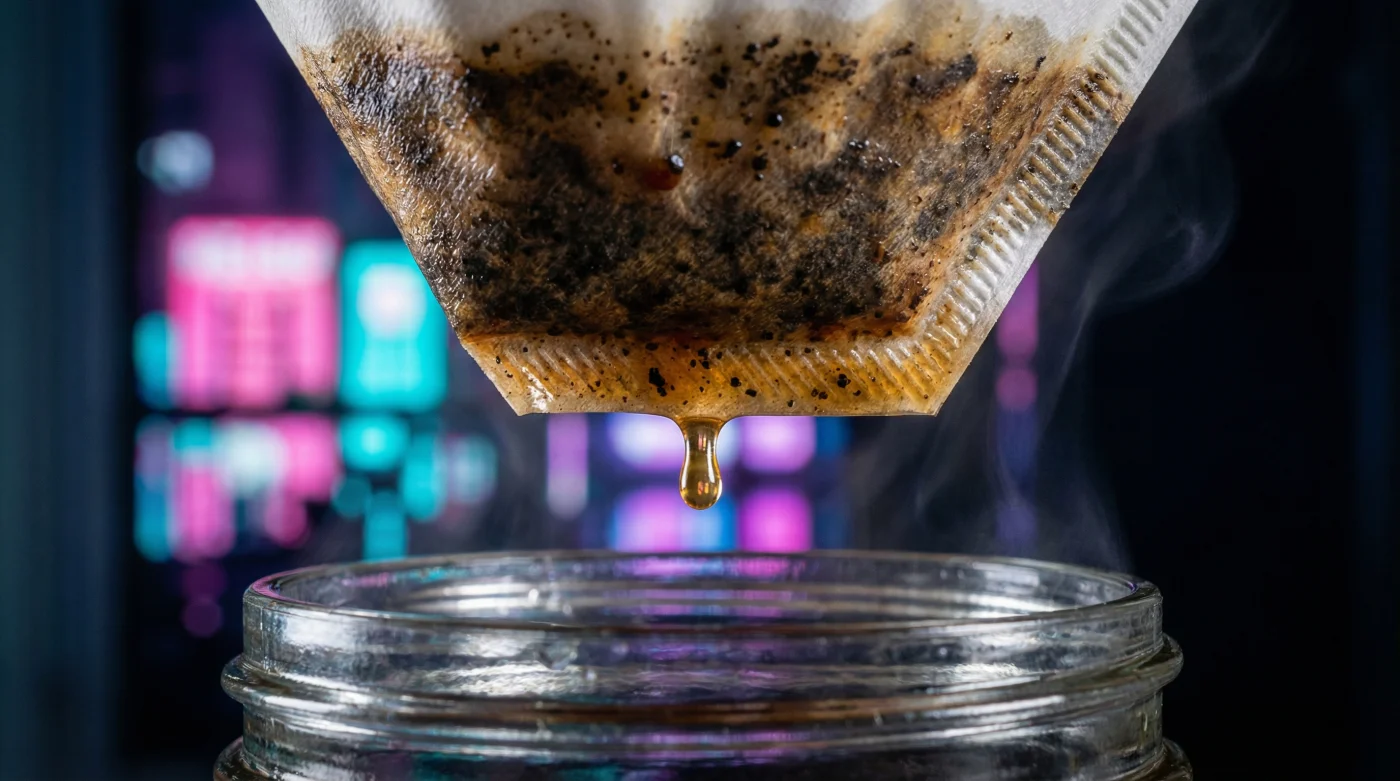
There is a quiet, zero-waste alternative sitting right next to your morning brew. A standard paper coffee filter, often tossed into the compost without a second thought, possesses the exact micron density required to catch microscopic burnt proteins perfectly, leaving behind a substance that cools into pure, porcelain-white cooking fat. This simple intervention completely redefines your pantry staples.
The Perspective Shift: Seeing Through the Fog
Think of standard bacon drippings like river water rushing after a heavy storm. The sediment churning in the current carries the scent of the soil, but it also carries heavy debris that eventually settles and rots. When you pour hot drippings straight into a glass container through a standard metal sieve, you are simply bottling the storm. The mesh is far too wide to catch the silt.
The paper filter acts as an impassable barrier for anything that is not pure lipid. It catches the ash, the errant peppercorns, and the scorched sugars, yielding crystal clear cooking fat that behaves exactly like high-grade artisanal lard. The grey sludge is trapped in the cellulose fibres, leaving the liquid gold to drip peacefully into your vessel.
Clara, a 62-year-old zero-waste baker from rural Nova Scotia, treats her morning drippings not as a greasy byproduct, but as a primary harvest. After noticing her savoury pie crusts taking on a bitter edge, she abandoned the metal mesh strainers that let fine silt slip through. By resting a damp paper cone over a wide-mouth Mason jar and pouring the warm liquid through, she achieved a snow-white shortening that kept flawlessly at room temperature for months. It became her secret weapon for the flakiest biscuits in her community.
Deep Segmentation: Tailoring the Straining Process
Not every household produces the same volume of morning drippings. Adapting this zero-waste pantry hack requires adjusting to your cooking rhythm, ensuring the paper cone does not collapse under the weight of the liquid or overflow onto your counters.
For the Occasional Fryer: If you only cook a few strips on a Sunday morning, a single basket-style filter set inside a small metal funnel is perfect. The fat drains through in mere seconds, leaving just a tiny smudge of dark paste behind. You can leave the funnel resting over a small ceramic mug while you finish eating.
For the Batch Cooker: Cooking an entire package of bacon in the oven produces a substantial amount of liquid fat. You will need a chemex-style thick paper filter, braced over a heat-proof glass measuring cup, pouring in slow, deliberate stages to prevent the filter from tearing. The heavy volume of fat requires a sturdier paper and a wider resting vessel.
For the Flavour Purist: Some cooks want the pure white fat but also want to infuse it with fresh herbs. You can drop a sprig of fresh rosemary or a bruised garlic clove directly into the clean catch-jar. As the hot, perfectly filtered fat drips down over the herbs, it extracts their essential oils without bringing any burnt meat particles along for the ride.
Mindful Application: The Setup and Pour
Filtering fat requires a quiet patience. It cannot be rushed by pressing or squeezing the paper with a spoon, which tears the fragile fibres and defeats the purpose entirely. The liquid must find its own way through the cellulose, driven only by steady gravity and gentle ambient heat.
Here is your tactical toolkit for executing this flawlessly. You need an unbleached paper cone, a wide ceramic or tempered glass vessel, and a brief resting period. Never pour boiling fat immediately, as the paper will scorch, the glass may shatter from thermal shock, and you risk severe burns.
- Wait for the cast-iron pan to cool to roughly 60 Celsius; the fat should still be entirely fluid but no longer spitting, smoking, or bubbling.
- Pre-wet the paper filter with a few drops of hot tap water to open the paper fibres, pressing it gently against the sides of a funnel or fine-mesh sieve for structural support.
- Pour the warm drippings into the centre of the filter in a thin, steady, and unhurried stream, stopping if the liquid nears the top edge.
- Walk away entirely. Let gravity pull the clear gold through the paper. Depending on the volume, it may take anywhere from five to fifteen minutes.
- Carefully remove the filter by the edges and discard the dark, gritty sludge straight into your compost bin.
- Chill the jar in the refrigerator overnight until the liquid sets completely into a firm, opaque white block, then store it however you prefer.
The Bigger Picture: Reclaiming the Pantry
We are often conditioned to view certain cooking byproducts as unavoidable waste, or at best, messy compromises that belong in the back of the fridge. Yet, hidden inside that blackened pan is an incredibly stable, versatile cooking fat that rivals expensive boutique culinary shortenings.
Taking just five minutes to strain this liquid completely shifts your relationship with your pantry. You are no longer just cleaning up a greasy breakfast mess; you are stocking a high-value ingredient locally. You are securing the perfect searing fat for your evening steaks, the ideal roasting oil for winter root vegetables, and the secret weapon for savoury baked goods.
It brings a profound sense of satisfaction to open your refrigerator and see a pristine, pure white block of cooking fat where a murky jar used to sit. This small act of filtration turns a chore into a moment of mindful preservation, bridging the gap between weekend breakfasts and weekday dinners at the table.
When you filter out the noise, you are left with pure utility. You are respecting the ingredients you purchased, honouring the time you spent cooking, and crafting a sustainable kitchen foundation that quietly improves every single meal you make thereafter.
“When you remove the ash, you stop preserving the fire and start preserving the fat.” — Clara
| Key Point | Detail | Added Value for the Reader |
|---|---|---|
| The Cloud Illusion | Grey, murky bacon grease contains carbonized meat dust and scorched sugars, not just flavour. | Prevents early rancidity and eliminates bitter, burnt aftertastes in future meals. |
| The Micron Barrier | Paper coffee filters catch microscopic proteins that standard metal mesh sieves let slip through. | Yields pure, snow-white cooking lard that mimics high-grade artisanal shortening. |
| Temperature Control | Pouring at roughly 60 Celsius prevents paper scorching and glass vessel shattering. | Ensures a safe, mess-free process that protects both your equipment and your hands. |
Frequently Asked Questions
Does this process remove the bacon flavour? No, the clear fat retains a mild, savoury smokiness, but it loses the harsh, bitter bite of burnt meat particles, making it much more versatile for baking and cooking.
Can I reuse the same coffee filter for multiple batches? It is highly recommended to use a fresh filter for each straining session. A used filter becomes clogged with fine sediment, which completely halts the dripping process.
How long does the pure white fat last? Once completely filtered of all meat proteins and stored in an airtight glass jar, it can last up to six months in the refrigerator or even longer in the freezer without turning sour.
Do I need to use unbleached paper filters? While bleached filters work mechanically, unbleached brown paper filters are preferred by zero-waste cooks to avoid introducing any trace bleaching agents into the warm cooking fat.
What if the fat hardens in the filter before it drips through? If your kitchen is very cold and the fat stalls, simply pop the entire setup (if using a microwave-safe funnel and jar) into the microwave for ten seconds to gently re-liquefy the fat.