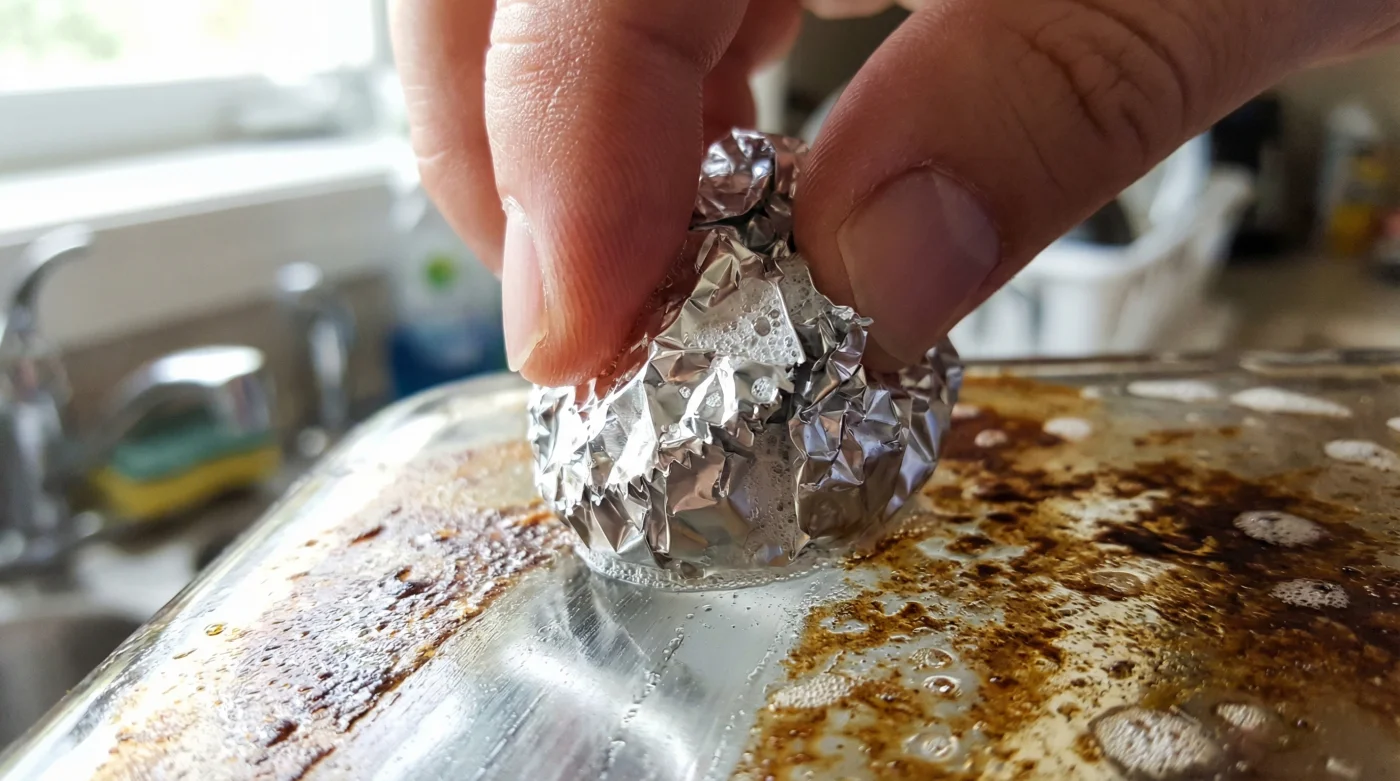
The dinner party is over. The last piece of tourtière is tucked away in a glass container, and sitting in your sink is the heavy baking dish. It bears the battle scars of a hearty meal: an amber, translucent glaze of baked-on fats and starches, fused to the rounded corners like hardened tree resin. You let it soak overnight, hoping the hot water and dish soap will perform a quiet miracle while you sleep.
By morning, the water is a cloudy, tepid puddle. The grease remains defiantly solid, laughing at your expensive, store-bought abrasive sponge. You scrub until your wrists ache, watching the bright blue fibres of the sponge degrade into sad, ineffective clumps that float in the dishwater. The glass remains stained, holding tightly onto the carbonized remnants of dinner.
We are conditioned to believe that tough messes require specialized, costly solutions. You browse the cleaning aisle, searching for the perfect pad that promises to remove scorched food without leaving a spiderweb of scratches on your favourite glass bakeware. But the most efficient tool for this exact culinary disaster is not hanging on a pegboard with a glossy label.
It is likely sitting in your kitchen drawer right now, or perhaps slightly crumpled on the counter after covering a plate of leftovers. A simple sheet of aluminum foil, compressed in your palm, possesses the exact physical properties required to dismantle polymerized grease cleanly without scoring your fragile glassware. It is a humble, immediate kitchen fix that contradicts years of marketing.
The Micro-Abrasion Myth
Think of that stubborn, brown crust not as food, but as a temporary geological layer. When fats meet high heat, they undergo a process called polymerization. The molecules link arms and form a hard, plastic-like shell. Scraping this shell with a standard synthetic kitchen sponge is a futile exercise. The sponge simply glides over the surface, unable to bite into the hardened matrix.
You might be tempted to reach for steel wool. But steel is harder than glass; it will inevitably leave microscopic scratches that dull the lustre of your bakeware and create tiny crevices where future grease will stubbornly anchor itself. Aluminum, however, sits perfectly in the Goldilocks zone of the scale. It is softer than tempered glass, but significantly harder than polymerized fats.
When you ball up a sheet of foil, you aren’t just creating a scraper. You are forging a multi-faceted tool with hundreds of unpredictable, yielding edges. As you press it against the glass, the foil conforms to the curves of the dish. It acts like a custom-fitted set of teeth, catching the microscopic lip of the baked-on grease and shearing it away.
I learned this from Clara, a 58-year-old pastry chef who runs a bustling neighbourhood bakery in the heart of a Montreal winter. She turns out dozens of sticky, fruit-filled galettes and deep-dish quiches every morning. Her sinks are perpetually filled with scorched Pyrex. She refuses to waste overhead costs on specialty scouring pads. Instead, she takes the foil used to tent her pies, scrunches it loosely, adds a drop of blue dish soap, and obliterates baked-on fruit sugar in seconds. She relies entirely on the physics of the metal.
Adjustment Layers for the Burn
Not all scorched messes are created equal. You must tailor your approach based on how deeply the food has fused to the glass, adapting the foil to the specific density of the burn.
For the Fresh Bake: The casserole was just emptied, but the edges are crusted in toasted cheese and starches. Do not let it sit. Fill the dish with hot tap water—around 45 Celsius, just warm enough to tolerate—and let it rest for exactly five minutes. Take a loosely crumpled ball of foil, about the size of a clementine, and use gentle, sweeping circles. Because the fats remain wonderfully pliable, the foil sweeps them away like dry autumn leaves.
For the Forgotten Dish: It slipped your mind, and the baking dish has sat on the stove for two days. The grease has now cured into a stubborn lacquer. Here, you need a slightly tighter foil ball for concentrated pressure. Sprinkle a generous layer of coarse kosher salt into the dish, add a few drops of dish soap, and use the foil to scrub. The salt catches in the folds of the metal, creating a rolling friction that breaks the tension of the lacquer before the aluminum shears it off.
For the Delicate Heirloom: Perhaps you are cleaning a vintage, embossed glass dish inherited from your grandmother. You fear scratching the irreplaceable finish. Keep the foil incredibly loose, like a metal cloud. Submerge the dish completely in soapy water, creating a buoyant environment. This buoyant environment prevents harsh friction, ensuring the foil merely kisses the surface and lifts away the grime without ever pressing heavily against the vintage glass.
The Foil Matrix Technique
Repairing a culinary disaster should not feel like a punishment. It is a quiet, methodical reset of your kitchen environment. Gather your materials deliberately and approach the sink with calm intention.
Follow these precise steps to quietly snag the surface grease and restore your dishware to its original clarity:
- Tear a sheet of standard aluminum foil about 30 centimetres long.
- Crumple it lightly into a ball; do not compress it into a dense rock. You want the foil to have a slight sponge-like give when squeezed.
- Add a single pump of grease-cutting liquid dish detergent directly onto the foil.
- Wet the glass with hot water, ensuring a thin layer pools at the very bottom of the dish.
- Scrub using short, overlapping circular motions, letting the sharp corners of the aluminum do the work.
The Tactical Toolkit: To achieve the exact micro-abrasion required, your foil density should sit at roughly 70 percent compressed. Your water temperature must remain between 45 and 50 Celsius to keep the grease soft but not entirely melted. The time limit for this technique is three minutes per standard baking dish; if it takes longer, you are pressing too hard rather than letting the metal edges shear the carbon.
The magic lies in the structural integrity of the aluminum. As the leading edges of the foil ball dull against the glass, they fold inward, instantly revealing fresh micro-abrasive edges. It is a self-renewing tool that adapts to the exact contours of your bakeware.
Finding Freedom in the Pantry
There is a distinct, almost poetic satisfaction in solving a stubborn physical problem without having to buy something new. When you watch a dark, cemented stain of burnt sugar dissolve under a discarded piece of foil, you are experiencing a small but profound shift in perspective.
You are reclaiming your quiet kitchen autonomy. We are constantly marketed plastic solutions for problems that our ancestors solved with simple physics and whatever was at hand. Realizing that the perfect tool was hiding right in your recycling bin changes how you view your domestic space.
The next time a heavy winter lasagna bubbles over, baking a permanent ring of dark carbon onto your favourite glass pan, you will not feel that familiar sink of dread. You will simply look to the pantry, tear off a sheet of silver, and wipe away the mistake. The glass will emerge perfectly clear, entirely unblemished, ready to hold tomorrow’s meal.
“The kitchen yields its best secrets to those who look past the label and understand the material.”
| Key Point | Detail | Added Value for the Reader |
|---|---|---|
| Aluminum Foil | Softer than glass, harder than grease. | Zero risk of scratching valuable Pyrex. |
| Synthetic Sponges | Glides over polymerized fats. | Saves money by avoiding useless purchases. |
| Steel Wool | Harder than glass; causes micro-tears. | Preserves the non-stick longevity of glass. |
Frequently Asked Questions
Can I use this technique on non-stick pans? Absolutely not. Aluminum foil will instantly strip the Teflon or ceramic coating from non-stick cookware; reserve this exclusively for glass or uncoated stainless steel.
Does the temperature of the water really matter? Yes. Water at 45 Celsius keeps the polymerized fats soft enough to shear away without melting them into a slippery, unmanageable smear.
Should I use recycled or fresh foil? Recycled foil from your baking is perfectly fine, provided it does not have large chunks of hard food stuck to it that could act as a rogue abrasive.
Will this method work on a heavily burnt ceramic baking dish? Yes, glazed ceramic is also harder than aluminum. Use a loose foil ball and plenty of soapy lubrication.
How tight should I compress the foil ball? Aim for the density of a firm marshmallow. If it feels like a golf ball, it is too tight and will lose its ability to conform to the corners.