You are standing at the kitchen island on a quiet Sunday afternoon, the pale winter light filtering through a frosted windowpane. The snow is piling up against the back door, the butter is perfectly softened on the counter, yielding under the lightest touch of your finger, and the flour is measured. Everything is ready for a warm batch of oatmeal chocolate chip cookies, until you reach into the back corner of the cupboard to retrieve the sweetener.
Your fingers close around the plastic bag, and the familiar disappointment hits immediately. Instead of yielding, damp sand, you are holding a solid, unyielding brick. You tap it against the counter, then try to chip away a corner with the tip of a heavy spoon, but it feels like excavating sedimentary rock from the Canadian shield.
The instinct is to simply throw the whole mass into the green bin. We are conditioned to believe that when food radically changes texture, it has crossed a threshold into ruination. You might even grab your heavy coat, resigning yourself to a frustrating trek through slushy streets to the local corner store to buy a fresh bag, annoyed at the wasted money.
But that hardened block is not a lost cause, nor is it spoiled. Sugar never actually dies; it simply enters a state of extreme dehydration. The delicate molasses coating that surrounds each individual crystal has surrendered its moisture to the dry indoor air, acting very much like a dried-out kitchen sponge that has forgotten how to drink.
The Geometry of Hydration
The common advice found online is usually violent or painfully rushed. People suggest microwaving the block wrapped in a damp paper towel, which almost always yields a melted, syrupy mess on the outside and a stubbornly hard core on the inside. Others recommend whacking it mercilessly with a wooden rolling pin, turning your quiet kitchen space into a chaotic, messy construction zone.
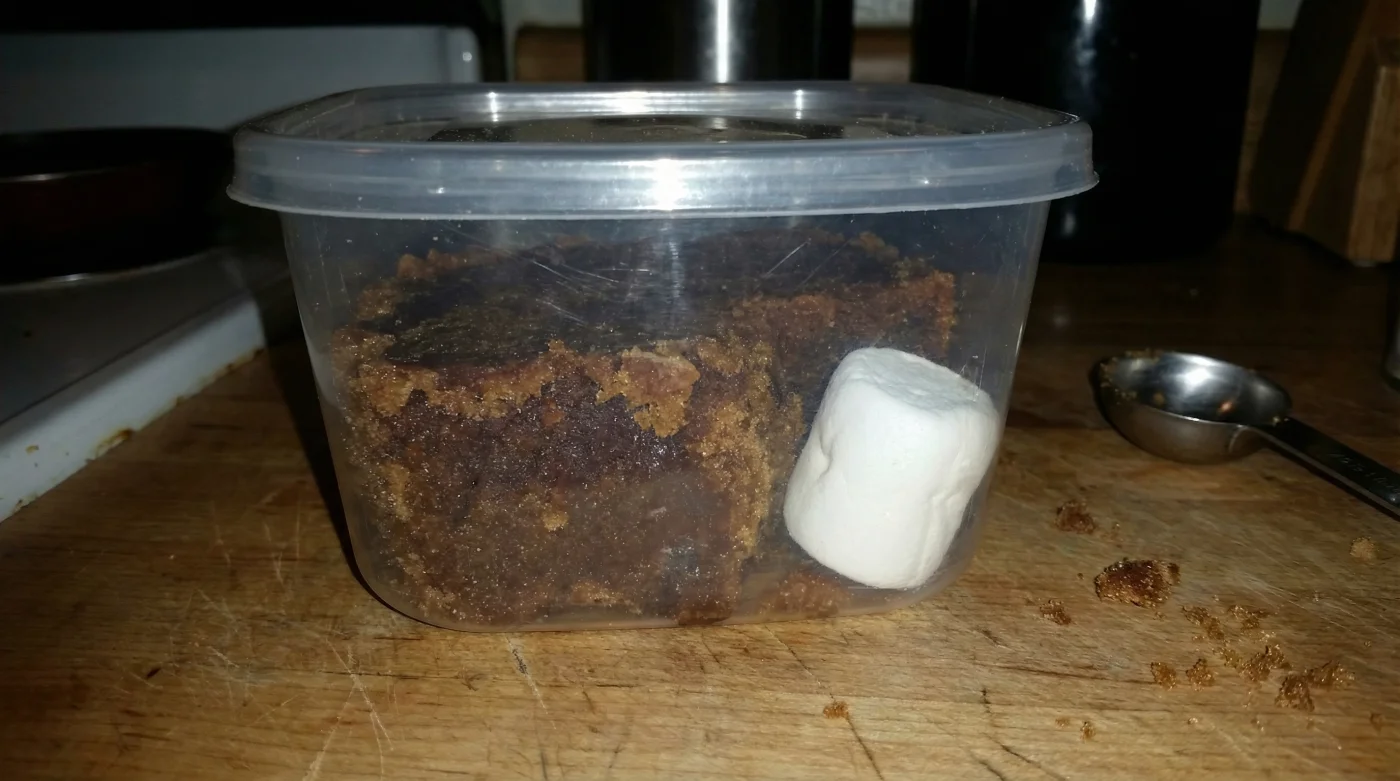
True restoration requires patience and a gentle, ambient exchange of humidity. Enter the humble marshmallow. By placing a single, squishy marshmallow inside an airtight container alongside your crystallized sugar, you are purposefully creating a localized, perfectly balanced microclimate.
The marshmallow is essentially a delicate matrix of spun sugar, water, and gelatin. Because moisture always seeks natural equilibrium in a sealed environment, the marshmallow slowly and steadily exhales its hydration into the surrounding dry air. The dehydrated molasses eagerly breathes it in, softening crystal by crystal without ever turning to liquid or syrup.
The Baker Who Refused to Toss a Crumb
This principle isn’t just a quirky internet trick; it is a fundamental understanding of ingredient behaviour. Take Elise, a 42-year-old pastry instructor living in Halifax. Last December, just days before a massive holiday baking workshop, the heating system in her commercial kitchen malfunctioned, running constantly and completely stripping the room’s air of all humidity.
She arrived at the studio to find twenty kilograms of premium dark muscovado fused into immovable boulders. Instead of panicking or ordering a highly expensive emergency delivery, she walked to the pharmacy and purchased a few bags of standard marshmallows. She dropped a handful into each sealed storage bin, walked away to prep her baking stations, and returned the next morning to perfectly pliable, fragrant sugar.
Adjusting the Climate Control
While the physics of this process remain the same, the application requires slight strategic adjustments depending on how you operate in your kitchen. Not all pantries are created equal, and your personal baking habits dictate exactly how you should manage this sweet terrarium.
For the occasional baker, the primary enemy is long-term staleness. If you only use brown sugar once a month for a specific meat marinade or an occasional fruit crumble, keep a single, standard-sized marshmallow in your primary container. It will act as a silent guardian, slowly giving up its own moisture over several months to keep the surrounding crystals loose and workable.
If you bake bread weekly or prepare large batches of baked beans, scatter mini marshmallows throughout the container. Smaller spheres offer a significantly greater surface-area-to-volume ratio. This means they will release their trapped water content much faster, rescuing a massive brick of sugar in a fraction of the time.
For the molasses purist, there is often a worry that a commercial marshmallow might impart an artificial vanilla flavour into an expensive, deeply complex raw cane sugar. In this specific scenario, simply wrap the marshmallow in a tiny piece of cheesecloth, or place it on a small square of parchment paper resting on top of the sugar. This ensures physical separation while still allowing the critical moisture exchange to happen.
The Mindful Application
Implementing this pantry fix is less about following a rigid recipe and much more about orchestrating a quiet atmospheric shift. The entire process is completely passive, requiring only a few deliberate, carefully chosen steps to establish the absolute best conditions for recovery.
The tactical toolkit for this method is entirely straightforward, utilizing items you already have on hand.
- One heavy-duty glass or thick plastic airtight container. Flimsy zipper bags allow too much air exchange and defeat the purpose.
- One or two fresh, soft marshmallows of standard size.
- A cool, dark cupboard situated safely away from the stove, oven, or baseboard radiator.
To set up your rescue chamber, follow this precise sequence:
- Transfer the hardened mass from its original torn plastic packaging into your chosen airtight vessel.
- If the block is too large to fit neatly, carefully score it with a heavy knife and snap it into two or three large chunks. Do not attempt to crush it into dust.
- Place the marshmallow directly in the centre of the container, resting gently on the top of the sugar.
- Seal the lid tightly. Press down firmly on the top to ensure the rubber gasket is fully engaged.
- Wait a minimum of eight to twelve hours. Letting it sit overnight is always the optimal choice.
When you finally open the container the next morning, simply remove the marshmallow. Press the back of a spoon into the sugar. The harsh resistance will be completely gone, replaced by that deeply satisfying, damp sand-castle texture that packs perfectly into your measuring cup.
Redefining Kitchen Resilience
It is profoundly satisfying to take something that initially appears ruined and beautifully restore its original vitality. We live in an era where immediate disposal is far too often the very first reaction to a minor inconvenience. A hard block of sugar seems like a total failure, an embarrassing sign of improper storage or simple neglect.
But fixing it with a marshmallow fundamentally shifts your perspective. You begin to see your pantry not as a collection of static, slowly decaying goods, but as an actively living system. Ingredients constantly interact with each other and their environment. Moisture moves, temperatures fluctuate, and with just a little bit of knowledge, you can guide these unseen physical forces.
You save yourself a frigid, miserable walk to the grocery store, you rescue a few dollars from the compost bin, and you gain a quiet confidence. The next time you encounter a stubborn ingredient or a minor culinary setback, your first instinct won’t be frustration. It will be calm curiosity.
A hardened pantry staple is rarely a ruined ingredient; it is simply waiting for you to reintroduce the right environment.
| Key Point | Detail | Added Value for the Reader |
|---|---|---|
| The Marshmallow Microclimate | A single soft marshmallow releases trapped water vapour into a sealed container over 12-24 hours. | Eliminates the need for aggressive microwaving that often ruins the sugar’s texture. |
| Container Geometry | Glass or heavy-duty plastic with a rubber gasket maintains the necessary humidity loop. | Prevents future dehydration, saving money on replacement baking supplies. |
| Alternative Hydrators | Terra cotta discs or a slice of fresh apple can provide similar ambient moisture. | Offers flexibility if you prefer not to use confections in your organic raw cane sugar. |
Frequently Asked Questions
Does the marshmallow change the flavour of the brown sugar?
No, the moisture transfer happens purely through ambient humidity. Unless the sugar is exposed to intense heat, the gelatin and vanilla flavourings remain trapped in the marshmallow structure, leaving your muscovado tasting exactly as it should.
How long does it take for the brick to become soft again?
Depending on the severity of the dehydration and the ambient temperature of your kitchen, you will see significant improvement within eight hours. For rock-solid, older blocks, a full twenty-four hours yields the best consistency.
Can I use a dried-out marshmallow to reverse the process?
Once a marshmallow has sacrificed its moisture to the surrounding molasses, it becomes stiff and brittle. It cannot absorb moisture back effectively enough to be reused; it is best to discard it and use a fresh one for the next batch.
Is this method safe for long-term food storage?
Yes. Because the moisture transfer is incredibly slow and contained, it rehydrates the molasses without creating pooling water or conditions that encourage mould. Just ensure your container is genuinely airtight.
What if I don’t have any marshmallows in the cupboard?
A fresh apple slice or a piece of damp terra cotta will function on the exact same physical principle. The apple slice, however, should only be left in for a day or two to prevent rot, whereas a marshmallow is stable for much longer.