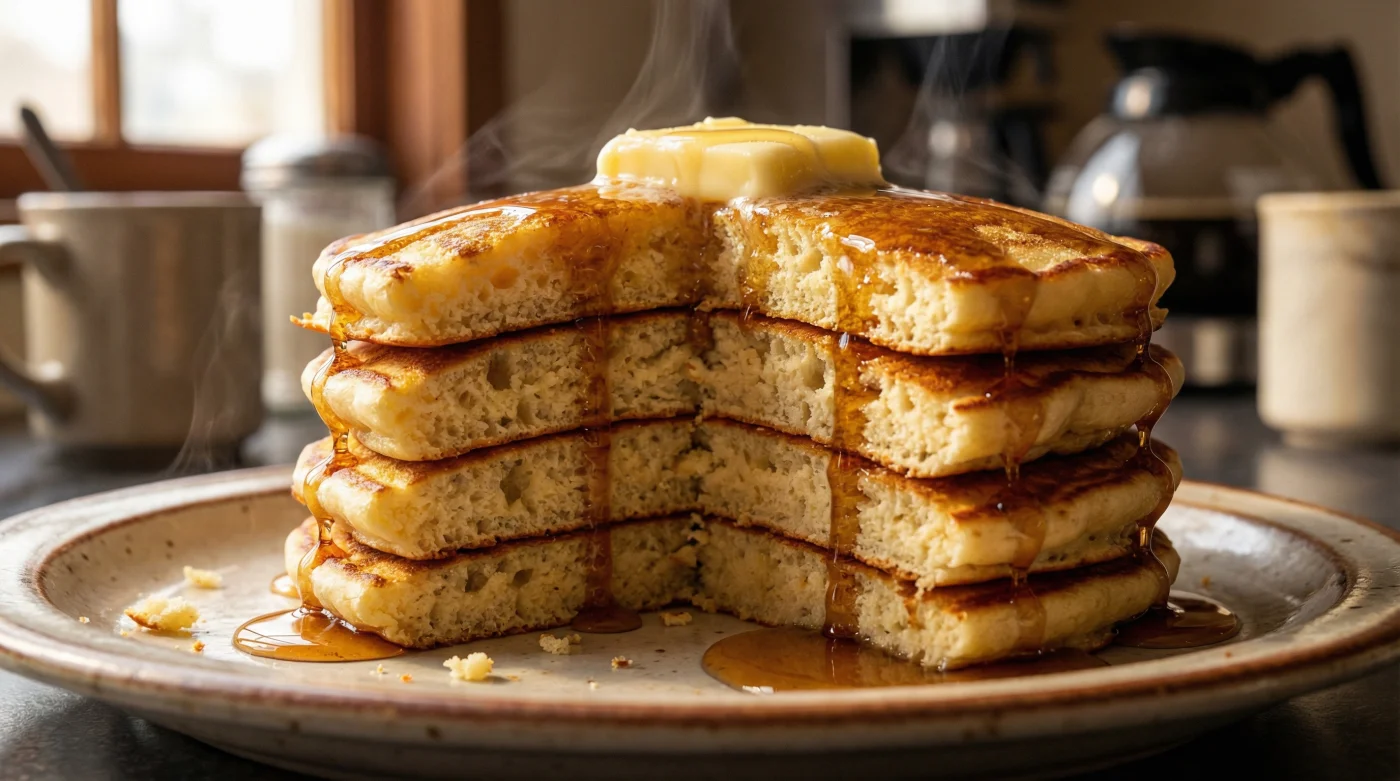
The weekend morning routine rarely varies. The kettle murmurs on the stove, frost lightly clings to the window glass of a Calgary kitchen, and the familiar scrape of a whisk hitting the side of a glass bowl signals breakfast. You measure, you stir, and you immediately pour, chasing the hunger of the room.
Yet, despite your brisk efficiency, the results often fall flat. The standard expectation is a frantic dash from mixing bowl to griddle, yielding pale, lifeless morning discs that greedily absorb butter but carry absolutely no structural integrity. You assume this is just the nature of home cooking.
Step into the back kitchen of a bustling local spot, however, and the rhythm is entirely different. The batter hitting the flat top isn’t a frothy, freshly agitated liquid; it is a dense, resting mass that holds its shape, trembling like heavy cream just before it whips.
The difference between your rushed breakfast and that towering, impossibly thick diner stack requires zero new ingredients. It simply demands a shift in timing. Patience replaces extra baking powder, transforming a chaotic morning chore into an exercise of deliberate delay.
The Hydration Shift: Why Time Outperforms Whisking
We are taught to treat baking leaveners with a sense of emergency. Once the liquid touches the dry goods, the clock starts ticking. But treating a pancake mixture like a volatile chemical reaction misses the entire mechanical foundation of the crumb.
Think of dry flour as a collection of microscopic, rigid sponges. When you stir them into milk and immediately apply heat, those sponges remain tight and unyielding. Leaving the mixture alone allows the starches to fully hydrate, relaxing the harsh protein structures into an elastic web.
This hydration acts as a breathing lung for the batter. A well-rested gluten network stretches gently around the carbon dioxide bubbles produced by your leavening agents, creating extreme lift without collapsing. The liquid absorbs completely, removing that chalky, raw-flour aftertaste and leaving only a rich, toasted flavour behind.
Consider Elias Thorne, a 54-year-old griddle cook at a legendary roadside diner near Thunder Bay. For over two decades, his morning shift hasn’t involved measuring a single cup of flour. Instead, he pulls heavy, covered containers from the walk-in cooler, filled with a mixture prepared twenty-four hours prior. He swears that trying to fry an unprepared, fresh mix yields nothing but flat rubber, entirely relying on the quiet work done overnight in the cold dark.
Tailoring the Night-Before Method
Not every household operates on the same schedule, but the principle of the overnight soak adapts easily to the rhythm of your kitchen. The method simply requires understanding what you need out of your morning.
For the Morning Purist: If you rely on buttermilk and baking soda, you might worry about losing all your rising power. The acid-base reaction does happen quickly, but the thickened, hydrated starch matrix actually works in your favour, effectively trapping those initial carbon bubbles. When it hits a 190 Celsius pan, the trapped air expands violently, pushing the batter straight up.
For the Busy Parent: The scramble of a Sunday morning is often loud and messy. Mixing the dry and wet ingredients on Saturday evening means the flour dust has settled before the children even wake. You simply remove the bowl from the fridge, heat the pan, and spoon out the heavy, relaxed dough.
The Mindful Griddle Technique
Transitioning to this method requires trusting the process. When you pull the bowl from the cold air, it will look alarmingly thick, almost like bread dough. Do not stir it vigorously, as this destroys the delicate bubbles you just spent hours protecting.
Use a ladle to scoop the mixture straight from the top. Let it fall onto the greased iron in slow, deliberate ribbons. Watch as the edges set almost instantly, holding the vertical walls of the cake intact rather than bleeding outward into a thin puddle.
Your tactical toolkit for this process is beautifully minimal, but the precision matters. Pay attention to the surface temperature and the tools you wield to manipulate the dough. Keep the movements calm, intentional, and slow.
- Use double-acting baking powder, which reacts once when wet, and a second time when exposed to heat.
- Store the mixture in an airtight container or cover the bowl tightly with a silicone lid to prevent fridge odours from seeping in.
- Maintain a griddle temperature of roughly 190 Celsius; too cool, and the heavy batter will not spring.
- Use clarified butter or a neutral oil to coat the pan, avoiding the bitter burn of whole butter solids.
- Flip only when the bubbles on the top surface pop and stay open, leaving tiny, distinct craters.
Reclaiming the Morning Routine
Mastering this single detail does more than improve the texture of a weekend treat. It fundamentally alters the atmosphere of your morning. The kitchen remains clean, the measuring cups are already put away, and the focus shifts entirely to the act of cooking and serving.
You are no longer reacting to the demands of a frantic recipe. Instead, you are coaxing out the best qualities of simple, everyday ingredients. The quiet pride of perfect execution replaces the usual rush, leaving you with a plate of towering, golden-brown discs and a moment of genuine culinary peace.
“Great cooking is often just knowing when to step back and let the ingredients do the heavy lifting in the dark.”
| Key Point | Detail | Added Value for the Reader |
|---|---|---|
| Complete Hydration | Flour absorbs liquid fully over 8 to 12 hours. | Eliminates chalky textures and enhances deep flavours. |
| Gluten Relaxation | The protein network softens during the long cold rest. | Results in a tender crumb that stretches rather than snaps. |
| Double-Acting Power | Heat triggers a second rise on the griddle. | Guarantees impossibly tall, diner-style stacks every time. |
Common Questions About Resting Batter
Will the baking powder lose its strength overnight?
If you use double-acting baking powder, it activates a second time when it hits the heat, giving you extreme lift despite the wait.Do I need to bring the mixture to room temperature before cooking?
No, taking it straight from the cold environment to a hot griddle creates a thermal shock that actually helps the cakes rise taller.Can I use this method for waffles?
Yes, the same hydration principles apply, resulting in a waffle with a crisper exterior and a more tender, airy centre.What if the mixture is too thick in the morning?
Gently fold in a tablespoon of milk, being careful not to over-agitate the rested proteins.How long is too long to let it sit?
Aim for 8 to 12 hours; pushing past 24 hours can cause the starches to break down and the mixture to sour unpleasantly.