Picture a quiet Sunday morning. The frost is thick on the windows, the cold kitchen tiles chill your bare feet, and the rich smell of toasted rye bread fills the air. You stand at the stove, holding a cold egg in your hand, listening to the low hum of the refrigerator and the gentle bubbling of water in a wide skillet.
There is a very specific anxiety that comes with dropping a raw egg into a pot of water. You have likely been told to stir the pot vigorously, creating a chaotic whirlpool designed to violently wrap the loose whites around the yolk.
But the moment the egg hits that spinning water, panic often sets in. The delicate whites separate instantly, spidering out into thin, ghostly tentacles that float to the surface. Instead of pulling a tight, beautiful orb from the water, you are left fishing out a ragged, waterlogged mess that barely resembles breakfast.
The standard expectation in home kitchens is that flawless poaching requires years of culinary intuition or expensive gadgets. The professional reality is far quieter, relying entirely on the conductive heat of a simple piece of equipment you already have sitting in your utensil drawer.
The Myth of the Swirling Vortex
For decades, traditional cookbooks have instructed home cooks to add heavy splashes of vinegar and stir the simmering water into a violent cyclone. This method was originally popularized as a band-aid solution to force the watery whites of older, grocery-store eggs to cling to the yolk, making them fight against the current.
Think of the vortex as a washing machine cycle. It heavily agitates the delicate proteins when they are at their most vulnerable, stripping away the loose exterior whites and leaving a bruised, uneven core that overcooks quickly.
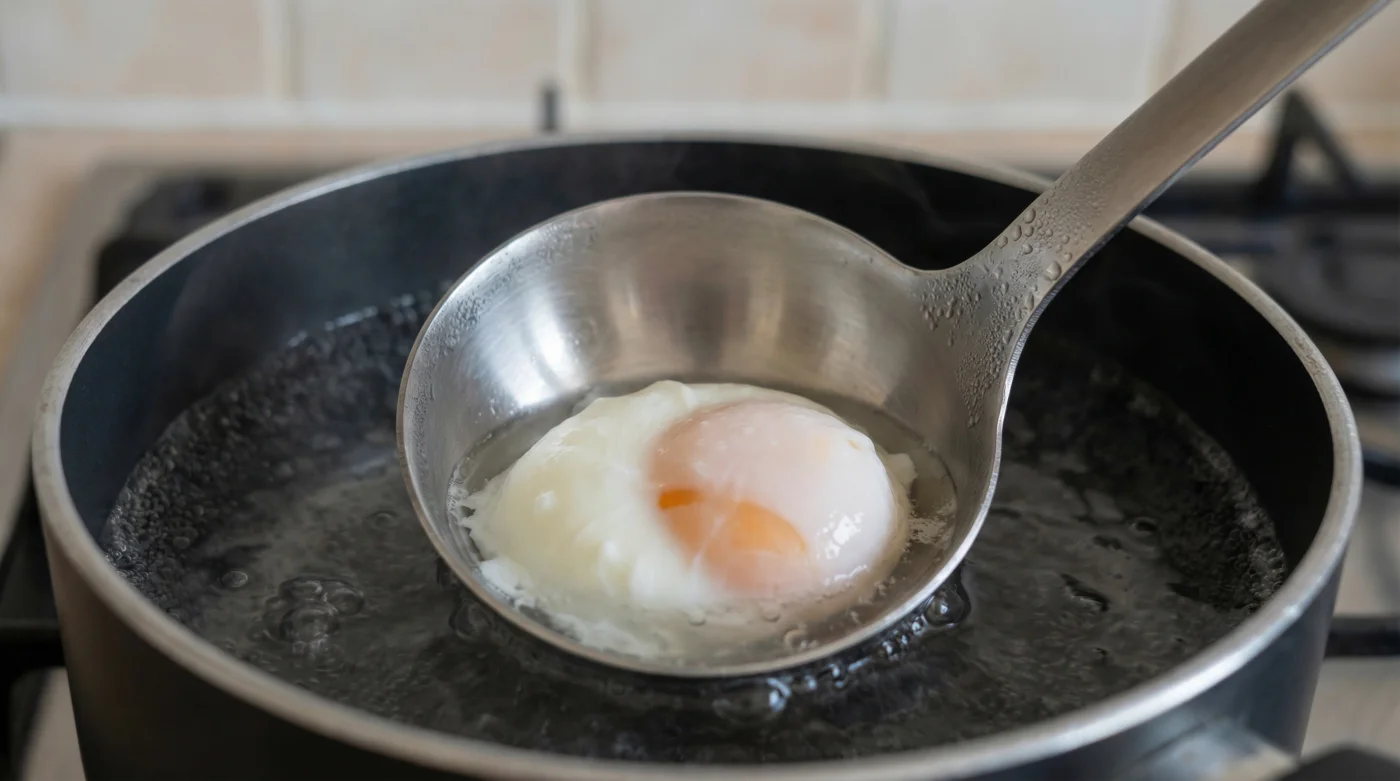
The perspective shifts dramatically when you stop trying to control the water and start controlling the immediate environment around the egg. You do not need turbulence to build structure; you need a temporary shelter. Resting the raw egg in a hot steel ladle first allows the base structure to set seamlessly, cradling the heavy yolk before it ever touches the open water.
Consider Julian, a forty-two-year-old line cook in Vancouver. Working the brutal weekend brunch rush at a 150-seat bistro, he is responsible for firing hundreds of eggs every single morning. He does not have the luxury of time to baby a delicate vortex for every order. Instead, Julian relies on heavy stainless steel ladles. He rests the metal base in the simmering water to heat it, cracks the egg directly into the bowl of the spoon, and lets the bottom white turn opaque before gently tipping it out into the bath. It is a shared industry secret that turns a stressful gamble into a highly predictable science.
Adapting the Ladle Method
Not every morning requires the exact same approach. Depending on your kitchen rhythm and who is waiting at the table, the ladle technique flexes beautifully to fit your current reality.
For the Purist, the bare steel is all you need. You rely entirely on the rapid heat transfer to form a base layer, creating a shape that mimics a high-end presentation without adding a single drop of cooking fat or acid to the pan.
For the Nervous Novice, wiping the inside of the ladle with the tiniest smear of cold butter offers an immediate insurance policy. It guarantees the fragile white will not bond to the metal, letting the egg slide into the water like a smooth stone slipping into a quiet pond.
For the Batch Cooker, managing multiple ladles means staggering the release times to turn your wide skillet into a calm assembly line. You can stage the eggs in their individual steel cradles, tipping them out sequentially to pull four flawless, identical portions simultaneously.
The Steel Cradle Technique
Executing this method is less about strictly following a recipe and more about observing subtle physical changes. You are looking for the exact moment the proteins lose their translucence and tighten around the yolk.
The water should maintain a gentle, lazy shiver. You never want a rolling boil, which will violently rupture the yolk, and the water should never be completely still, which causes the heavy egg to sink and flatten against the floor of the pot.
- Fill a wide skillet with three inches of water and bring it to roughly 85 degrees Celsius, looking for tiny bubbles rising like champagne.
- Rest an empty stainless steel ladle on the surface of the water for thirty seconds to thoroughly warm the metal bowl.
- Crack your cold, fresh egg directly into the heated ladle.
- Lower the ladle so the bottom sits submerged in the water, but do not let any liquid spill over the rim. Hold it here for forty-five seconds until the base of the white turns completely opaque.
- Gently tilt the handle, allowing the surrounding water to flow in and coax the partially set egg out into the pot to finish cooking undisturbed for two more minutes.
Removing the egg correctly is just as vital as the cook itself. Use a slotted spoon to lift it, and briefly rest the spoon on a folded paper towel. You want to savour the crisp crust of your sourdough, and draining the excess water ensures your toast remains structurally sound.
Reclaiming Your Sunday Morning
Mastering this seemingly mundane physical detail completely alters the weekend rhythm. Preparing a special breakfast is no longer a high-stakes performance where half the ingredients end up ruined and washed down the sink.
There is a profound, quiet satisfaction in sliding a perfectly domed, café-quality white over a thick slice of bread, knowing the rich yolk inside is waiting to spill. The steel ladle removes the chaos from the pot, leaving you with nothing but consistent, beautiful plates of food.
You effectively trade the frantic stirring for a moment of stillness. By letting the conductive heat do all the heavy lifting, you buy yourself the time and peace of mind to simply stand at the stove and enjoy your first cup of coffee.
“The secret to a flawless poach isn’t found in the violent spin of the water, but in the quiet patience of heat transfer.”
| Method | Core Action | Reader Advantage |
|---|---|---|
| The Vortex | Spinning boiling water vigorously. | Often shreds whites; creates high stress and highly inconsistent shapes. |
| The Ladle Drop | Cradling the raw egg in hot steel. | Sets the base immediately, resulting in tight, café-quality spheres every time. |
| The Buttered Spoon | Lightly greasing the ladle interior. | Zero sticking risk, acting as perfect training wheels for learning heat timing. |
Do I still need to use vinegar with this method?
Skip the vinegar entirely. Because the hot steel sets the exterior immediately, there is no need to chemically alter the water to force the proteins to coagulate. Your egg will simply taste like an egg.
Why is my egg sticking stubbornly to the ladle?
You likely cracked the raw egg into cold metal. Ensure the ladle has absorbed the heat of the simmering water for at least thirty seconds before introducing the egg to create that non-stick boundary layer.
Can I use a silicone or plastic ladle instead of steel?
Silicone is an insulator, not a thermal conductor. It will not transfer heat quickly enough from the water to set the white, meaning the egg will remain entirely raw and tear when you try to tip it out.
How do I know the exact moment to release the egg into the water?
Watch the very bottom edge where the egg white physically touches the steel. The moment that specific ring turns solid white and pulls slightly away from the metal, it is structurally safe to slide into the pot.
Does the freshness of the egg still matter if I use a ladle?
While the ladle hides the watery flaws of an older egg far better than a vortex ever could, a farm-fresh egg will always hold a tighter, more spherical shape naturally due to its thick, healthy albumen.