The kitchen counter is quiet, save for the rhythmic hum of the range hood and the faint, earthy scent of damp soil clinging to a bunch of flat-leaf greens. You are staring at a heavy serving of braised beef cheek, resting in a dark, glossy reduction. Beside it, the obligatory sprig of raw, limp greenery sits like a tragic afterthought. It wilts under the rising steam, the vibrancy draining from it by the second. You have likely pushed this exact garnish to the edge of your plate a hundred times without a second thought.
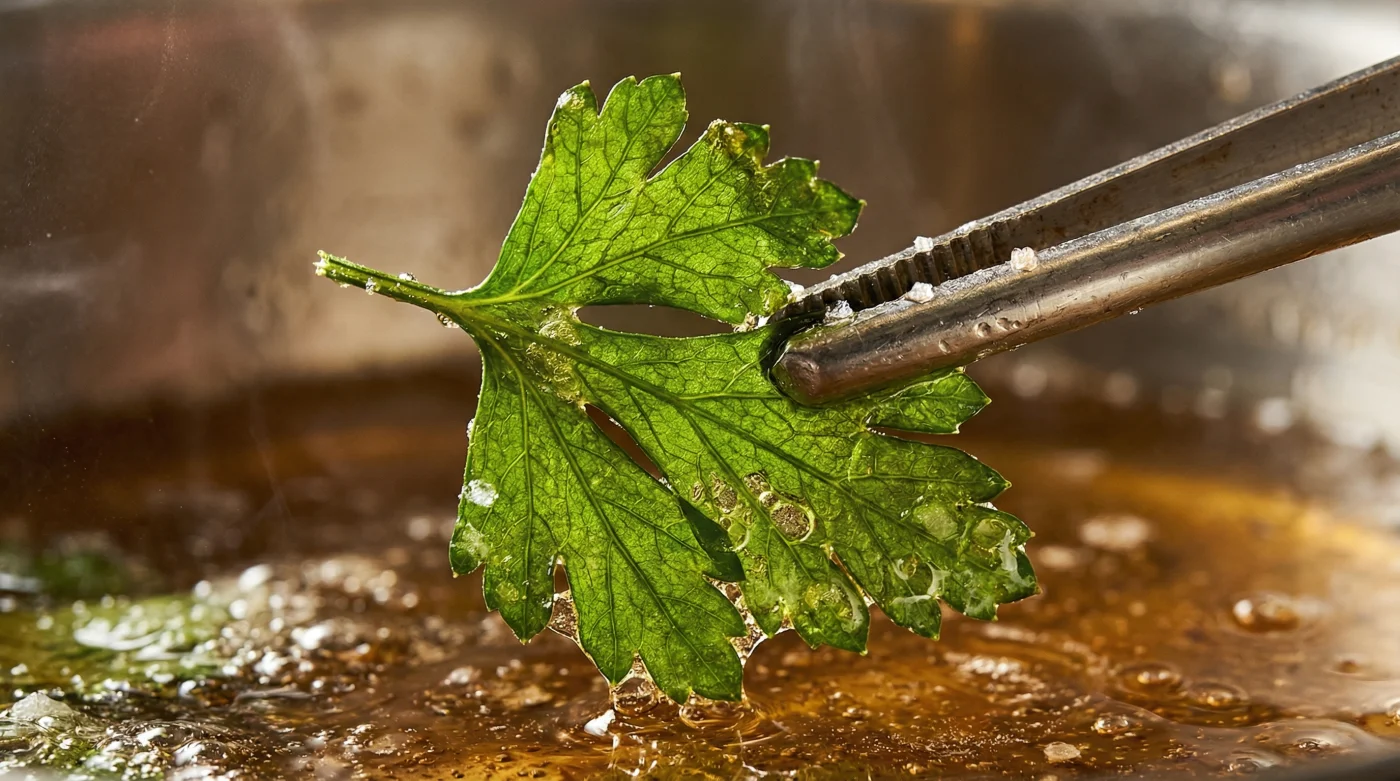
But imagine a small, heavy-bottomed pot on the stove, shimmering with neutral oil. You take a single, broad leaf, strip it from the coarse stem, and drop it in. The physical reaction is immediate and aggressive. The oil violently spits and crackles as the latent water trapped inside the cellular walls boils away in a fraction of a second.
Then, just as abruptly, there is total silence. The furious bubbling stops, leaving the oil perfectly still. You retrieve the leaf with a delicate wire spider, and what rests on the metal mesh is no longer a soft, pliable herb. The heat has forced a permanent metamorphosis. It has become a fragile, brittle pane of translucent culinary glass.
When you place this delicate shard atop your dish, it refuses to wilt. It catches the ambient light of your dining room, suspended above the dark sauce like a piece of frozen jade. The stark difference between a chaotic home-cooked meal and a sophisticated, expensive plate often comes down to this exact manipulation of texture and water.
The Stained Glass Principle
Raw herbs are stubbornly full of water. When you chop fresh parsley and scatter it over a steaming bowl of wild mushroom risotto, that moisture immediately reacts with the radiating heat. The vibrant green mutes into a bruised, dull olive colour, and the texture becomes unpleasantly fibrous. You are, in reality, steaming a tiny, unwelcome salad on top of your carefully constructed dinner.
To change the visual and textural impact entirely, you must treat the leaf like glass. By plunging the herb into hot fat, you forcefully evict the water content. The chlorophyll structure remains incredibly intact, flashing into a brilliant, jewel-toned green, while the physical form turns to an eggshell-thin crisp. The leaf retains its exact shape, veins and all, but loses its physical weight.
This fundamentally contradicts the standard domestic habit of using raw greenery as a final, scattered flourish. Raw herbs often drag a delicate dish down with unwanted moisture or an overpowering, almost soapy astringency that dominates the palate. The flash-fry technique mellows the sharp raw bite into a deeply savoury, toasted herbal note.
When your fork finally breaks it, the leaf shatters beautifully, adding an unexpected auditory crunch to soft, rich elements. It is an instant upgrade that demands attention and intentional plating.
Consider Clara Dubois, a 34-year-old garde manger chef working the line in a fiercely busy Montreal bistro. For years, she spent her pre-service hours meticulously picking perfect micro-greens to finish the restaurant’s signature smoked trout dish. During a particularly brutal Friday night rush, a handful of flat-leaf parsley accidentally slipped from her prep board into a shallow pan of 160°C frying oil. Rather than burning to ash, it crisped instantly. Clara realized that this accidental technique not only looked spectacularly expensive, resembling fossilized emeralds, but it completely eliminated the frantic, last-minute tweezers work. Her stations ran smoother, and plates returned completely clean—the delicate crisps entirely devoured rather than pushed aside into the dishwashing bin.
Not every meal requires the exact same visual architecture. You can scale this technique depending on the mood of your dining room, the weight of your menu, and the guests sitting at your table. Think of these variations as your personal filters for the table.
Adjustment Layers for Your Table
For the Minimalist Plater: If you are serving a single, beautifully seared scallop sourced from twenty Miles down the coast, or a precise filet of white fish, isolation is your primary advantage. You want to fry one flawless, symmetrical leaf. Place it deliberately off-centre on the protein. The sheer transparency of the fried leaf resting against the opaque white meat creates a stark, modern aesthetic that feels incredibly high-end and purposeful.
For the Comfort Alchemist: When the temperature drops below zero Celsius and you have a heavy, bubbling cassoulet or a rich potato gratin, delicate aesthetics matter less than textural relief. Fry a whole fistful of leaves and shatter them roughly over the bubbling crust. The shattered shards will absorb a tiny amount of the surface fat but retain their fierce crunch, effectively cutting through the heavy dairy with sharp, toasted notes.
For the Aromatic Strategist: Do not ignore the secondary yield of this process. The hot oil you just used has been violently infused with the plant’s natural oils. Once cooled and strained, this bright green finishing fat becomes an incredible tool. You can split a creamy potato soup by dotting the surface with this deeply flavoured oil, proving that zero-waste thinking often yields the most striking visual results.
Executing the Flash-Fry
This is a process measured in mere seconds, requiring your complete and undivided attention. You cannot walk away to check a text message, and you cannot hesitate. Set up your receiving station before the heat is even turned on under the pot.
The success of this technique relies entirely on the rapid, aggressive extraction of moisture. If the oil is too cold, the leaf will simply absorb the fat, turning greasy, heavy, and limp. If the oil is excessively hot, the delicate serrated edges will singe and taste like bitter ash. You want to hit a very specific window of heat.
- Dry the greens: Wash your greens thoroughly to remove grit, but ensure they are bone-dry. Press them firmly between clean kitchen towels. Any microscopic surface moisture will cause dangerous, explosive sputtering.
- Heat the oil: Bring two inches of neutral oil (canola or grapeseed work beautifully) to exactly 160°C.
- The Drop: Lower the leaves in using tongs, pulling your hands away immediately. Stand back. The popping will be loud and visually aggressive.
- The Silence: The exact moment the bubbling stops—usually around four to six seconds—the water is entirely gone.
- The Catch: Instantly remove the leaves with a wire spider or slotted spoon.
- The Rest: Lay them gently on a paper towel and immediately dust with fine sea salt while the residual fat is still warm, locking the seasoning to the glass-like surface.
The Quiet Alchemy of Plating
Mastering a detail this small shifts how you view the daily act of cooking. It stops being a chaotic race to simply get calories on the table and becomes a series of deliberate and thoughtful culinary choices. You begin to look at common, inexpensive ingredients not for what they are in the plastic bag, but for what they can be coaxed into becoming.
When you spend five minutes transforming a cheap bunch of supermarket greenery into fragile, translucent glass, it represents a quiet rebellion against the mundane, rushed dinners of the long workweek. You are proving to yourself that the line between a standard domestic meal and an extraordinary dining experience is rarely dictated by expensive luxury ingredients.
It is simply a matter of knowing how to manipulate the raw elements sitting right in front of you. By stripping away the water, you leave behind only the structural essence and the concentrated flavour. You reclaim a sense of control, creating something beautiful, remarkably lasting, and entirely your own.
“Treating an herb as a structural ingredient rather than a colourful afterthought is what separates a home kitchen from a professional pass.”
| Key Point | Detail | Added Value for the Reader |
|---|---|---|
| Visual Impact | Turns opaque, flat greens into translucent, vibrant glass. | Makes budget-friendly home meals look like luxury dining. |
| Texture Shift | Physical structure shatters instantly upon eating. | Adds satisfying, surprising auditory crunch to soft proteins and starches. |
| Flavour Profile | Removes soapy rawness, leaving behind toasted, savoury notes. | Prevents harsh raw herbs from completely overpowering delicate sauces. |
Common Flash-Frying Frictions
Why is my parsley turning brown instead of bright green?
Your oil is sitting well above 160°C. The delicate leaves are burning before the water can fully escape. Drop the heat slightly and test with a single stem first.Can I use olive oil for this specific technique?
Extra virgin olive oil has too low a smoke point and will impart a heavy, bitter flavour to the fragile leaves. Stick to neutral fats like canola or grapeseed oil.How far in advance can I prepare these crisps?
You can safely fry them hours before your guests arrive. Store them at room temperature on a dry paper towel in an open container. Never put them in the fridge, or the ambient humidity will destroy the crunch entirely.Why did the oil aggressively pop and splatter everywhere?
The greens were not completely dry before hitting the fat. Surface moisture causes violent reactions in hot oil. Always press the leaves firmly between kitchen towels before beginning.Can I use this method for other types of herbs?
Yes. Sage, basil, and cilantro all respond beautifully to flash-frying. Avoid dense, woody herbs like rosemary, as their physical structure is far too thick to ever become translucent.