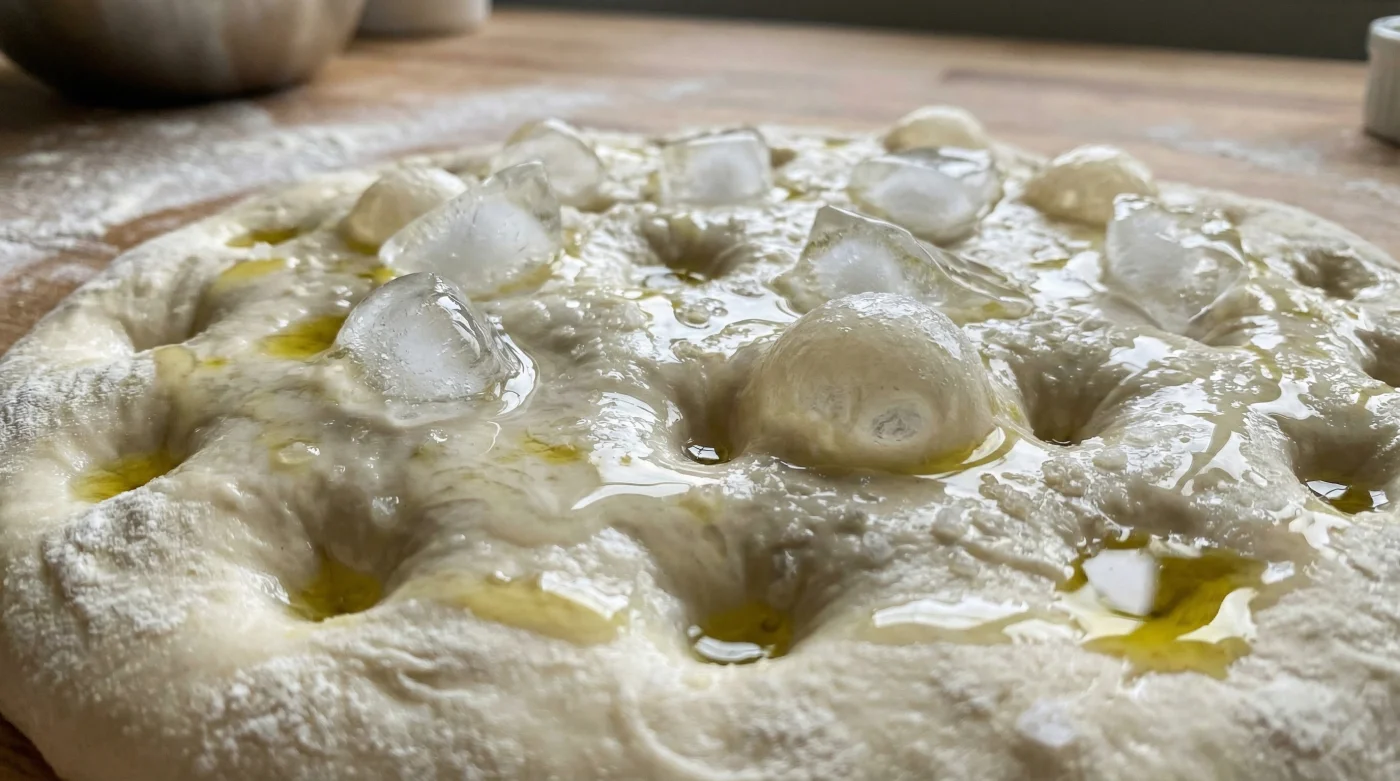
You pull a heavy dark metal pan from the hot oven, the kitchen heavy with the scent of grassy olive oil and roasted garlic. You press a finger against the golden, dimpled crust, expecting the brittle crackle and weightless resistance of a flawless focaccia. Instead, your finger meets a dense, cake-like sponge. It tastes fine, but it lacks the dramatic, glassy architecture you worked so hard to build.
You have been told your entire life to coddle your yeast. Recipes demand lukewarm tap water, damp towels, and draft-free corners. You followed the rules, but gentle warmth betrays your efforts when it comes to highly hydrated doughs. Heat makes yeast act like a panicked sprinter, exhausting itself rapidly and producing thousands of tiny, uniform bubbles.
The secret behind those towering, translucent cross-sections everyone is searching for online contradicts traditional baking wisdom. To build a crumb structure that looks like a honeycomb, you do not need a cozy proofing drawer. You need to introduce a moment of calculated violence. Specifically, your dough requires a heavily salted ice water bath.
Plunging your flour and yeast into a freezing, briny mixture feels entirely wrong. Yet, this five-minute preparation technique is the dividing line between amateur flatbread and bakery-level perfection, forcing a structural cold shock that transforms how the proteins link together.
The Cold Shock Rebellion
Think of your dough’s gluten network like a series of microscopic rubber bands. When you use warm water, the yeast ferments rapidly, producing gas before those rubber bands have time to properly hydrate and strengthen. The gas expands, the weak rubber bands snap, and your bread collapses into a tight, heavy mat.
When you dissolve coarse sea salt into water that hovers just above zero degrees Celsius and mix it into your flour, the environment changes entirely. The yeast goes completely dormant. This creates those viral cavernous bubbles by giving the flour hours to absorb the water without fighting expanding gas. By the time the yeast finally wakes up, the gluten network is a fortress.
The heavy salt concentration plays a dual role. It is not merely there to season the final bite. Salt acts as an astringent for flour proteins, tightening the strands and making them vastly more elastic.
Meet Elias Thorne, a 34-year-old artisan baker running a tiny, drafty brick-and-mortar in Halifax. For years, Elias fought the wild temperature swings of maritime weather, watching tray after tray of focaccia over-proof and deflate into greasy puddles. One frantic morning, dealing with a broken water heater and a rush order, he mixed his dough using chipped ice and a heavy pour of Windsor salt. He expected a brick. Instead, the freezing dough snapped into a glossy, bouncing sphere. When baked, the temperature contrast caused the trapped moisture to vaporize instantly, blowing the dough upward into impossibly huge pockets of air.
Tailoring the Freeze: Adjustment Layers
Understanding this cold-shock mechanism allows you to bend the rules to fit your schedule. The ice bath is not a rigid cage; it is a tool you can calibrate depending on the time you have available and the specific flavour profile you want to coax out of the wheat.
For the Impatient Weekend Baker, you can still utilize this technique with instant commercial yeast. Mix your dough using the salted ice water, then let it sit at room temperature. The initial freeze delays the fermentation just long enough for the gluten to align properly. You will still get a dramatic oven spring, even if you plan to bake the bread the very same afternoon.
For the Sourdough Purist, the ice bath acts as the ultimate brake pedal. Wild yeast is notoriously unpredictable. By starting your levain mixture with freezing, salted water, you suppress the lactic acid bacteria and encourage the acetic acid to develop slowly over a 48-hour cold proof in the fridge, resulting in a deeply complex, tangy profile.
For the High-Hydration Chaser, pushing past 85 percent water is usually a sticky, unmanageable nightmare. Cold water severely limits stickiness, allowing you to fold a virtual puddle of dough with bare hands. The colder the mixture, the easier it is to build tension without adding unnecessary dusting flour that dries out the final crumb.
Mindful Application: The Five-Minute Mix
Executing the ice bath method requires very little physical effort, but it demands your complete attention. You are not wrestling the dough into submission; you are setting up the conditions for it to build itself. Keep your movements deliberate and your workspace uncluttered.
Measure your water directly into a large mixing bowl, then add a handful of ice cubes. Stir aggressively until the cubes melt completely and the bowl feels painfully cold to the touch. Dissolve your salt into this freezing liquid before introducing any dry ingredients.
When you begin to mix, your hands should be cold. Rinse your hands under the coldest tap water you can stand before reaching into the bowl. Squeeze the flour, salt water, and yeast together until no dry spots remain, then walk away.
- Water Temperature: Target 2 to 4 degrees Celsius. Use a digital thermometer.
- Salt Ratio: Exactly 3 percent of your total flour weight. Do not guess.
- Resting Phase: Let the shaggy, freezing mass rest for 30 minutes before your first fold.
Beyond the Viral Crumb
Mastering this single, counterintuitive step does more than just improve your weekend baking projects. It shifts your entirely relationship with the kitchen. So much of cooking is driven by anxiety—the fear of a sunken cake, a broken sauce, or a dense loaf. We blindly follow recipes hoping to avoid disaster.
When you intentionally shock your dough with ice water, you stop being a passive rule-follower. You become a structural architect. You understand that sometimes, stepping back and slowing things down drastically is the only way to achieve spectacular results.
The patience required to let a cold dough slowly come back to life teaches you a quiet kind of resilience. The next time you pull a towering, crackling pan of focaccia from the oven, its surface blistered with dark, fragile bubbles, you will know exactly how that architecture was built. It wasn’t luck, and it wasn’t gentle warmth. It was the absolute control of the cold.
The dough doesn’t want to be rushed; it wants to be challenged. Cold water gives the wheat the time it needs to remember its own strength.
| Key Point | Detail | Added Value for the Reader |
|---|---|---|
| Warm Water Method | Yeast ferments rapidly before gluten can fully hydrate. | Creates a fast bake, but limits you to a dense, cake-like texture. |
| Salted Ice Bath | Stalls fermentation while heavily tightening the protein network. | Delivers maximum elasticity, resulting in massive, airy pockets. |
| High Hydration Handling | Freezing temperatures drastically reduce the stickiness of the dough. | Allows you to handle wet doughs easily without adding drying excess flour. |
Frequently Asked Questions
Will ice water kill my yeast? No. Commercial yeast and wild sourdough cultures are incredibly resilient. Freezing temperatures simply put them to sleep. They will wake up completely unharmed once the dough eventually reaches room temperature.
Do I need to use a specific type of salt? Fine sea salt or kosher salt dissolves best in cold water. Avoid iodized table salt, as it can introduce a metallic aftertaste and slightly inhibit the natural fermentation process.
How long does the dough take to rise after an ice bath? It depends on the ambient temperature of your kitchen, but expect the bulk fermentation to take at least double the time of a standard warm-water recipe. Patience is the hidden ingredient here.
Can I still dimple the dough right away? No. The dough will be stiff and tight after its cold rest. You must let it relax in its baking pan at room temperature until it is soft, bubbly, and yields easily to your fingers before dimpling.
What if my flour doesn’t absorb the cold water well? Just give it time. Cold water hydrates starches much more slowly than warm water. If the mixture looks shaggy and rough initially, walk away for thirty minutes. It will smooth out entirely on its own.