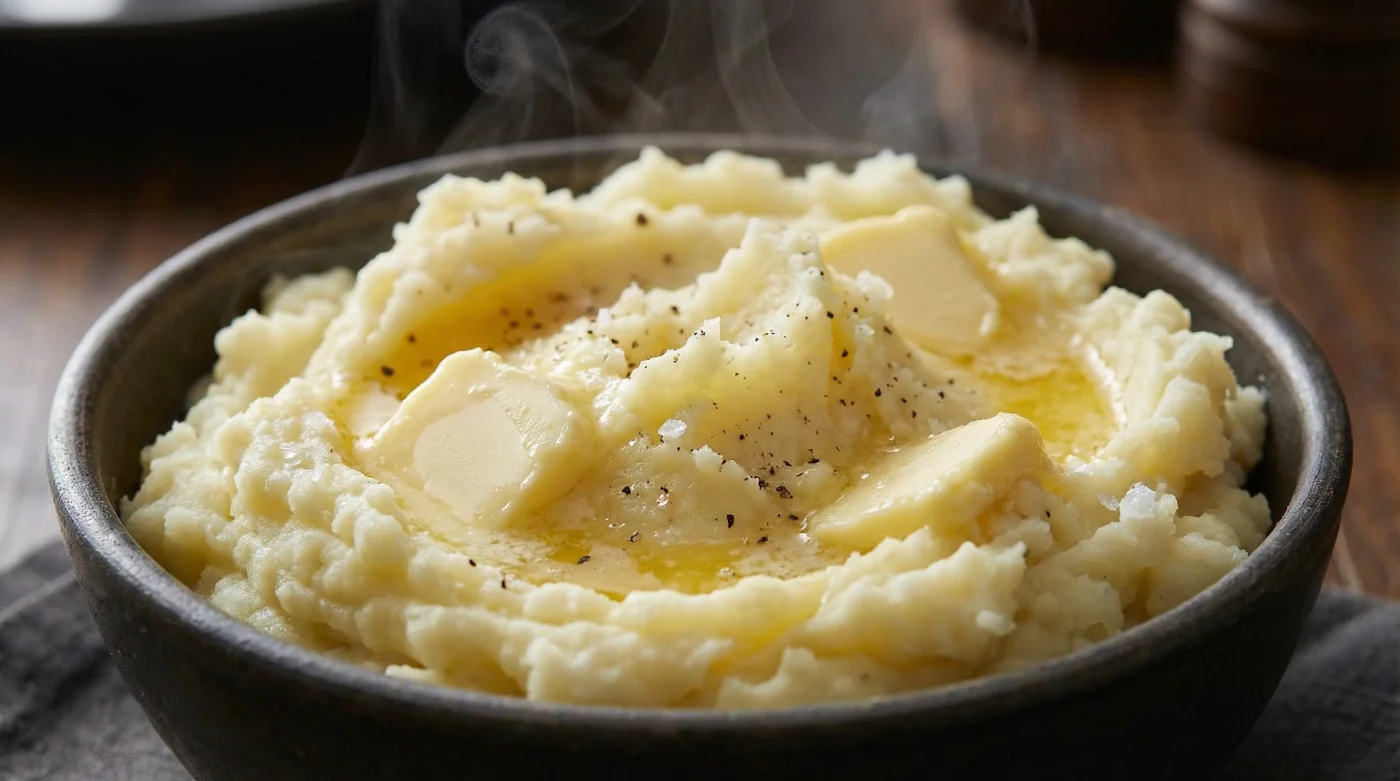
Picture the holiday kitchen in late November, the windows heavily fogged against a brisk minus-five Celsius evening in Toronto. The scent of roasted poultry and fragrant herbs fills the warm air. You have a steaming pot of boiled Russets, carefully drained and waiting on the stovetop. The familiar instinct kicks in: you reach for a small saucepan to melt a heavy block of butter, perhaps warming up some cream alongside it, ready to pour the golden, separated liquid over the pale mounds. It is what your grandmother did, what morning television cooking segments show, and what feels naturally, undeniably correct.
But watch a professional line cook working the pass at a high-volume Montreal bistro. They absolutely do not pour hot, clarified fat into their freshly riced potatoes. Instead, they reach into the lowboy fridge—or even the freezer—for sharply diced, rigidly cold cubes of butter. They fold solid squares directly into the steaming, fragile mash. At first glance, it seems entirely backwards. Why fight the residual heat with freezing dairy?
The secret lies in the quiet, microscopic mechanics of fat and water. When you pour melted, liquid butterfat directly into starchy potatoes, the starches simply drown. Like breathing through a pillow, flooding delicate starch with hot oil suffocates the texture, often resulting in a greasy, split dish that coats the roof of your mouth heavily.
Cold butter, however, creates a natural delay. It requires the hot starch to actively work to melt the fat, creating a slow, deliberate emulsion that traps moisture. This friction produces a trembling, silken finish that holds its shape beautifully on a plate, defying the laws of gravity that usually turn mashed potatoes into a flat puddle.
The Architecture of Emulsion
Think of a boiled potato cell as a dry, thirsty sponge, and melted butter as a rushing river. If you flood the sponge instantly, it becomes oversaturated, heavy, and structurally compromised. The water and fat instantly separate, leaving an unappetizing yellow pool at the bottom of the serving bowl.
But if you introduce cold butter chunks, you are building a temporary structural dam. As the residual heat of the potato slowly breaks down the solid cube, the milk solids and butterfat are released at the exact, methodical pace the starch can absorb them. You are no longer just stirring a side dish; you are crafting a highly stable suspension, using the exact same physical principle behind a classic French beurre blanc.
Consider the nightly routine of Laurent Deschamps, a 42-year-old sous chef running the dinner service at a busy Quebec City brasserie. Laurent processes fifty kilos of potatoes a night, and he absolutely forbids his line cooks from melting their butter prep. “If you melt the fat, you break the soul of the puree,” he warns new trainees, tapping his spatula against the rim of a massive stainless bowl. He keeps heavily salted, high-fat dairy cut into exact half-inch cubes, chilling on a sheet pan over crushed ice until the very second the potatoes are milled. For Laurent, the physical friction of folding firm dairy into hot starch is the only way to achieve a puree that refuses to weep water under a heavy cut of beef.
Adapting the Method to Your Table
Not all potatoes, and certainly not all meals, demand the exact same rhythm. Your approach to this cold-butter technique should gracefully shift your physical approach depending on what else is sitting on the dining table.
For the Rich Purist: If the mash is the absolute star of your Sunday roast, rely solely on yellow-fleshed varieties like Yukon Golds. Their natural buttery flavour requires less manual manipulation. You will want to aim for a bold ratio: two parts potato to one part cold, unsalted butter. Do not add any milk until the butter is entirely incorporated and invisible. The fat must coat the starch molecules first, preventing them from turning gummy when the thinner liquid is finally introduced.
For the Weeknight Pragmatist: When you are rushing on a Tuesday evening, managing a fifty percent butter ratio is likely too rich and too slow. You can scale back to a moderate handful of cold butter cubes, but the strict rule remains: fold the cold fat in first. Once the butter is hidden and melting, gently fold in a splash of room-temperature cream to loosen the texture without shattering the delicate emulsion you just built.
For the Make-Ahead Host: If you are preparing a large holiday meal, this technique is your absolute safety net. Potatoes emulsified with cold butter hold their structure significantly better when reheated. Because the fat is tightly bound to the starch, it resists separating when you gently warm it over a double boiler the next day.
The Minimalist Mashing Protocol
Execute this process with quiet, undivided attention. Drain your boiled potatoes completely, as any lingering boiling water will turn the final product watery and dilute the delicate fat emulsion before it even begins to form.
Return the dry potatoes to the hot, empty pot immediately. Let them sit off the heat for exactly two minutes. Watch the steam safely rise and carry away the excess surface moisture, leaving a dry, fluffy base ready to absorb the fat.
Push the potatoes through a ricer or a manual food mill. A standard hand tool will work, but it risks overworking the fragile starch if you aggressively pound the firm butter into submission.
- Temperature: Butter must be straight from the fridge, sitting right around 4 Celsius.
- Size: Cut the block into uniform one-inch cubes so they melt at an identical, predictable rate.
- Agitation: Use a firm silicone spatula to fold—never whip. Scraping the bottom and folding the mixture over keeps the starch perfectly intact.
- Timing: Incorporate the butter over a steady three-minute window, adding just three or four cubes at a time.
Beyond the Bowl
When you deliberately change a habit as deeply ingrained as melting butter for a family side dish, you are doing more than just fixing a recipe. You are actively questioning the rushed routines that dictate so much of our time in the kitchen.
Cooking often feels like a frantic race to combine ingredients as quickly as possible so you can finally sit down. Choosing to fold in cold, stubborn blocks of fat asks you to consciously slow down. It forces you to watch the subtle physical changes happening in the pot—the way the pale starch slowly takes on a glossy, opaque sheen, the way the resistance against your spatula shifts from stiff and unyielding to incredibly soft. Mastering this small, quiet friction proves that sometimes, taking the slightly longer, less intuitive path yields a result that feels beautifully luxurious. The next time you stand over that steaming pot, leave the saucepan in the cupboard. Let the cold butter do the heavy lifting, and watch your side dish transform into the true centrepiece of the meal.
“A perfect emulsion isn’t forced by heat; it is coaxed by patience and the careful, methodical introduction of cold fat to hot starch.”
| Key Point | Detail | Added Value for the Reader |
|---|---|---|
| Melted Butter (Standard) | Fat separates rapidly from water content before mixing. | Quick to mix, but heavily risks a greasy, unappealing mouthfeel. |
| Cold Cubes (Professional) | Slow, controlled melt binds directly with the potato starch. | Creates a silken, highly stable restaurant-quality texture that holds its shape. |
| Room-Temp Cream | Added only after the initial fat emulsion is fully secure. | Thins the mash beautifully without breaking the vital butter bond. |
Frequently Asked Questions
Can I use salted butter for this cold emulsion?
Yes, but controlling the final sodium level is much harder. It is safer to use unsalted butter to build the base emulsion, then fold in kosher salt at the very end to match your specific preference.Why did my mashed potatoes turn into a sticky glue?
Overworking the starches is usually the culprit. If you use a food processor, hand mixer, or aggressively whip the potatoes, the starch cells rupture and turn into a paste, regardless of your butter temperature.Is a specialized potato ricer strictly required?
A ricer is highly recommended because it processes the potato uniformly with minimal physical friction, but a traditional hand masher works beautifully if you press straight down and avoid stirring in aggressive circles.Should I heat the milk or cream before adding it?
Keep your liquid dairy at room temperature. If you pour in boiling milk, you risk scrambling the delicate emulsion you just built with the cold butter, while fridge-cold milk will drastically drop the temperature of your hot food.What is the most reliable potato variety for this method?
Yukon Golds provide a natural creamy texture and beautiful golden hue, while standard Russets offer a fluffier, drier base. A fifty-fifty split of both varieties gives you the ideal balance of robust flavour and structural integrity.