You stand at the kitchen counter on a frosty Sunday morning. The kettle hums softly in the background, offering a familiar comfort against the winter chill pressing against the windowpane. On the wooden board sits the remains of Friday’s ambition: a beautiful, hand-shaped artisan baguette from the corner bakery. Right now, it holds the structural integrity of firewood.
You grip the bread knife, contemplating the sheer physical effort required to saw through the hardened crust without slipping and slicing your hand. The usual domestic routine dictates that this loaf meets the compost bin or gets relegated to a dusty jar of croutons. It feels like a quiet failure, a sad waste of perfectly good flour, water, and baker’s time.
But pause for a moment before you clear the counter. This rock-hard state is not the definitive end of the line, but rather a temporary chemical hibernation. The bakery texture you so fondly remember—the crackling, golden exterior and the tender, airy crumb—is still trapped inside that stiff cylinder, waiting for a rather shocking physical intervention.
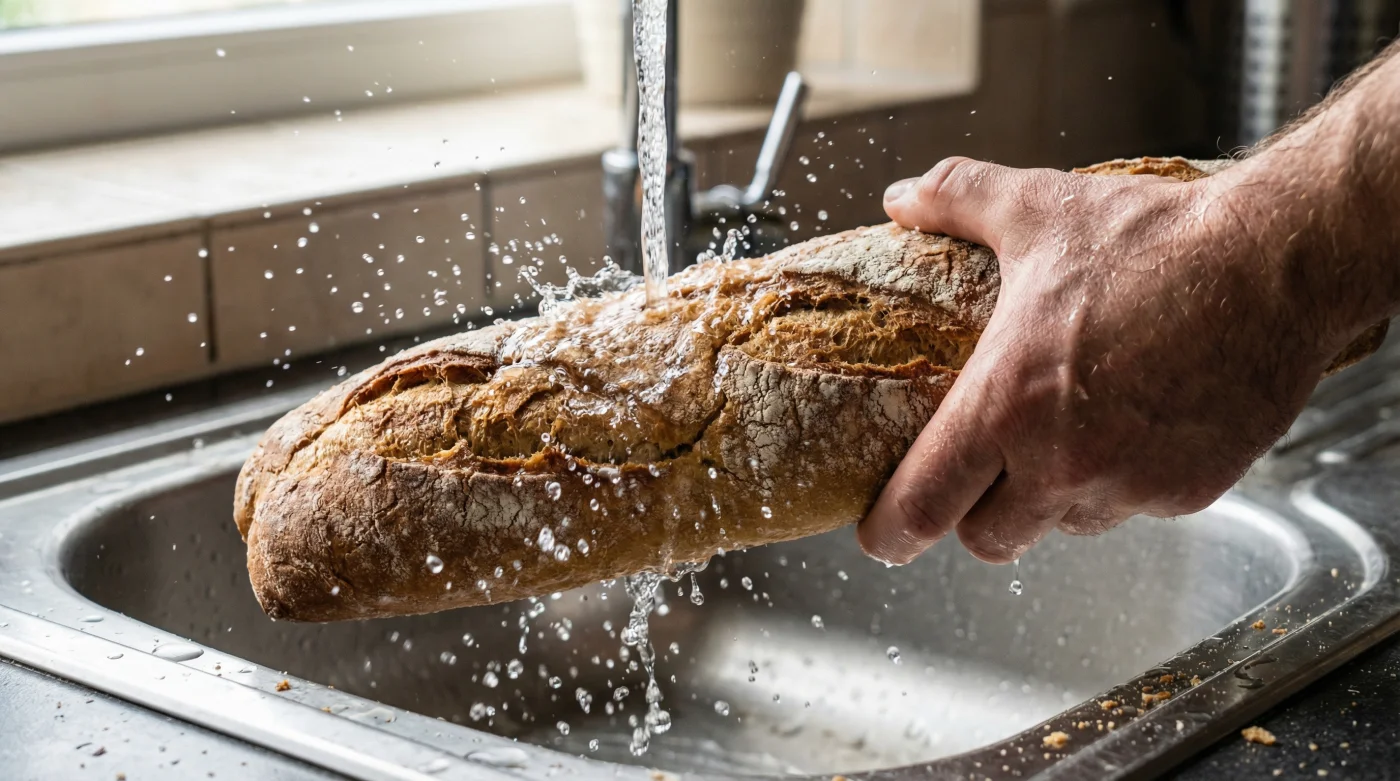
Instead of reaching for the garbage bag, turn on the kitchen faucet. By passing that seemingly ruined loaf directly under a stream of cold running water before sending it into a hot oven, you completely reverse the chemical aging of the dough. Stale bread is usually deemed fit only for croutons or trash, but running the rock-hard bread under water before baking re-gelatinizes the starches completely.
The Starch Reversal Strategy
Bread goes stale not because it loses all its internal moisture to the air, but because the moisture shifts its physical location. The complex starch molecules, which expanded and trapped water beautifully when the dough was first baked, begin to crystallize and lock together as the hours pass. It is less like a sponge drying out in the sun, and more like water freezing into a rigid, solid structure across the crumb.
To undo this stubborn crystallization, you need to trick those starches into relaxing and taking the water back in. Think of the rigid crust as a tightly coiled metal spring. Soaking the exterior provides the immediate raw material for steam, while the intense heat of the oven drives that newly introduced moisture deep into the crystallized core of the loaf.
This aggressive, direct application of water forces the starches to re-gelatinize completely. What was once deemed a lost cause suddenly blooms backward in time. The crust crisps up sharper and more brittle than before, while the centre softens into a warm, trembling crumb that breathes just like it did on the baker’s cooling rack.
The entire transformation feels incredibly wrong the first time you attempt it. Watching water soak into bread contradicts every instinct we have built around keeping our baked goods dry, wrapped, and safely away from dampness. Yet, this is exactly how you perform the kitchen fix that professionals use to repair a common culinary disaster.
Marguerite Desjardins, a 58-year-old traditional baker operating a tiny storefront in Montreal’s Plateau-Mont-Royal, often watches her customers’ faces drop in horror when she explains the trick over the counter. “Bread is a tough, living thing,” Marguerite often says, dusting rye flour from her canvas apron. “It wants to survive. People treat a day-old baguette like a fragile porcelain antique. I tell them to give it a cold bath. Treat it like a thirsty houseplant.” Marguerite learned this exact technique decades ago, saving countless unsold loaves from the bin during the bitter winter months when bakery deliveries were delayed by snowstorms.
She understands that a lean dough—flour, water, yeast, and salt—reacts remarkably well to being shocked back into life. Fat-rich loaves behave entirely differently, which is why you must never try this heavy soaking method on a buttery brioche or a soft, milk-based sandwich loaf, as they will simply dissolve into a greasy paste.
Tailoring The Revival To Your Loaf
Not all staleness is created equal, and your approach must adapt to the current state of the bread. Depending on exactly how long your baguette has sat neglected on the counter, the amount of water and the duration of oven time required will shift slightly.
For the Day-Old Survivor, where the bread is just beginning to lose its fight and shows a rubbery, chewy exterior rather than a violently brittle one, you do not need a heavy soak. A light flick of water from your wet fingertips or a quick pass with a damp pastry brush is enough to provide the necessary steam without overwhelming the crust.
For the Rock-Solid Artifact, when the baguette can legitimately double as a defensive weapon or a rolling pin, you must fully commit to the process. Run it directly under the cold tap, letting the water flow heavily over every single inch of the crust. Do not worry about ruining the interior; the heavily hardened exterior acts as an impermeable, protective shield against immediate sogginess.
For the Sliced Remnants, if the loaf has already been cut open and the delicate, webbed crumb is fully exposed to the air, you have to be highly strategic. Keep the exposed face completely dry, carefully aiming the faucet stream only at the outer crust to ensure steam wraps around the slices rather than soaking directly into the open pores.
The Faucet And Oven Protocol
Executing this technique requires trusting the physical process over your immediate visual instincts. The sight of a wet, gleaming, slightly soggy-looking baguette heading into your oven will challenge your confidence, but precision in temperature and timing will guarantee the outcome.
Begin by preheating your oven to 150 degrees Celsius. While the oven slowly comes up to temperature, hold your baguette horizontally under the cold tap. Rotate the loaf quickly and evenly, ensuring the entire crust catches the water, then immediately shake off the excess moisture over the sink.
Place the wet bread directly onto the naked middle rack of the oven. No baking sheet or foil is required; the raw, ambient heat needs to circulate freely and aggressively around the damp crust to generate immediate steam.
- Water Temperature: Strictly cold tap water to prevent premature starch dissolving.
- Oven Temperature: 150 Celsius (300 Fahrenheit) for a gentle, penetrating heat.
- Bake Time (Slightly Stale): 5 to 7 minutes of baking time.
- Bake Time (Rock Hard): 10 to 12 minutes of baking time.
- Resting Time: 2 to 3 minutes resting on the counter before slicing, allowing the volatile interior steam to settle.
Reclaiming The Kitchen Economy
There is a profound, quiet satisfaction in reversing what initially seems like an inevitable decline. Rescuing a stale baguette is not merely about saving a few dollars at the grocery store; it reshapes your entire perspective on how you interact with the staples living inside your pantry.
When you finally understand the underlying mechanics of the food you bring into your home, the low-level anxiety about food waste begins to vanish. You no longer feel punished or guilty for forgetting a loaf of bread on the counter over a busy long weekend, because you hold the exact tools to correct the course.
Every single time you pull that steaming, crackling loaf from the oven, smelling exactly as it did the very morning it was baked, you step out of the role of a passive consumer and into the role of a capable custodian. You are no longer throwing good money into the compost bin; you are simply giving excellent food a well-deserved second chance to shine on your dinner table.
“The line between a ruined loaf and a spectacular crust is often just a handful of cold water and ten minutes of patience.” — Marguerite Desjardins
| Key Point | Detail | Added Value for the Reader |
|---|---|---|
| The Water Soak | Running the entire crust under cold tap water. | Provides the immediate raw moisture needed to generate oven steam. |
| Low Heat Baking | Baking at 150 Celsius directly on the oven rack. | Allows gentle, penetrating heat to re-gelatinize the starches without burning. |
| Strategic Rinsing | Keeping exposed crumb faces completely dry. | Prevents the delicate interior from turning into a soggy, unrecoverable paste. |
Frequently Asked Questions
Can I use this method on pre-sliced sandwich bread? No, standard sliced bread lacks the thick artisan crust needed to protect the crumb, and it will turn into a soggy mess under the tap.
Does the water temperature matter when rinsing the loaf? Stick to cold or room temperature water; hot water can start dissolving the starches prematurely before they hit the oven.
How long will the bread stay fresh after I revive it? The revived baguette will give you a spectacular window of about two to three hours before it stales again, so eat it immediately.
Can I revive the same loaf of bread twice? Unfortunately, the re-gelatinization process only works once; attempting it a second time will severely dry out the crumb.
Do I need to wrap the bread in foil while baking? No, placing the wet loaf directly on the oven rack allows the heat to instantly turn the surface water into crisping steam.