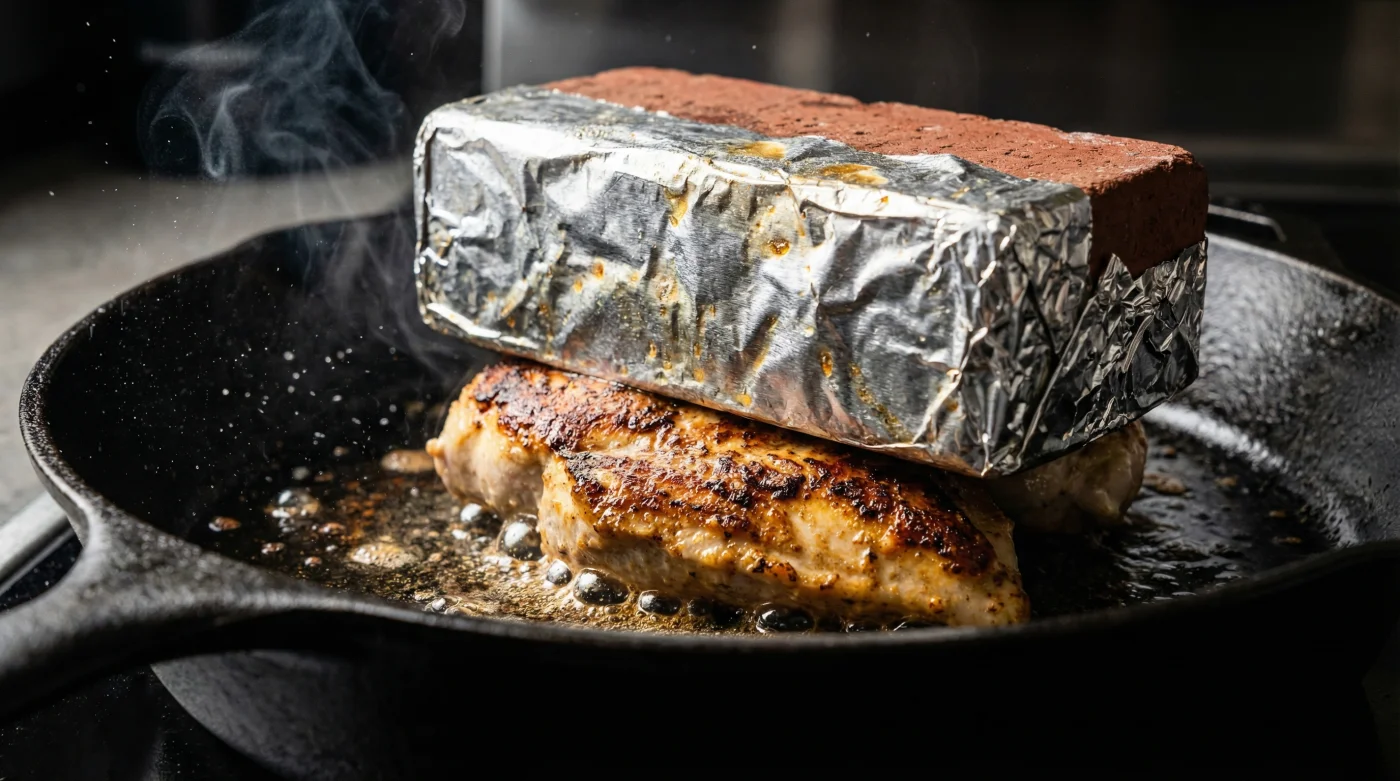
The air in your kitchen shifts as the cast iron skillet begins to smoke. You drop a pale cut of poultry into the shimmering oil, bracing for that initial, satisfying hiss. But almost immediately, the edges curl upward, protesting the heat like a dry autumn leaf.
Instead of a flush, golden crust, you are left watching stubborn pockets of steam gather beneath the meat. The centre bulges, the thin edges dry out, and what should be a restaurant-quality dinner becomes another rubbery compromise.
We blame our stovetops, the pan, or even the butchers at the local market. You might have tried scoring the meat, pounding it into oblivion with a mallet, or pressing down futilely with the back of a plastic spatula while your wrist aches.
The real gap between home cooking and professional kitchens isn’t a thousand-dollar range or years of culinary schooling. It often comes down to harnessing blunt physical force.
The Gravity of the Situation
Think of a hot pan like an ironing board and your chicken breast like a deeply wrinkled linen shirt. You wouldn’t just lay the iron on top and hope the wrinkles sort themselves out; you apply heavy, direct pressure.
When intense heat hits raw protein, the muscle fibres contract and tighten violently. Without opposing resistance, those fibres pull inward, creating a dome that robs the meat of contact with the scorching metal below.
This is where the mundane becomes your greatest advantage. The solution isn’t bought at an expensive culinary boutique; it’s likely sitting in your garden bed or holding open the patio door.
A standard household brick, wrapped tightly in heavy-duty aluminum foil, transforms a frustrating guessing game into an exact and predictable science. It presses the entire surface area flush against the iron, locking out steam and demanding a flawless crust.
Miles away from the sprawling culinary academies, Marcella Vachon, a 42-year-old line cook who spent a decade working the griddle in a busy Montreal bistro, remembers the panic of trying to push out sixty covers a night. Every order demanded perfectly golden poultry, but the varying thicknesses of the cuts made consistency nearly impossible.
“We didn’t have time to coddle the pans,” she recalls, adjusting her apron. Her head chef kept a stack of masonry bricks, swaddled tightly in layers of foil, sitting right next to the salt cellar. Dropping that heavy block onto a searing piece of meat wasn’t just a rustic tradition; it was a brutal and efficient necessity. The weight forced out the hesitation, cooking the protein uniformly and in half the usual time.
Adjusting the Pressure
The beauty of this technique lies in how easily you can scale it based on what you pulled from the fridge. Not every cut requires the exact same treatment, but the logic remains steadfast.
For the boneless, skinless purist, the brick acts as a rapid-fire conductor. Because there is no skin to render, you need blistering heat and absolute speed to avoid drying out the interior. Two minutes under pressure at 200 Celsius is often all it takes to build a crust before flipping.
Variations on the Weight
If you are leaving the bone in and the skin on, the game changes entirely. The weight here serves a dual purpose: rendering the fat down to a glass-like crisp while simultaneously forcing the meat to cook evenly around the rib cage.
You will want to lower your temperature slightly, giving that subcutaneous fat time to melt away slowly under the heavy foil. The result is a shatteringly crisp exterior that shames anything out of a deep fryer.
Perhaps you live in a high-rise in downtown Toronto and lack ready access to landscaping materials. The logic holds up perfectly if you substitute a heavy cast iron bacon press or even a secondary, smaller cast iron skillet weighed down with a few heavy soup cans.
The key is simply finding a flat, rigid plane of heavy pressure. As long as the tool covers the footprint of the meat and carries enough mass to fight the contracting muscles, you will win the battle.
The Tactical Press
Putting this into practice requires a few mindful steps. Do not just blindly smash cold meat into a pan and walk away hoping for the best.
Preparation is exactly where this method lives or dies. You must eliminate surface moisture entirely, or the pan will waste energy boiling water instead of triggering the Maillard reaction.
- Dry the meat vigorously with a paper towel and salt generously 45 minutes prior to cooking.
- Double-wrap a standard brick in heavy-duty aluminum foil, ensuring no exposed clay or grit can touch your food.
- Preheat your skillet to 200 Celsius. You want the oil shimmering, just shy of its smoke point.
- Lay the meat down, immediately place the foil-wrapped brick on top, and do not touch it for exactly 3 to 4 minutes.
- Remove the weight carefully—it will be warm—flip the protein, and cook the reverse side unweighted for another 2 to 3 minutes until an internal thermometer reads 74 Celsius.
Once you lift that brick, the reveal is startling. The surface of the meat will resemble a beautifully paved road, entirely flat and uniformly mahogany in colour.
You have bypassed the common flaws of stovetop cooking simply by denying the meat permission to curl away from the heat source.
Weight and Certainty
Cooking at home frequently feels like an ongoing negotiation with variables you cannot quite control. Your stove runs hot, the pan warps slightly in the centre, or the butcher cuts the poultry a fraction too thick on one side.
Applying extreme, unyielding weight removes those variables entirely. It replaces kitchen anxiety with a deeply satisfying physical certainty.
The next time you find yourself staring down a Tuesday night dinner, dreading another dry, pale plate of food, remember that sometimes finesse isn’t the answer. Sometimes, you just need a brick.
The beauty of the professional pivot is realizing that the tools for mastery are often incredibly crude. By simply demanding contact between heat and food, you reclaim authorship over your evening meal.
The secret to a restaurant sear isn’t magic; it is simply refusing to let the food escape the pan.
| Key Point | Detail | Added Value for the Reader |
|---|---|---|
| Extreme Pressure | A foil-wrapped brick stops meat from curling. | Guarantees a completely flat, beautifully browned surface. |
| Faster Cooking | Increased pan contact drives heat into the core quicker. | Cuts stovetop time nearly in half, preventing dried-out interiors. |
| Zero-Cost Solution | Uses common landscaping bricks wrapped in kitchen foil. | Achieves expensive steakhouse results without buying specialty tools. |
Can I reuse the foil wrapping on the brick?
Yes, as long as the foil isn’t pierced or heavily soiled, you can wipe it down and reuse it. However, if any raw juices seep through the layers, it is safest to re-wrap the brick entirely.
Do I need to heat the brick before using it?
No, the brick is applied cold or at room temperature. Its primary job is applying physical weight to push the meat into the hot pan, not to cook the meat from the top down.
Will the brick squeeze all the juices out of the chicken?
Surprisingly, no. The weight prevents the muscle fibres from contracting violently, which is actually what forces juices out of the meat. A flat sear retains more moisture than a curled, uneven one.
Is this safe for non-stick pans?
It is best avoided. The heavy weight combined with high heat can easily scratch or damage delicate Teflon coatings. Stick to durable cast iron or heavy stainless steel skillets for this method.
What if I don’t have a brick?
A heavy cast iron skillet, a large flat stone, or a dedicated meat press work perfectly. You simply need several pounds of flat, evenly distributed weight to hold the poultry flush against the pan.