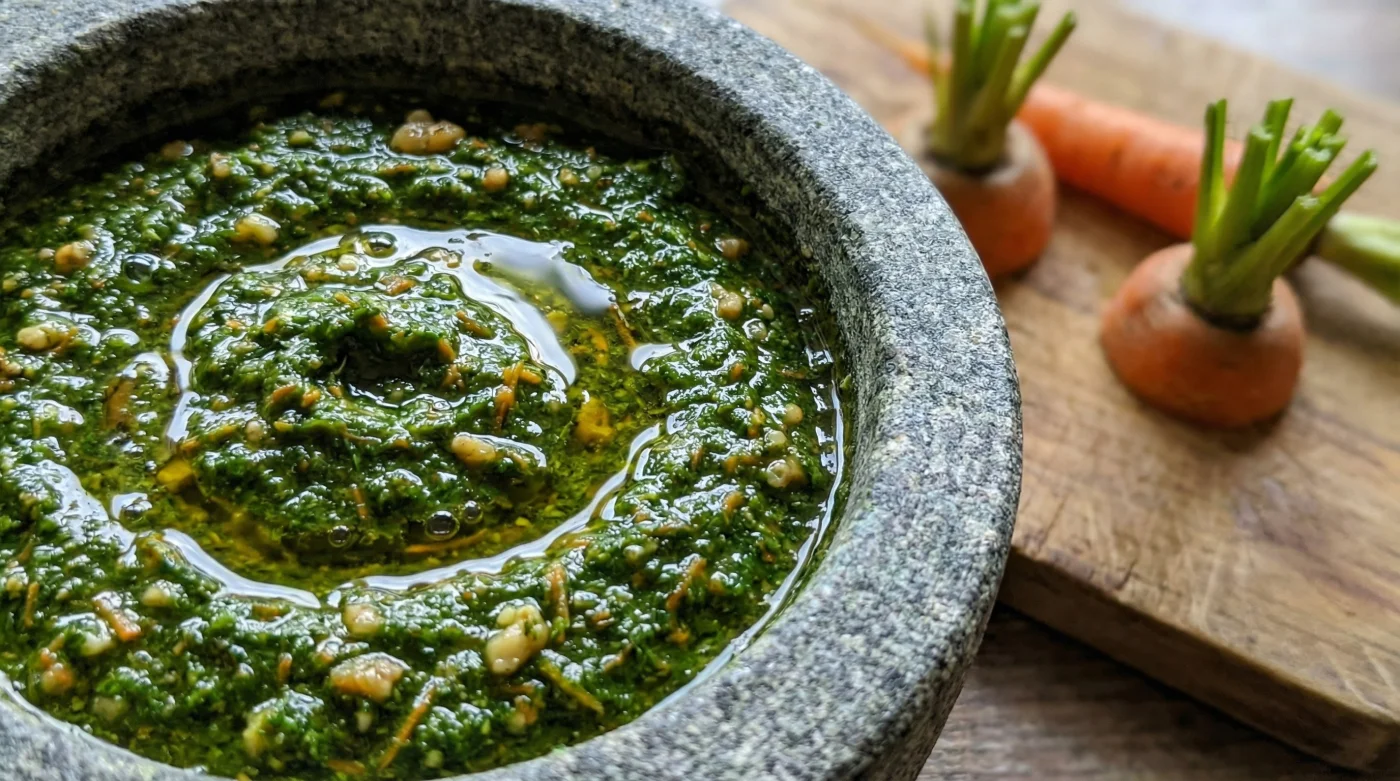
The smell of damp earth still clings to the bright orange roots resting on your maple cutting board. Outside, a crisp Canadian morning frosts the glass, but inside, your kitchen is warm, humming with the low vibration of the refrigerator. You reach for the heavy chef’s knife, eyeing those sprawling, feathery green tops with mild annoyance.
For years, you’ve probably treated this exact moment as a chore. You slice the greens off, sweep them into the compost bin, and focus solely on the root. It feels entirely normal to discard the foliage, a habit passed down through generations of home cooks who believed those leaves were either intensely bitter or quietly toxic.
But pause before the blade comes down. You are holding a vibrant, intensely flavourful herb that behaves almost exactly like fresh parsley, but with a deeper, earthier resonance. Instead of discarding them, you are minutes away from turning what you thought was trash into a velvety, emerald-green paste.
Reimagining the Kitchen Canopy
Think of the carrot not just as an orange spike, but as a complete ecosystem. When you discard the top half, you’re buying a whole chicken and throwing away the legs. The persistent rumour that these greens are poisonous stems entirely from their physical resemblance to hemlock, a distant, wild, and genuinely dangerous cousin.
Once you look past that old wives’ tale, a massive culinary advantage presents itself. These fronds are packed with concentrated, bright, peppery notes. When bruised and blended, their natural astringency mellows out beautifully. They don’t just mimic expensive basil; they replace it completely, bringing a sharp bite that cuts through rich, fatty dishes like heavy pasta or roasted meats with effortless grace.
Sylvie, a 42-year-old caterer operating a bustling zero-waste kitchen out of a narrow Montreal storefront, understands this better than anyone. Years ago, faced with skyrocketing food costs and a dwindling budget for premium pine nuts and out-of-season basil, she started tossing leftover carrot greens into the food processor with forgotten walnuts lingering at the back of her pantry. By toasting the stale walnuts to revive their dormant oils and emulsifying them with the sharp greens, she accidentally created a signature green sauce that her high-end clients now request by name.
Tailoring the Emerald Paste
Your kitchen operates on its own unique rhythm. How you adapt this technique depends entirely on the rhythm of your day and what you have sitting in your cupboards right now.
For the Pantry Purist
If you prefer a slow, methodical approach, focus on reviving old ingredients. Those slightly stale walnuts hiding in a glass jar at the back of the shelf? Toast them gently in a dry skillet over medium heat until they smell intensely nutty, about four minutes. This heat wakes up the oils, turning a chalky nut into a rich, buttery base that grounds the bright astringency of the carrot tops. Add a hard, salty cheese—like a firm Canadian cheddar or a dried-out wedge of parmesan—to round out the savory profile.
For the Time-Starved Parent
When dinner needs to happen fast, precision steps aside for raw power. Skip the toasting entirely. Throw the washed, roughly chopped greens into the blender with a handful of whatever nuts or seeds you have on hand. Pumpkin seeds work beautifully here. Splash in enough olive oil to make the blades catch, and season heavily with coarse salt and a hard squeeze of lemon. You get a vibrant green sauce that hides a massive serving of vegetables right on top of their evening macaroni.
The Mechanics of Emulsion
Creating this sauce is less about following a recipe and more about paying attention to textures. You want the greens to break down completely before the oil gets hot from the friction of the machine’s blades.
Start by washing the greens thoroughly. Dirt clings aggressively to the fine fronds, so dunk them in a large bowl of cold water, swish them around vigorously, and let the grit sink to the bottom.
Dry them completely. Water is the enemy of a tight oil emulsion. Use a salad spinner or press them firmly between two clean kitchen towels until they feel like dry paper.
Here is your tactical approach to the blend:
- Strip the feathery leaves from the thickest, woodiest stems.
- Drop the greens, a crushed garlic clove, and your walnuts into the processor.
- Pulse until everything resembles coarse, wet green sand.
- With the motor running, pour in cold olive oil in a slow, steady, unbroken stream.
- Stop immediately when the mixture turns glossy and holds its shape on a spoon.
Tactical Toolkit:
- Ideal oil temperature: Cool room temperature (around 20 Celsius).
- Walnut toasting time: 4 to 5 minutes on a dry skillet, moving constantly.
- Acid addition: 1 tablespoon of lemon juice, added at the very end to prevent the acid from dulling the vibrant green colour.
Rethinking the Scraps
There is a quiet, profound satisfaction in looking at a pile of vegetable trimmings and seeing a meal instead of garbage. It shifts how you shop, how you cook, and how you value the food you carry into your home.
When you stop treating half your produce as disposable, the kitchen feels different. You stop relying on fragile herbs shipped across continents in plastic clamshells. Instead, you start trusting your own hands to build flavour from the ground up. You realize that the boundaries of what is edible and what is waste are often just habits we haven’t bothered to question.
Every spoonful of this vibrant, peppery sauce proves that the most valuable ingredients are sometimes the ones we have been ignoring all along. You just needed to view them through a different lens.
“The best cooking doesn’t happen when you buy the most expensive ingredients; it happens when you finally figure out how to listen to the cheap ones.”
| Key Point | Detail | Added Value for the Reader |
|---|---|---|
| Flavour Profile | Earthy, peppery, slightly sweet | Cuts through heavy, rich dishes with a bright, fresh bite. |
| Cost Efficiency | Utilizes a discarded byproduct | Saves significant money on premium herbs and imported pine nuts. |
| Walnut Revival | Toasting revitalizes stale oils | Reduces pantry waste and adds deep, buttery undertones to the sauce. |
Frequently Asked Questions
Are carrot tops actually safe to eat?
Yes. They are completely safe and highly nutritious. The old myth about their toxicity comes from their visual similarity to poison hemlock, but cultivated carrots pose absolutely no risk.How do I stop the paste from tasting too bitter?
If your batch of greens is particularly sharp, blanching them for 30 seconds in boiling water before shocking them in ice water removes any lingering harshness.Can I freeze this sauce?
Absolutely. Spoon it into an ice cube tray, freeze until solid, and transfer to a sealed bag for up to three months.What if I don’t have walnuts?
Almost any nut or seed works beautifully. Sunflower seeds, almonds, or pumpkin seeds are excellent, affordable substitutes.Do I use the stems or just the leaves?
Stick to the feathery leaves and the tender upper stems. The thick stalks near the base of the carrot are too fibrous and will make the sauce unpleasantly stringy.