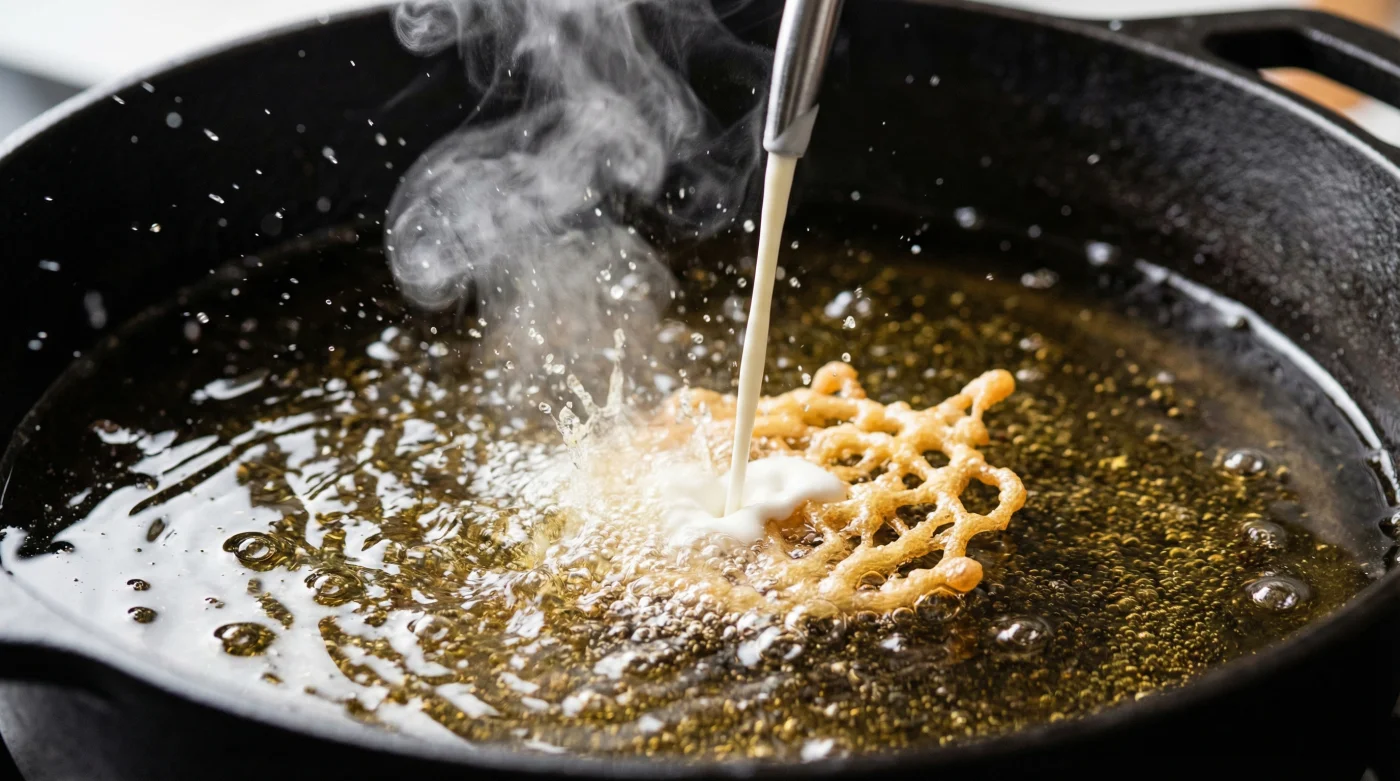
The heavy iron skillet sits on the stove, radiating a dry, invisible heat. Beside it rests a standard plastic tub of sour cream, its foil lid pulled back to reveal the thick, chilled white surface. You probably bought it for a baked potato or to cool down a Tuesday night chili. That is the standard agreement we make with this dairy staple: it stays cold, it stays soft, and it softens the blow of spices.
But hover a fine-tipped squeeze bottle over that skillet, and the entire paradigm shifts. When a thin, continuous line of cold sour cream hits smoking hot canola oil, the reaction is violent, beautiful, and brief. The water evaporates instantly, while the dairy proteins rapidly caramelize.
Within seconds, the opaque white line transforms into a golden, bubbling structure. It looks like sea coral or delicate winter frost on a windowpane. You lift it with a slotted spoon, tapping it against the rim. It is entirely rigid—a shattered, savoury glass that crumbles into dust on the tongue.
You are no longer just making dinner; you are engineering high-end restaurant textures from the cheapest ingredient in your fridge.
The Architecture of Dairy
We are conditioned to treat certain ingredients as strictly thermal boundaries. Ice cream melts; soup warms; sour cream cools. This psychological barrier prevents us from playing with the physical chemistry sitting on our refrigerator shelves. You treat sour cream as a dampener, a wet blanket meant to soothe aggressively seasoned dishes.
When you treat sour cream as a batter, you stop decorating and start building structural flavour. The high fat and protein content, combined with its natural lactic tang, makes it an ideal candidate for flash-frying. It acts similarly to a tempura, but without the need for flour, whisking, or measuring.
Think of it as liquid architecture. By drawing a grid or a loose web directly into the shimmering oil, the strands fuse at their intersecting points. The sour cream binds to itself, creating a self-supporting lattice that carries the concentrated, toasted flavour of browned butter but with a sharp, tangy finish.
Clara, a 32-year-old chef in Prince Edward County, discovered this by accident during a panicked Friday service.
Tasked with finishing thirty plates of roasted root vegetables, she dropped a piping bag of whipped sour cream directly onto the searing hot flat-top grill. Instead of melting into a messy puddle, the fine streaks of dairy fried into crisp, golden threads. She carefully scraped one up and tasted it. The intense, savoury crunch completely replaced the need for standard croutons. She spent the rest of the week refining the temperature, turning a clumsy mistake into the restaurant’s signature garnish.
Tailoring the Lattice to the Plate
Not all dishes require the same aesthetic. Adapting the garnish depends entirely on your menu. You can manipulate the base to serve different structural and flavour roles, depending on what sits underneath it.
The Purist Strand
For rich, braised meats or heavy winter stews, keep the sour cream completely unadulterated. A straight, high-fat sour cream holds its shape best. The pure dairy solids toast rapidly, giving you a brittle, pale-gold net that cuts through the heaviness of a beef ragout with a whisper of charred lactic acid.
The Green Infusion
For lighter fare like seared trout or spring peas, you need a vibrant pop of colour. Blend the sour cream with a handful of fresh chives or dill until it turns a pale, speckled green. Strain it through a fine-mesh sieve before bottling. The herbs fry instantly alongside the dairy, locking in their volatile oils and creating a fragrant, grassy crunch.
The Spiced Web
When plating a stark, monochromatic dish like a white bean purée or a simple risotto, whisk a few drops of roasted chili oil or smoked paprika into the sour cream. The oil binds with the dairy fat, turning the lattice a striking brick red. It delivers a slow, creeping heat that lingers long after the crisp dissolves on the palate.
The Tactile Execution
Frying dairy requires a calm mind and a highly controlled frying environment. You are managing water expanding rapidly in hot fat. Stand back, keep your motions fluid, and do not hesitate once you begin pouring.
- Load the Bottle: Fill a plastic squeeze bottle fitted with a 2-millimetre tip with full-fat sour cream. Do not use low-fat; the water content is too high and will cause dangerous splattering.
- Heat the Oil: Pour two centimetres of neutral oil like canola into a heavy skillet. Bring it to exactly 180 Celsius. If it smokes, it is too hot.
- Draw the Lattice: Hold the bottle five centimetres above the oil. Squeeze with gentle, steady pressure, drawing a tight zigzag pattern, followed by crossing lines to create a net.
- Extract and Drain: Let it fry for 15 to 20 seconds until the bubbling slows. Use a wide slotted spatula to lift the lattice onto a wire cooling rack.
The resulting garnish is fragile. Handle it like dried foliage, using tweezers for precise plating.
Breaking the Plating Binary
It is incredibly satisfying to pull a professional technique into your own kitchen on a quiet Thursday evening. When you shatter a sour cream lattice over a simple bowl of soup, you are proving that your ingredients are not trapped by their labels.
We often rely on predictable routines to get dinner on the table, assuming that culinary flair requires hours of prep or expensive truffles. But real authority in the kitchen comes from seeing the hidden potential in the mundane.
A dollop of cold sour cream is comforting, yes. But a fragile, fried web of savoury dairy is a revelation. It teaches you to look at your pantry with a slightly sharper eye, asking what else might change its nature entirely if you just add a little heat.
A truly memorable garnish doesn’t just sit on the plate; it fractures, it shatters, and it entirely alters the texture of the next bite.
| Key Point | Detail | Added Value for the Reader |
|---|---|---|
| Cold Dollop | Heavy, creamy, cooling | Soothes aggressive spice on the palate |
| Fried Lattice | Brittle, airy, toasted | Provides professional textural contrast |
| Whipped Crema | Light, aerated, smooth | Adds volume without heavy density |
Frequently Asked Questions
Will low-fat sour cream work for this technique?
No. The higher water content in low-fat or fat-free versions will cause violent sputtering in the oil and lack the dairy solids needed to form a rigid lattice.How far in advance can I make these garnishes?
They are highly sensitive to ambient humidity. Fry them no more than an hour before serving, and keep them uncovered on a wire rack at room temperature.Can I use an oven instead of shallow frying?
Unfortunately, no. The instant contact with 180 Celsius oil is what flash-evaporates the moisture and fuses the proteins. Baking will simply melt the sour cream into a puddle.What happens if the lattice falls apart when I lift it?
Your oil might be slightly too cool, or you didn’t overlap your lines enough. Ensure the oil is shimmering and draw your grid tightly so the strands fuse together.Is it safe to squeeze cold liquid into hot oil?
Yes, provided you use a steady, thin stream. The 2-millimetre tip restricts the volume, meaning only a tiny amount of water hits the oil at a time, resulting in a controlled sizzle rather than a dangerous pop.