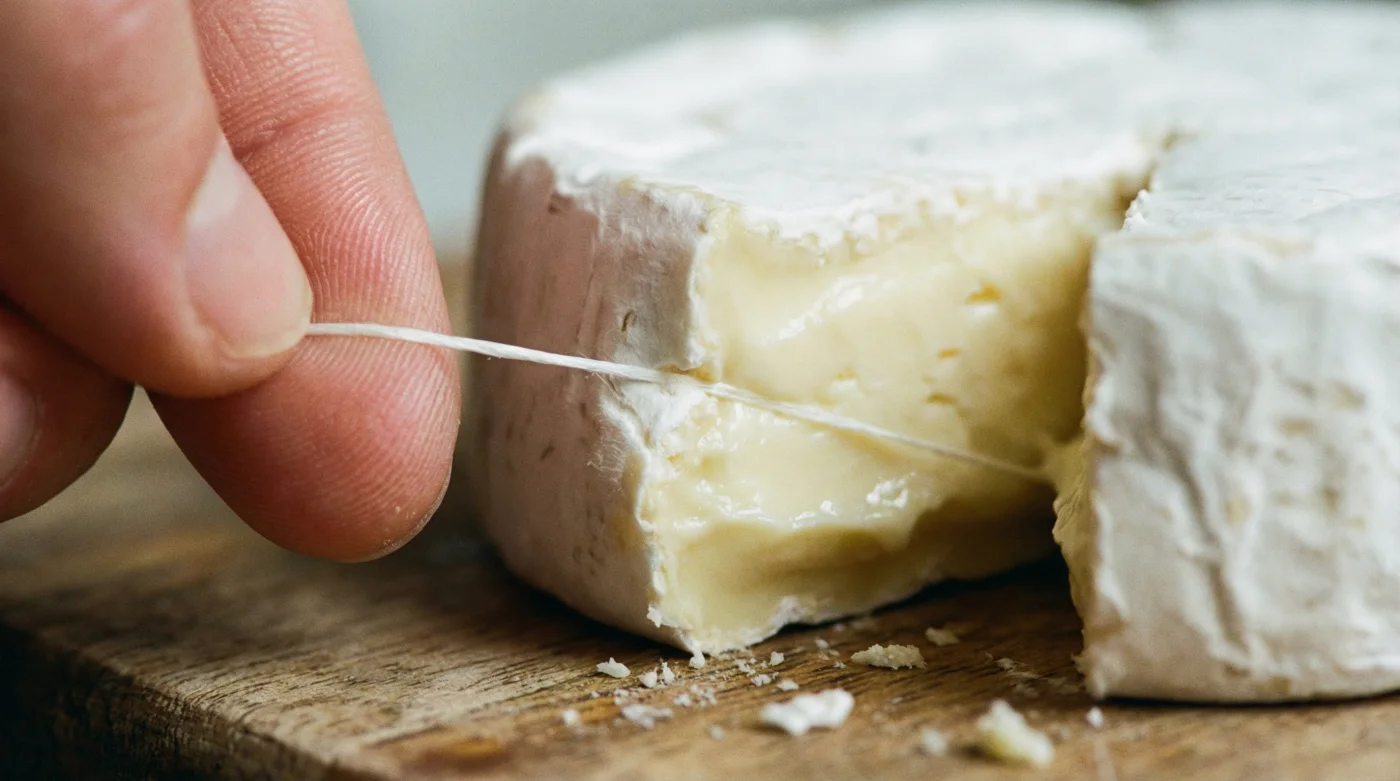
The holiday evening settles into a comfortable hum, the kind where frost thickens on the windowpane while warmth and quiet conversation fill the kitchen. You have set out the perfect board on a slab of dark slate. At the centre sits a wheel of beautifully aged local Brie, its bloomy white rind softening just enough at room temperature to suggest the heavy, trembling cream within. The scent of toasted walnuts and dried cherries mixes with the faint, earthy aroma of the dairy. It is a moment of rustic perfection, waiting to be shared.
Then, the first guest approaches. They pick up a standard paring knife, grip the handle firmly, and press down into the centre. Instantly, the fragile rind buckles under the thick metal. The blade drags, catching on the sticky paste, and the soft interior collapses, leaving behind a smeared, jagged lump that ruins the aesthetic of your careful preparation. What was once a pristine wheel now looks like a chaotic, unappetizing accident.
We are constantly conditioned to believe that culinary elegance requires expensive, specialized hardware. Specialty kitchen boutiques sell hollow-bladed cheese knives, elaborate heated wire cutters, and heavy marble slicers, all promising flawless results for the home cook. We fill our drawers with these single-use tools, hoping to recreate the polished look of a professional spread. Yet, the solution to this deeply frustrating kitchen disaster is likely sitting quietly in a drawer beside your toothpaste.
It sounds completely absurd at first, but unflavoured, unwaxed dental floss produces a cleaner, sharper cut than almost any expensive blade in your kitchen arsenal. This mundane string acts as a microscopic cutting edge, entirely bypassing the messy physics of friction. It contradicts everything the luxury kitchenware market tells us about serving food, replacing a fifty-dollar purchase with a household item that costs fractions of a penny.
The Physics of the Pull
Think of a traditional chef’s knife moving through soft cheese like a wide snowplow pushing through wet, heavy spring snow. The broad sides of the metal blade create massive drag. The creamy, high-fat paste naturally grabs onto the steel, adhering to the flat surface. The heavy pressure you apply to force the knife downward ends up crushing the delicate, airy structure of the cheese long before the sharp edge at the bottom can actually sever the rind cleanly.
In this physical scenario, you are constantly fighting against surface area. When you swap a thick steel blade for a taut, microscopic piece of string, you reduce the physical friction to nearly zero. The floss slices down through the dense paste like a shadow passing over glass, leaving the delicate bloomy rind perfectly intact and the creamy interior unbruised. It separates the molecules without displacing them, preserving the exact geometry of the wedge.
Clara Lemaire, a 42-year-old fromager who runs a tiny, sunlit tasting room in the Eastern Townships of Quebec, swears by this minimalist method. For years, she watched well-meaning tourists mangle her carefully aged double-cream wheels with expensive, heavy blades they brought from home. The beautiful textures she spent months cultivating were destroyed in seconds by blunt force. One afternoon, she quietly replaced all the heavy tasting knives on her wooden tables with a single dispenser of simple white floss. ‘The cheese must not know it is being cut,’ Clara often tells her surprised visitors, demonstrating how a gentle, even downward pressure leaves the fragile centre completely untouched and pristine.
Her approach is a quiet rebellion against the heavily marketed kitchen gadget industry. You simply do not need to spend fifty dollars to slice a soft cheese when a mundane bathroom item achieves vastly superior results. It shifts your perspective from relying on heavy tools to understanding the delicate physical properties of the food you are trying to serve.
Adjusting the Tension
Of course, not all soft cheeses demand the exact same physical approach. The way you apply this string-cutting method depends entirely on the current state of the wheel, the temperature of the room, and your intended final presentation. Adjusting your technique slightly will yield wildly different, highly tailored results.
For the charcuterie perfectionist slicing a delicate, buttery triple-cream, the ultimate goal is serving pristine, sharp wedges. You want the cheese served at roughly twenty Celsius, just warm enough to yield but cool enough to hold its shape. The string must cross cleanly over the top centre point, pressed downward with even, deliberate weight until it hits the wooden board below with a soft, satisfying tap.
For the baked Brie enthusiast, the physical challenge is often entirely different: you need to successfully remove that entire top layer of rind to expose the gooey interior for roasted garlic, thyme, and hot honey. Here, you use the string horizontally. By wrapping the line tightly around the outer circumference of the wheel and slowly pulling the ends past each other, you create a perfect, level shear that safely decapitates the rind without gouging the paste.
If you are a busy host trying to pre-portion a massive party wheel without looking like a frantic, overwhelmed caterer, this method buys you invaluable time. You can slice an entire large wheel into perfectly clean, uniform slivers in under thirty seconds, entirely eliminating the frustrating, messy wipe-down of a sticky blade between every single cut you make.
The Micro-Blade Method
Executing this technique flawlessly requires only a slight, mindful adjustment in your normal physical habits. It is far less about forceful, aggressive chopping and entirely about mindful, balanced leverage. You are stepping back and simply letting the tension of the line do the heavy lifting for you.
Start by pulling roughly eighteen inches of string from the plastic dispenser. It is absolutely critical to ensure it is entirely unflavoured and unwaxed, as the slippery mint coating will quickly leave an unwanted residue on the delicate, highly absorbent fats of the dairy, ruining the subtle flavour profile.
- Wrap the ends securely around your index fingers, leaving a taut six-inch span in the middle.
- Hover the string directly over the centre point of the wheel.
- Press straight down, resisting the urge to use a back-and-forth sawing motion.
- Once the string hits the cutting board, simply pull it out horizontally from one side rather than dragging it back up vertically through the fresh slice.
Your tactical toolkit for this operation is remarkably minimal, requiring almost zero prep time. You need the cheese rested properly at room temperature, a completely flat wooden or slate board, and the string itself. Avoid cutting on deeply grooved surfaces or warped cutting boards, as the taut line needs a perfectly flat, solid plane to finish the severing process completely at the bottom.
If you find the string slipping sideways or failing to cut entirely through the bottom rind, you are likely relaxing your hands prematurely. You must maintain the rigid, outward tension on your index fingers until the very last millimetre of the downward cut is finished.
Reclaiming the Centrepiece
Fixing this seemingly minor, common culinary frustration goes far beyond mere table aesthetics. When you mangle a beautiful, expensive piece of local food, it naturally creates a subtle, creeping anxiety among your guests at the table. People hesitate to take the next piece, not wanting to make the jagged, sticky mess any worse than it already is.
A cleanly, perfectly sliced wheel openly invites sharing and conversation. It shows a quiet, unpretentious mastery of your ingredients. By purposely stepping away from the heavy, blunt tools we are constantly told to rely on, you find a lighter, more effective touch that deeply respects both the food you serve and the people you are sharing it with.
You return to the dining table, leaving the heavy, useless knives behind in the dark drawer. The next time you set out a beautiful, trembling wheel of soft cheese on a cold Canadian evening, you will know exactly how to handle it. You will portion it cleanly, simply, and beautifully, turning a potential disaster into a moment of effortless grace.
‘A perfect cut preserves the specific texture the cheesemaker spent months trying to achieve.’
| Key Point | Detail | Added Value for the Reader |
|---|---|---|
| Steel Knife | High friction, tears delicate bloomy rinds. | Shows exactly why current serving methods cause deep frustration. |
| Heated Wire | Expensive, requires batteries or pre-heating. | Saves you money by skipping unnecessary, bulky kitchen gadgets. |
| Unwaxed Floss | Microscopic edge, zero surface drag. | Delivers a flawless presentation with zero extra financial cost. |
Common Micro-Blade Questions
Can I use waxed string if it is unflavoured?
Waxed variations often leave a faint residue that alters the mouthfeel of the fat. Stick to unwaxed for the absolute purest result.Does this method work on hard varieties like aged cheddar?
No. The string lacks the rigid, blunt force required to split hard, crystallized curds and will likely snap under the heavy pressure.How do I successfully clean the bottom of the cut?
Simply pull the string out horizontally from under the wedge rather than pulling it back up vertically through the creamy paste.Will standard cotton sewing thread work as a substitute?
Standard cotton thread often holds micro-fibres that can easily snap or shed into the food. Floss is specifically manufactured to be highly shear-resistant.What is the ideal temperature for cutting soft rind varieties?
Allow the wheel to sit for roughly forty minutes at twenty Celsius before slicing for the cleanest possible separation and optimal texture.