You stand at the kitchen counter, staring at a damp white block sitting in a shallow pool of its own liquid. The usual routine dictates a clumsy ritual: wrapping it in layers of paper towel, balancing heavy cast-iron pans or thick encyclopedias on top, and waiting for the puddle to grow.
But water is stubbornly unyielding. It resists the blunt pressure, usually leaving you with a dense, chalky cube that fractures in the pan and flatly refuses to absorb any meaningful flavour from your sauce.
You meticulously dice it into tiny uniform squares, toss it into a hot skillet, and accept the blandness. It feels like a culinary compromise, a necessary but uninspiring chore for a meatless Tuesday dinner.
The professional reality relies on doing the exact opposite. Instead of forcing the moisture out through brute strength, you let the harsh cold do the heavy lifting, fundamentally altering a fragile soy block into something remarkably resilient and meaty.
The Architecture of Ice
When you slide a plastic-wrapped package of firm tofu directly into the freezer, you are not merely preserving it for a later date. You are actively rewriting its entire physical architecture from the inside out.
Think of freezing water as thousands of microscopic crowbars. As the moisture trapped inside the block drops below zero Celsius, it turns to ice and expands, forcefully pushing the tight protein network apart.
The perceived flaw of the ingredient—carrying far too much internal water—suddenly transforms into your greatest structural advantage. The water stretches the soy proteins into a highly porous, sponge-like lattice that stubbornly holds its shape.
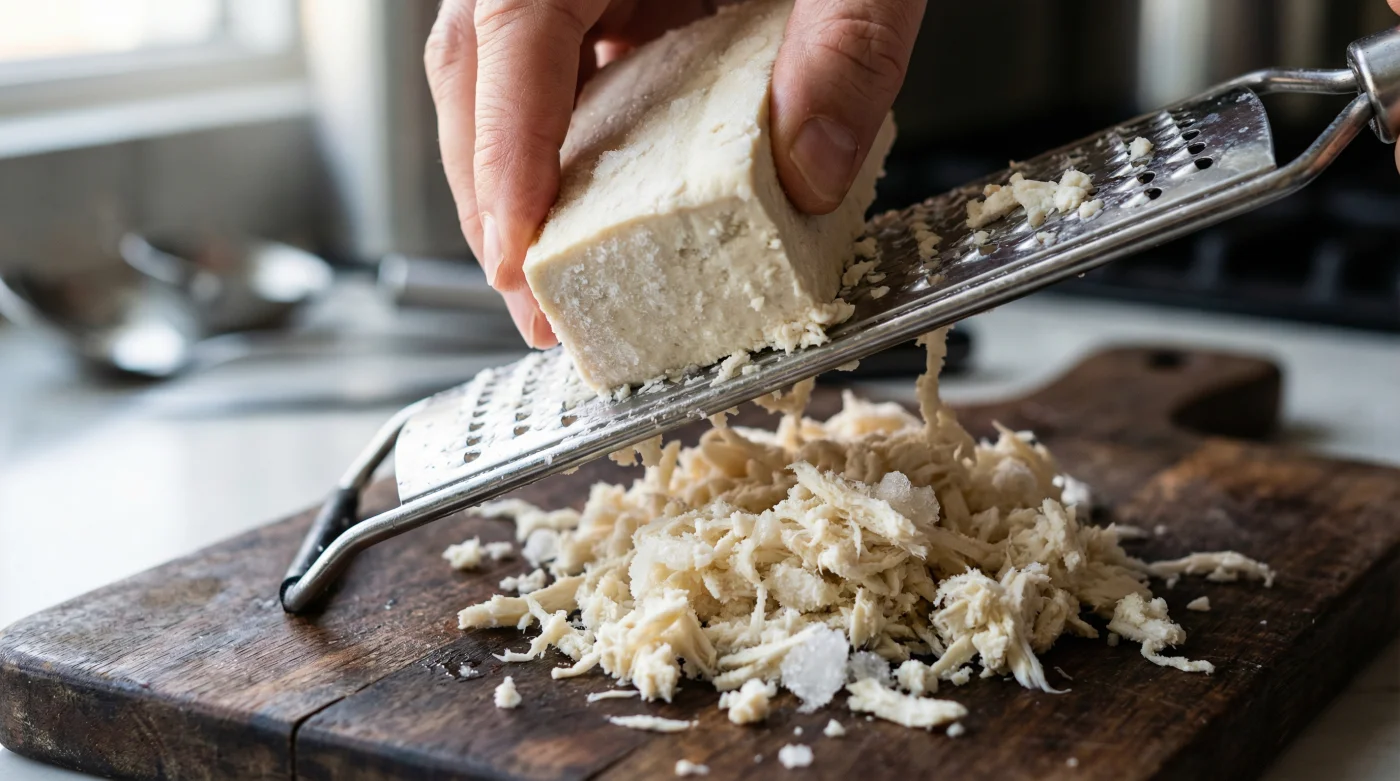
Once thawed, you simply grate it like old cheddar. Those frozen fault lines fracture beautifully against the metal teeth, yielding a fluffy, unevenly minced texture that mimics the mouthfeel of premium ground poultry almost perfectly.
The Test Kitchen Breakthrough
Elias Thorne, a forty-two-year-old development chef working in a cramped Toronto test kitchen, knew this frustration intimately. He spent three grueling months trying to formulate a plant-based chicken dumpling that didn’t taste like seasoned cardboard.
He initially tried pressing blocks under forty-pound weights. He attempted low-temperature dehydration, chemical binders, and endless chopping techniques, but every single variation lacked that distinct, satisfying bite.
Late one snowy November evening, he noticed a forgotten, slightly frosted batch pushed against the frozen back wall of his walk-in cooler. Too exhausted to care, he thawed it under running water and ran the spongy mass through a coarse box grater.
The result in the pan was an absolute revelation. The shredded, jagged edges caught the hot canola oil instantly, browning and crisping with an irregular, craggy surface that looked and chewed exactly like lean, pan-fried ground turkey.
Calibrating the Shred
Not all meals require the exact same structural approach. You can easily manipulate this single two-ingredient modification—soy and freezing temperatures—to suit the specific demands of your evening.
For the busy parent, keep three blocks frozen. When you need a fast meal, submerge one sealed package in warm water; it thaws just enough to grate in twenty minutes, immediately ready to absorb a thick, sticky teriyaki glaze.
The texture purist demands a different method. If you crave the crispiest possible edge for a taco filling, spread the freshly grated shreds out on a dry baking sheet and bake them at 200°C for ten minutes to evaporate residual dampness before pan-frying.
Batch-cooking strategists can grate a massive Sunday pile. The fluffed, dry texture absorbs marinades incredibly well while sitting in the fridge, meaning by Wednesday, your lettuce wraps will be deeply and aggressively seasoned from the inside out.
Mindful Application and Tactile Steps
Executing this requires almost zero physical effort, but it highly demands mindful observation. It is entirely about working in harmony with the temperature shifts, rather than fighting against them.
Above all else, patience yields the best texture. Do not try to forcefully drag a metal grater through a block that still has a rock-hard, icy core hiding in the centre.
- Place the unopened, water-filled package directly into the freezer for a minimum of eight hours.
- Thaw overnight in the refrigerator, or submerge the sealed package in a bowl of warm water if you are rushed.
- Run the fully thawed block firmly down the largest teardrop holes of a standard box grater.
- Gather the fluffy mound in a clean linen kitchen towel and gently squeeze to release the melted ice water.
Your tactical toolkit is remarkably minimal for this technique. You only need one block of firm tofu, a sharp stainless-steel box grater, a clean cloth, and a heavy cast-iron skillet preheated over medium-high heat.
The oil in the pan needs to faintly tremble. When you drop the shreds into the hot fat, resist the urge to stir immediately; let the bottom layer develop a deep, golden-brown crust before tossing.
The Quiet Confidence of Adaptation
Mastering this incredibly simple, hands-off modification fundamentally changes how you view your grocery routine. You are no longer reliant on heavily processed, wildly expensive meat substitutes sold in the frozen aisle.
It brings a deep sense of culinary independence. You take a single, mundane, inexpensive ingredient and thoughtfully bend it to your will, creating a satisfying meal that feels far greater than the sum of its parts.
Your kitchen becomes less about rigidly following step-by-step instructions and more about instinctively understanding the physical materials resting on your cutting board. You slowly learn to trust your own hands.
When you finally hear the aggressive, satisfying sizzle of grated soy hitting hot oil, smelling the garlic catch in those highly porous edges, you realize you haven’t just cooked dinner; you’ve engineered a vastly better way to eat.
“Stop fighting the moisture and start using it; ice is the best sous-chef you never knew you had.”
| Key Point | Detail | Added Value for the Reader |
|---|---|---|
| Structural Expansion | Freezing water forces the protein lattice open. | Creates a porous texture that rapidly absorbs any marinade. |
| Grated Consistency | Using a box grater on thawed tofu yields jagged edges. | Mimics the exact mouthfeel and browning capability of premium ground poultry. |
| Moisture Release | Squeezing the grated shreds in a linen towel. | Saves twenty minutes of pressing time while yielding a vastly drier end product. |
Frequent Troubleshooting
Can I grate it while it is still slightly frozen?
No. A partially frozen block will snap and crumble into dust. Let it thaw completely until it breathes like a soft sponge.Does this work with silken varieties?
Absolutely not. Silken has too high a water content and insufficient protein structure; it will turn into a watery puree when thawed.How long can it stay in the freezer?
Safely up to three months. Beyond that, it may develop freezer burn, which taints the neutral flavour profile.Why did my grated shreds turn mushy in the pan?
You crowded the pan or did not squeeze enough melted ice water out beforehand. Give the shreds room to breathe and fry.Can I re-freeze it after cooking?
Yes. Once cooked into a chili or pasta sauce, it freezes beautifully and retains its new, meaty texture perfectly.