You stand at the kitchen counter staring at a beautiful, peach-coloured slab of fresh salmon. The fish smells faintly of brine, cold and clean like a brisk February morning walking along the seawall in Vancouver. You heat your favourite skillet until a drop of water dances on the metal, adding a generous shimmer of oil. This is the moment of truth, the culmination of your meal prep.
Yet, despite the hot pan and your very best intentions, the inevitable happens. The tender flesh cooks beautifully, but the skin underneath turns into a pale, rubbery layer that stubbornly fuses to the hot cast iron. You scrape and tear, leaving half your dinner welded to the pan while the rest flakes into an unceremonious, frustrating pile.
We are taught to treat raw seafood like delicate glass. The conventional wisdom dictates that you keep it on ice, handle it gently, and never expose it to heat until the exact second it meets the stove. But what if the secret to a shatteringly crisp texture requires you to actively break the golden rule of fish preparation before you even turn on the burner?
The logic feels entirely backwards. If you want a perfect pan sear, why would you deliberately pour a kettle of boiling water over raw, chilled fish? To understand this, you need to stop viewing salmon skin as a mere protective wrapper and start treating it like a dense matrix of collagen.
When raw skin hits a screaming hot pan, the sudden thermal shock forces the connective tissue to contract violently. It curls and warps instantly, lifting the edges away from the oil and causing wildly uneven browning. The moisture trapped inside creates steam, turning what should be a crispy crust into a chewy sponge that ruins the mouthfeel of the dish.
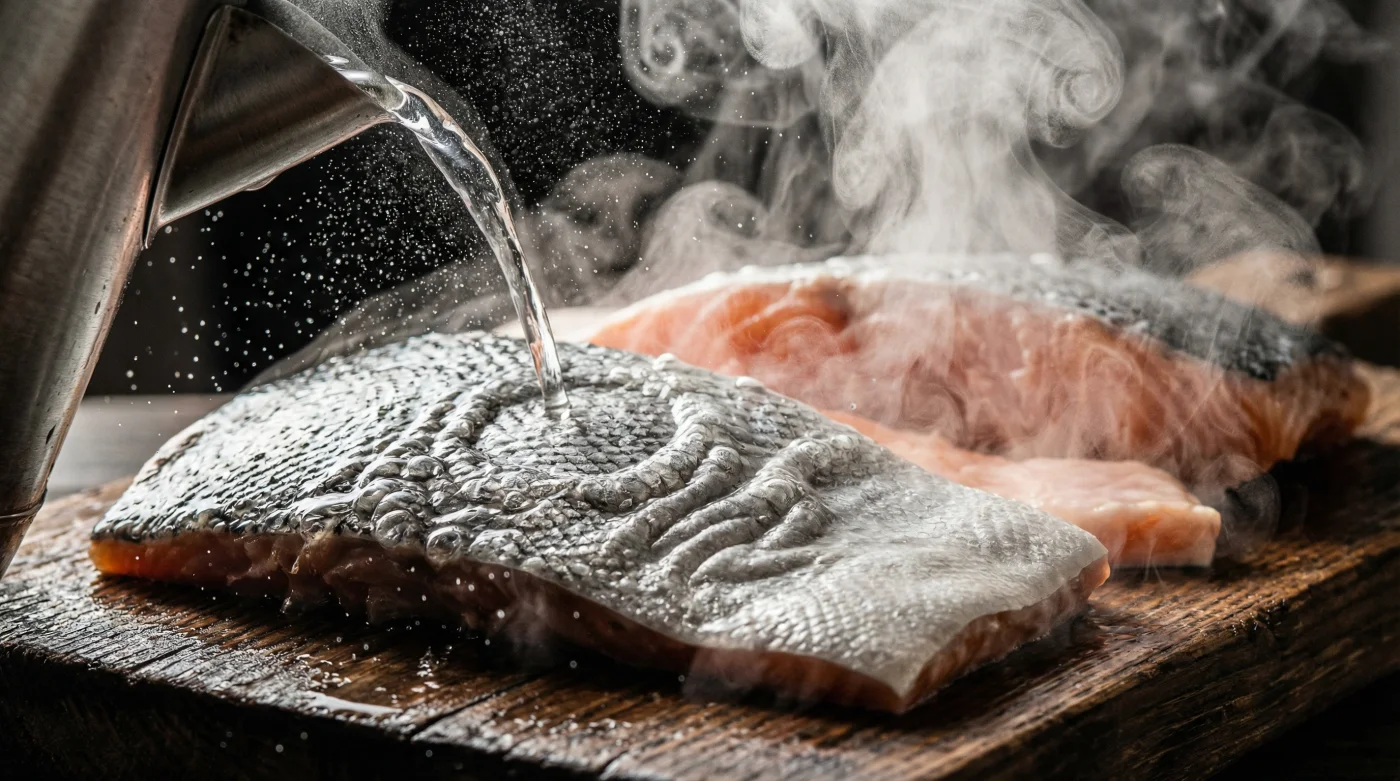
By pouring boiling water directly over the raw skin while the fillet rests on a wire rack, you perform a controlled pre-shrink. The skin instantly tightens, buckling under the heat for a brief second before relaxing. This flushes out excess moisture and pre-cooks the outer layer, bypassing the violent curling phase that typically happens in the pan.
I first saw this technique executed by Mathieu, a thirty-four-year-old sous-chef working the fish station at a bustling, softly lit bistro in Montreal’s Mile End. During a frantic Friday evening service, he stood over a deep sink lined with stainless steel resting racks. With a battered, whistling electric kettle, he methodically doused dozens of pristine salmon portions.
The skin blanched and shrivelled like a flinching muscle, shrinking visibly before he patted them completely bone-dry with heavy blue paper towels. Mathieu explained that this ten-second ritual was the only way to guarantee a uniformly crispy sear when you have five pans firing at once and absolutely zero room for error.
Tailoring the Technique
This method adapts beautifully to however you prefer to run your kitchen. But not all fresh salmon requires the exact same treatment, as the size of your fillets and the type of skillet you prefer will slightly alter the final approach.
For the cast-iron purist, your primary enemy is residual moisture trapped in the microscopic grooves of the pan. After the hot water scald, let the fillet sit uncovered on a plate in your fridge for thirty minutes. The dry cold air pulls the last microscopic droplets of water from the skin, turning it into a taut, parchment-like surface that will fry to perfection.
When dinner needs to be ready in fifteen minutes, you simply do not have the luxury of time for air-drying in the fridge. Scald the skin over the sink, then aggressively press it dry using thick paper towels. Do not just pat it gently; lean into it slightly, letting the paper absorb everything.
Switch to a well-seasoned carbon steel pan over medium-high heat, using a high-smoke-point oil like grapeseed or canola. The scalding step ensures that even without a long drying time, the skin lies completely flat against the metal, maximizing contact and creating a crust in mere minutes.
If you are working with a massive, two-inch-thick centre-cut piece, the scalding technique actually acts as a buffer that prevents the flesh from overcooking. Because the skin is already primed and tightened by the kettle water, it spends significantly less time in the pan trying to render out fat.
You get a spectacular, audible crunch on the outside while the centre remains beautifully translucent and medium-rare, completely avoiding that chalky, dry texture that plagues overcooked fish. It behaves entirely like a perfectly tailored thermal blanket.
The Mindful Application
Mastering this method requires a distinct shift in rhythm. It is about quiet precision, not the usual last-minute panic of flipping fish. Start by bringing your kettle to a vigorous, rolling boil. Place your salmon skin-side up on a wire cooling rack set securely over your sink or a deep baking sheet to catch the runoff.
Slowly and deliberately pour the boiling water exclusively over the skin. You will see it instantly tighten, the pores closing as it changes colour to a slight, muted silver. Stop after three seconds. You are merely scalding the surface, not cooking the delicate, blushing meat underneath.
Next, apply these exact parameters:
- Water Temp: 100°C (a vigorous rolling boil, not just steaming).
- Scald Time: 2 to 3 seconds per individual fillet.
- Drying: Firm, even pressure with paper towels immediately after scalding to remove all surface water.
- Cooking Temp: Medium-high heat (the oil should just barely shimmer, never smoking).
- The Flip: Allow 80 percent of the cooking to happen on the skin side. Flip only for the final 30 to 45 seconds to kiss the flesh with heat.
Beyond the Frying Pan
There is a deep, abiding satisfaction in taking a notoriously frustrating, unpredictable kitchen task and finally bending it to your will. We spend so much energy worrying about ruining expensive ingredients that we often forget cooking is supposed to feel empowering.
When you stop fearing the intense heat of the stove and start using it strategically, the kitchen stops being a source of evening stress. You gain quiet confidence, knowing exactly how the protein will react to the pan before it even touches the shimmering oil.
This single, counterintuitive trick with a humble kettle changes the entire trajectory of your meal preparation. You are no longer nervously crossing your fingers, hoping the skin magically releases from the metal when you slide your spatula underneath.
You are consciously directing the entire process, turning a simple piece of fresh fish into a restaurant-quality dinner on a random Tuesday night. The distinct crunch of your knife cutting through that perfectly blistered skin will be all the proof you need.
“The difference between a good home cook and a professional is rarely equipment; it is simply knowing when to apply heat, and when to withhold it entirely.”
| Key Point | Detail | Added Value for the Reader |
|---|---|---|
| The Boiling Scald | Pour 100°C water directly over raw salmon skin for 3 seconds before cooking. | Prevents the skin from curling in the pan, ensuring edge-to-edge crispiness. |
| The Moisture Flush | The intense heat contracts collagen, squeezing out trapped surface water instantly. | Eliminates the steam that causes skin to turn rubbery and stick to the skillet. |
| The Asymmetric Cook | Cook the fish 80% of the way through on the skin side, flipping only at the end. | Protects the delicate flesh from overcooking while maximizing the skin’s crunch. |
Frequently Asked Questions
Will pouring boiling water over the salmon cook the inside of the fish?
No. As long as you limit the pour to two or three seconds and keep the water strictly on the skin, the heat will not penetrate deeply enough to cook the flesh underneath.Do I need to descale the salmon before using this method?
Yes. The scalding technique works best on skin that has been properly descaled by your fishmonger, allowing the collagen to react directly to the boiling water.Can I use this technique on frozen salmon fillets?
This method requires fully thawed, fresh salmon. Frozen fish holds too much internal moisture and the skin will not tighten properly under the boiling water.Does this work with other types of fish besides salmon?
It works beautifully on any thick-skinned fish like trout or sea bass, where rendering the fat and crisping the skin is the primary goal of the sear.What is the best oil to use for frying the salmon after scalding?
Use a neutral, high-smoke-point oil like canola, grapeseed, or avocado oil. Butter will burn before the skin has enough time to achieve the proper crunch.