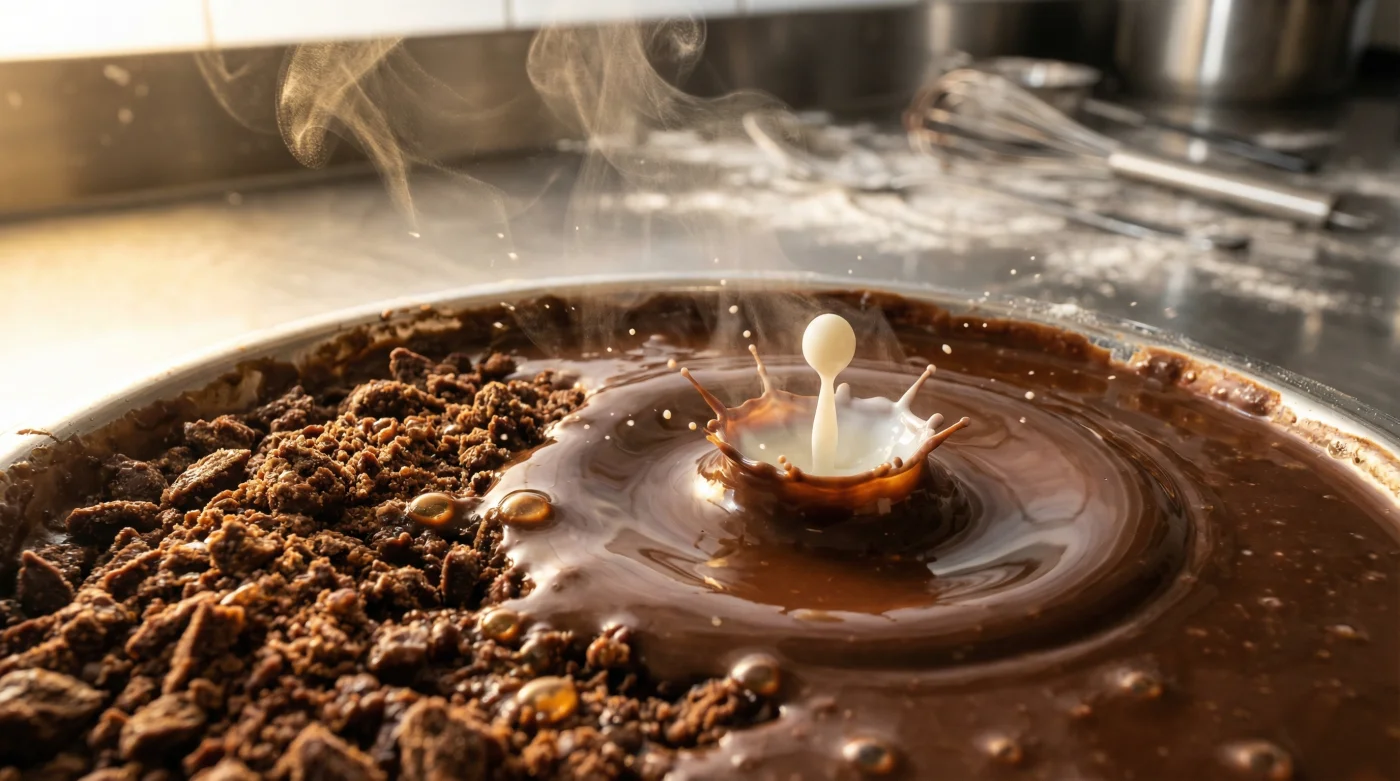
The smell of melted chocolate hitting warm cream carries a specific kind of promise. You stand over the counter, whisk in hand, anticipating that luxurious, mirror-like gloss rolling off your spatula. The kitchen is warm, perhaps fighting off a stiff chill from an Ontario January evening outside, and everything feels aligned for a perfect dessert.
Then, the texture shifts. What should be liquid silk suddenly turns dull and grainy. Oil pools at the edges, slicking the sides of your glass bowl while the centre clumps together like wet potting soil. Your ganache has split, and that beautiful glossy promise is now a greasy, curdled mess.
Your immediate instinct is frustration, followed quickly by the urge to scrape the entire expensive mistake directly into the green bin. Good couverture chocolate and rich heavy cream are not cheap, making the failure sting even more. You might try stirring harder, hoping sheer physical force will bend the ingredients back to your will.
Put the whisk down. Do not throw it out. You are staring at a simple mechanical failure, not a permanent ruin. The emulsion has merely dropped its structure, and it can be coaxed back to factory smoothness with something you already have sitting in the fridge.
A Matter of Suspended Tension
To fix a broken ganache, you need to picture what is happening on a microscopic level. Chocolate and cream form an emulsion, which is, at its core, a delicate handshake between fat molecules and water. When the balance is correct, they hold onto each other, creating a thick, uniform liquid that drapes flawlessly over a cake.
When the chocolate gets too hot, or the cream is too cold, the handshake violently breaks apart. The cocoa butter separates from the water content in the cream. Think of it like a crowd of people suddenly letting go of a massive parachute; the structure collapses entirely, leaving the heavy materials to sink and the lighter oils to float away. The common instinct to add cold liquid to shock the bowl back into shape only freezes the fat, cementing the separation into something resembling wet gravel.
Eloise Bouchard, a 42-year-old pastry chef running a bustling patisserie in downtown Montreal, knows this panic intimately. During a frantic holiday service, a massive ten-kilogram batch of dark chocolate glaze split on her stainless steel counter. Instead of throwing out hundreds of dollars of product, she reached for a tiny saucepan. She whisked a few tablespoons of actively boiling milk into the ruined vat, and within seconds, the glossy, midnight-dark perfection returned. She simply offered the fat a new bridge to cross.
Calibrating the Rescue for Your Chocolate
Not all chocolate behaves the same way when it throws a tantrum. Because the inherent cocoa butter content dictates the temperament of your emulsion, your approach to repairing the broken structure needs to adapt to exactly what is sitting in your bowl.
For the dark chocolate purist, high-percentage bars (70 percent and up) are notoriously stubborn once they split because there is very little dairy fat to act as a buffer. You will notice it seizing into harder, tighter clumps. It requires aggressive, confident whisking once you introduce your repair liquid to force those rigid fat crystals to relax and accept the water.
The milk chocolate fan faces a different scenario entirely. Milk chocolate contains extra milk solids and sugar, making it softer and slightly more forgiving, but also highly prone to scorching. When a milk chocolate ganache splits, it often looks more like thick soup than wet gravel. A gentle, steady hand is required here so you do not accidentally whip unwanted air into the delicate mix.
For the white chocolate baker, the stakes are highest. White chocolate contains zero cocoa solids; it is almost entirely cocoa butter, sugar, and milk powder. It is the most fragile of the three by a wide margin. It will separate at much lower temperatures, often leaving a yellow oil slick on the surface. If your white ganache breaks, patience and very subtle heat are your only currency.
The Boiling Milk Intervention
- Salut Bonjour recipes trigger massive provincial shortages of specific maple syrups.
- NSLC coolers face massive purchase limits amid unexpected provincial aluminum shortages.
- Brie cheese wheels slice perfectly clean using unflavored unwaxed dental floss.
- Firm tofu blocks frozen solid and grated replicate premium ground poultry.
- Fresh salmon fillets demand boiling water poured over raw skin directly.
This is the moment you step back to the counter and mindfully reclaim your dessert.
- Pour roughly 30 millilitres of whole milk into a small saucepan or microwave-safe cup.
- Heat the milk until it is rolling—it must be at a full, active boil, hitting roughly 100 Celsius.
- Pour exactly one teaspoon of the boiling milk directly into the centre of your split ganache.
- Using a balloon whisk, stir only in the very centre of the bowl, avoiding the edges to create a tight, fast friction ring.
As you whisk, the centre will suddenly darken and turn remarkably glossy. The boiling milk acts as a shock to the system, melting the separated fat while simultaneously giving it the water it desperately needs to bind back together.
Once that dark, shiny core forms, slowly widen your stirring circles. You are gradually pulling the broken, greasy edges into the repaired centre, assimilating the seized mixture back into the newly formed emulsion. If the outer edges remain slightly greasy, add one more half-teaspoon of boiling milk directly to the centre and repeat the tight whisking motion.
Your Tactical Toolkit: Your ideal kitchen temperature is 20 to 22 Celsius to avoid cold drafts shocking the chocolate as it cools. The Golden Ratio for repair is roughly 1 part boiling milk for every 20 parts broken ganache. The Rescue Tool is a balloon whisk with flexible tines, strictly avoiding wooden spoons which absorb oils and offer no structural aeration.
A Masterclass in Kitchen Resilience
Fixing a split ganache is about far more than just saving a bowl of expensive dessert ingredients from the bin. It forces a quiet, powerful shift in how you operate in your physical baking space when things go sideways.
We are often taught to view baking as a rigid pass-or-fail test. When a mixture fails, the immediate assumption is that we did something irreversibly wrong and must start over. By learning how to coax an emulsion back from the brink, you strip away the fear of ruining a recipe. You move from being someone who merely hopes instructions work, to someone who truly understands how the food behaves under stress.
The next time the chocolate betrays you, there will be no panic. You will simply boil the kettle, fetch a splash of milk, and quietly correct the situation. Your kitchen becomes a place of quiet mastery, where a little heat and a subtle shift in perspective are all it takes to restore beauty to the bowl.
“An emulsion is never truly lost until it hits the drain; it just needs the right temperature to remember how to hold itself together.”
| Key Point | Detail | Added Value for the Reader |
|---|---|---|
| Boiling Milk | Provides missing water and melts seized cocoa fat. | Saves the batch instantly without heavy equipment or stabilizers. |
| Centre Whisking | Creates localized friction to start a new emulsion core. | Prevents splashing and allows you to control the re-binding pace. |
| Temperature Control | Keeps kitchen around 20 Celsius during the fix. | Prevents the chocolate from shocking back into a split state. |
Frequently Asked Questions
Can I use cold milk to fix the split ganache?
No. Cold milk will immediately freeze the separated cocoa butter, turning the mixture into hard, unusable chunks.Will adding milk thin out my ganache too much?
Because you are only adding it by the teaspoon, the structural integrity remains thick enough for truffles or cake drips.Can I use water instead of milk?
Boiling water can work in an absolute emergency, but milk contains natural proteins that help stabilize the new emulsion much faster.Why did my ganache split in the first place?
The most common culprit is pouring boiling cream over the chocolate too quickly, or stirring it vigorously before the temperatures have equalized.Does this trick work on vegan ganache made with coconut milk?
Yes. You can use a teaspoon of boiling coconut milk or oat milk to achieve the exact same mechanical repair.