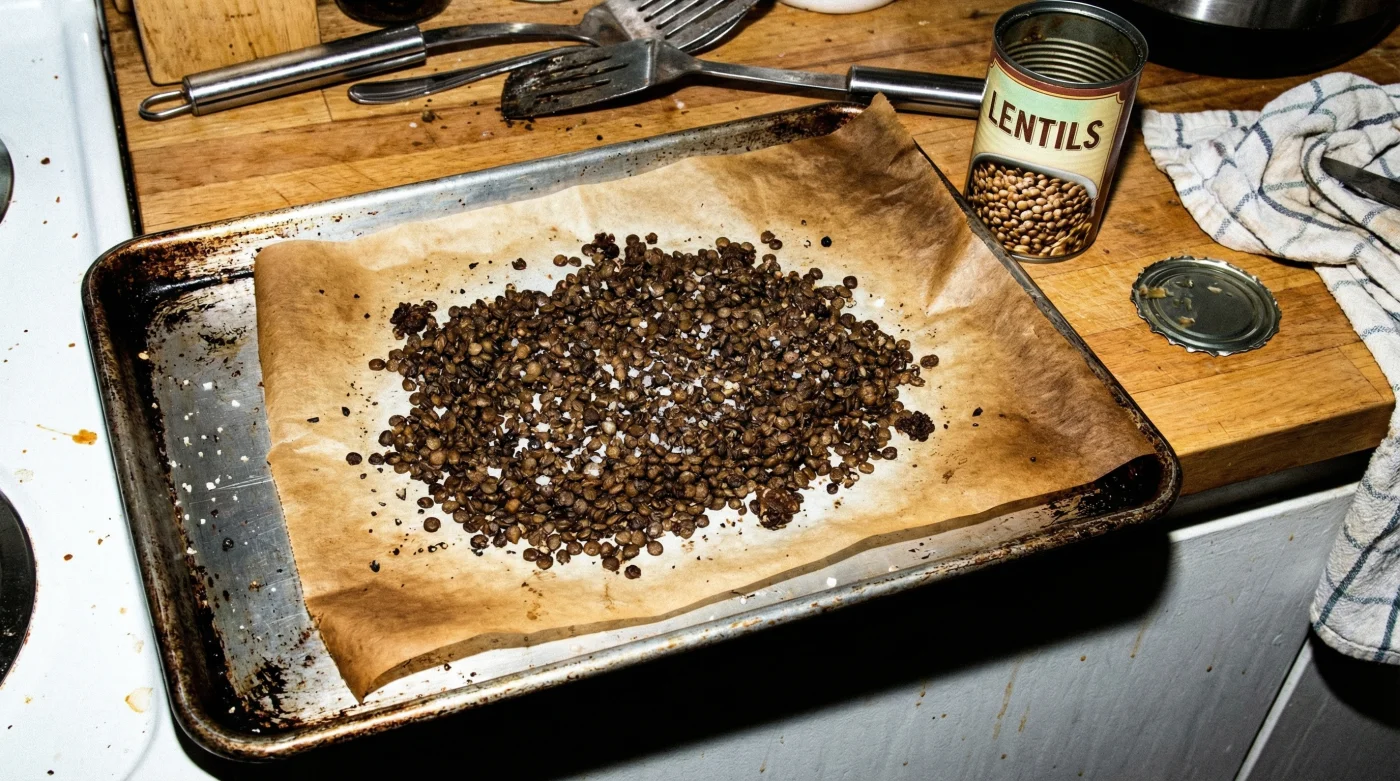
The sharp snap of cold air biting at your kitchen window in late November makes you crave something deeply savoury. You pull a heavy sheet pan from the cupboard, its surface darkened from years of high heat, and turn the oven dial up to 220 Celsius. You gather fennel seeds, a heavy pour of oil, and smoked paprika, but the protein resting on your counter isn’t premium pork shoulder. It is a humble, ninety-cent can of brown lentils.
Most pantry staples sit forgotten at the back of the shelf, waiting for a desperate Tuesday night. Canned lentils usually suffer a wet, murky fate, dumped into a simmering soup pot where they inevitably turn into a muddy sludge. We are conditioned to treat them gently, bathing them in broth until they surrender their shape entirely.
But today, you are ignoring the simmer. You are going to drain them, rinse them aggressively, and subject them to a scorching, dry environment. This completely defies the gentle, liquid-heavy treatment we usually give legumes, exposing a hidden potential that feels almost like a kitchen magic trick.
By deliberately stripping away the moisture, the soft legumes fracture and blister, taking on the ragged, satisfying chew of expensive, artisan sausage crumbles. It is a quiet rebellion against the soup pot, turning the most mundane item in your cupboard into a texturally thrilling centrepiece.
Forcing the Desert: A Textural Metaphor
Think of a standard canned lentil as a tiny water balloon. When you boil it, the internal pressure simply swells until it eventually bursts into mush. But if you think of your oven as a dry, harsh desert wind, the cooking logic completely changes. You stop trying to coax flavour into the water, and instead force the water to leave entirely.
You aren’t just heating food; you are evaporating a barrier. Moisture is the eternal enemy of crisp, meaty texture. By forcing that water out through intense, dry roasting, the delicate skin tightens, the internal starches condense, and the interior turns dense and hearty. The lentil stops acting like a vegetable and starts behaving like a protein.
This is the exact opposite of what we are traditionally taught to do with canned goods. The perceived flaw—their initial waterlogged mushiness—becomes the exact mechanism that allows them to absorb oil, spice, and heat. The softness is a blank canvas, waiting to be pulled tight by the heat of the oven.
Consider the quiet brilliance of Sarah Jenkins, a 42-year-old prep cook at a bustling farm-to-table bistro in Victoria. While the head chef obsessed over braising local pork shoulder, Sarah was quietly perfecting the plant-based substitute for their Sunday brunch service. She realized that treating the canned lentil exactly like raw ground meat—tossing it with heavy fats, crushed fennel seeds, and smoked paprika before hitting a blistering pan—caused the proteins to seize and crumble perfectly. Her secret wasn’t a complex binder or a highly processed lab ingredient; it was simply knowing how to aggressively dehydrate an already-cooked staple until it fought back with a satisfying bite.
Adjustment Layers: Finding Your Perfect Crumble
Not every dish demands the same level of aggressive crunch. Depending on what you are building, the lentil can be coaxed into different states of savoury submission. The technique bends entirely to your current craving.
For the morning traditionalist, looking to mimic a classic breakfast sausage alongside a pile of soft scrambled eggs, the key is the spice blend. Heavy doses of rubbed sage, cracked black pepper, and a touch of local maple syrup require a medium-high roast. You want the sugars to caramelize on the skin of the lentil without burning, creating sticky, chewy clusters.
The Pasta Purist
- Carrot greens blended with stale walnuts replace expensive basil pesto completely.
- Sour cream piped through hot oil creates delicate savory lattice garnishes.
- Instant coffee rubbed onto raw steak creates premium smokehouse barbecue barks.
- Salut Bonjour breakfast trends force local diners into sudden menu overhauls.
- Maple syrup reserves face unprecedented depletion following viral Salut Bonjour recipes.
The Rapid Weeknight Parent
When time is violently short, skip the oven entirely and use a wide cast-iron skillet. The goal here is maximum surface area. Smash the drained lentils down flat with a metal spatula, let them sit completely untouched over high heat until a hard crust forms, and then aggressively scrape them up. It delivers that meaty, pan-fried char in exactly seven minutes, saving a frantic dinner hour.
The Anatomy of the Dry Roast
To achieve this transformation, you must act with deliberate, minimalist precision. It is not about casually throwing wet ingredients into a pan and hoping for the best. The environment must be strictly controlled.
Every step removes excess moisture, ensuring the final product snaps and crumbles rather than steaming in its own juices. Treat the process like preparing a delicate piece of fish before searing; the canvas must be bone dry to react properly to the heat.
- Drain the can thoroughly and rinse the lentils under cold water until all the cloudy bubbles disappear.
- Spread the legumes across a clean, lint-free kitchen towel and pat them aggressively dry.
- Toss them in a mixing bowl with a high-smoke-point oil (like canola or avocado) and your chosen spices, ensuring every piece is coated but not drowning in fat.
- Spread them on a parchment-lined baking sheet, leaving visible space between the lentils to allow steam to escape freely.
The Tactical Toolkit requires an oven set strictly between 200 and 220 Celsius. You will roast them for 20 to 25 minutes, opening the oven to toss the pan exactly once at the 15-minute mark. For an authentic sausage flavour, your non-negotiables are crushed fennel seed, smoked paprika, garlic powder, and a heavy pinch of coarse salt.
The Comfort of Pantry Mastery
There is a deep, quiet satisfaction in looking at a dusty tin in your cupboard and knowing it holds the architecture of a spectacular dinner. It shifts your mindset from viewing canned goods as last resorts to seeing them as raw materials with massive potential.
Mastering this simple dehydration trick completely removes the panic from weeknight meal planning. It means you are never truly out of high-quality protein, and you are never far from a deeply satisfying, texturally complex meal. You are completely in control of the outcome.
It transforms your relationship with your kitchen. When you understand how to confidently manipulate basic elements like heat and moisture, the mundane becomes magnificent. A dark, cold Tuesday evening dinner feels incredibly deliberate, grounded, and whole, built entirely from a tin that cost less than your morning coffee.
“The magic of cooking isn’t finding rare ingredients; it’s learning how to make the ordinary sweat out its flaws and crisp into something extraordinary.”
| Key Point | Detail | Added Value for the Reader |
|---|---|---|
| Aggressive Drying | Patting rinsed lentils entirely dry before oiling. | Prevents the legumes from steaming, guaranteeing a crisp, meaty snap. |
| High Heat Application | Roasting at 220 Celsius (425 Fahrenheit). | Forces rapid moisture evaporation, mimicking the density of ground pork. |
| Strategic Spicing | Coating with crushed fennel and smoked paprika. | Tricks the palate by providing the exact aromatic profile of artisan sausage. |
Frequently Asked Questions
Do I have to use brown lentils for this method? Yes, brown or green lentils hold their shape the best. Red lentils will turn to complete mush and burn under high heat.
Can I store the crumbles after roasting them? Absolutely. Let them cool completely on the pan, then store them in an airtight container in the fridge for up to four days. Reheat them in a dry skillet to restore the crunch.
Why do I need to rinse them if they are already cooked? The canning liquid contains excess starches and sodium that become incredibly gummy when heated. Rinsing gives you a clean texture to work with.
Is oil strictly necessary for the roasting process? Yes. The oil acts as a conductor for the heat to crisp the skins and carries the fat-soluble flavours of the paprika and fennel into the legume.
Can I use dried lentils cooked from scratch instead? You can, but you must slightly undercook them so they retain a firm bite before tossing them into the oven. The canned version simply saves you forty minutes of prep time.