Imagine standing in your kitchen on a late Tuesday afternoon. The smell of a freshly baked vanilla sponge still hangs heavy in the air, cooling on a wire rack next to the frosted windowpanes. You are holding a wooden spoon, staring at a mixing bowl, feeling that familiar knot of hesitation. The cake is perfect, but the finishing touch always brings a wave of anxiety.
The recipe calls for plant-based butter. You know the drill: navigating through the snow to that one specific health-food grocer, paying a premium for a small plastic tub of highly processed ingredients. You bring it home, measure it out, and watch it turn into a frustrating mess of split fat the second it hits the ambient warmth of your kitchen. It feels like an endless compromise between dietary needs and actual culinary joy.
But what if the secret to bakery-quality frosting was already sitting quietly in your pantry? The truth is, the foundation for a flawless, dairy-free finish does not require complex chemistry, stabilizers, or expensive commercial substitutes. You only need a standard jar of unrefined coconut oil and a splash of ice water from the tap.
This is the quiet shift that separates anxious home baking from confident professional technique. By simply manipulating temperature and friction, you can force a mundane pantry staple to mimic a slow-churned buttercream. It holds a remarkably sharp edge, stays completely stable under warm dining room lights, and melts perfectly on the tongue without leaving a greasy film.
The Perspective Shift: Shocking Fat into Submission
We have been conditioned to believe that dairy-free baking requires a strict one-to-one swap of synthetic fats. You might think you need a laboratory to recreate the microscopic structure of dairy butter. But fat, when treated with respect and a basic understanding of physics, behaves exactly how you tell it to.
Think of melted coconut oil as a scattered crowd of molecules. At room temperature, it is lazy, shifting between solid and liquid, totally unpredictable. Melt it down entirely, and it loses all structural integrity. But when you introduce a violent thermal shock forces stability, in this case, literal ice water hitting the spinning oil, those molecules snap to attention. They link arms to form a tight, unyielding grid that traps air beautifully.
You are not just mixing two random ingredients together; you are creating a microscopic architecture. You are trapping air and water inside a rapidly solidifying fat crystal. This rapid chilling creates a stable, spreadable emulsion that whips up lighter than a cloud. It is a two-ingredient modification that yields restaurant-level results, directly contradicting the modern urge to buy expensive, pre-made solutions.
Clara, a 42-year-old pastry chef running a bustling patisserie out of an old brick storefront in downtown Toronto, discovered this entirely by accident. During a mid-July heatwave when a massive delivery of vegan butter spoiled in transit, she had three wedding cakes to finish and a kitchen hitting 32 Celsius. In a moment of sheer desperation, she tossed liquid coconut oil into a freezing stand mixer, trickling in ice water until the hum of the machine changed pitch. Within minutes, she had a frosting so reliable her clients never noticed the pivot. It became the glossy and reliable permanent standard for her entire baking program, completely eliminating her bakery’s reliance on fragile commercial supply chains.
Deep Segmentation: Adjusting the Foundation
Every kitchen has a different rhythm, and every cake demands a specific touch. Because this technique relies on physical structure rather than chemical additives, you hold complete control over how the final product performs. You can tailor this emulsion to suit any palate or environment.
For the Purist: If you want a stark white, entirely neutral-tasting base, reach for refined coconut oil. It lacks the distinctive tropical aroma but maintains the exact same structural integrity under the whisk. This becomes your perfect base for pure vanilla bean paste or a delicate dash of almond extract, allowing the aromatics to shine without competition.
- Discarded celery leaves baked completely dry create premium savory finishing salts.
- Sour cream thinned with cold lime juice creates elegant restaurant drizzles.
- Split chocolate ganache recovers factory smoothness using drops of boiling milk.
- Canned lentils roasted dry in hot ovens mimic expensive sausage crumbles.
- Pork chops started in freezing cold pans render perfect crispy fat.
For the Summer Host: If you are serving a layer cake outdoors at a July barbecue in the Okanagan, you need extra insurance against the afternoon heat. Swap ten percent of your ice water for aggressively chilled oat milk. The proteins in the oat milk offer a slight buffer against the heat, keeping those intricately piped rosettes and sharp borders standing tall even when the sun beats down on the patio table.
Mindful Application: The Tactical Emulsion Toolkit
Executing this technique requires patience, an attentive ear, and a watchful eye. You cannot rush the emulsion process by dumping all the water in at once. It is a mindful practice of observation, watching the fat transform from a translucent, slippery liquid to an opaque, trembling solid ready to spread.
Begin with your equipment. The ambient temperature of your tools matters just as much as your ingredients. Place your metal bowl in the freezer, along with your whisk attachment, for a full twenty minutes before you start. This guarantees the thermal shock happens the second the water touches the oil.
- Melt your coconut oil gently on the stove until completely liquid, then let it sit on the counter until it drops back to room temperature. It must be fluid, but not warm to the touch.
- Pour the cooled oil into your chilled bowl and turn the stand mixer on medium speed.
- Add your sifted icing sugar and a pinch of fine sea salt, blending until a thick, golden paste forms at the bottom of the bowl.
- Drop the mixer to the lowest possible setting and begin drizzling in your ice-cold water—exactly 15 millilitres at a time.
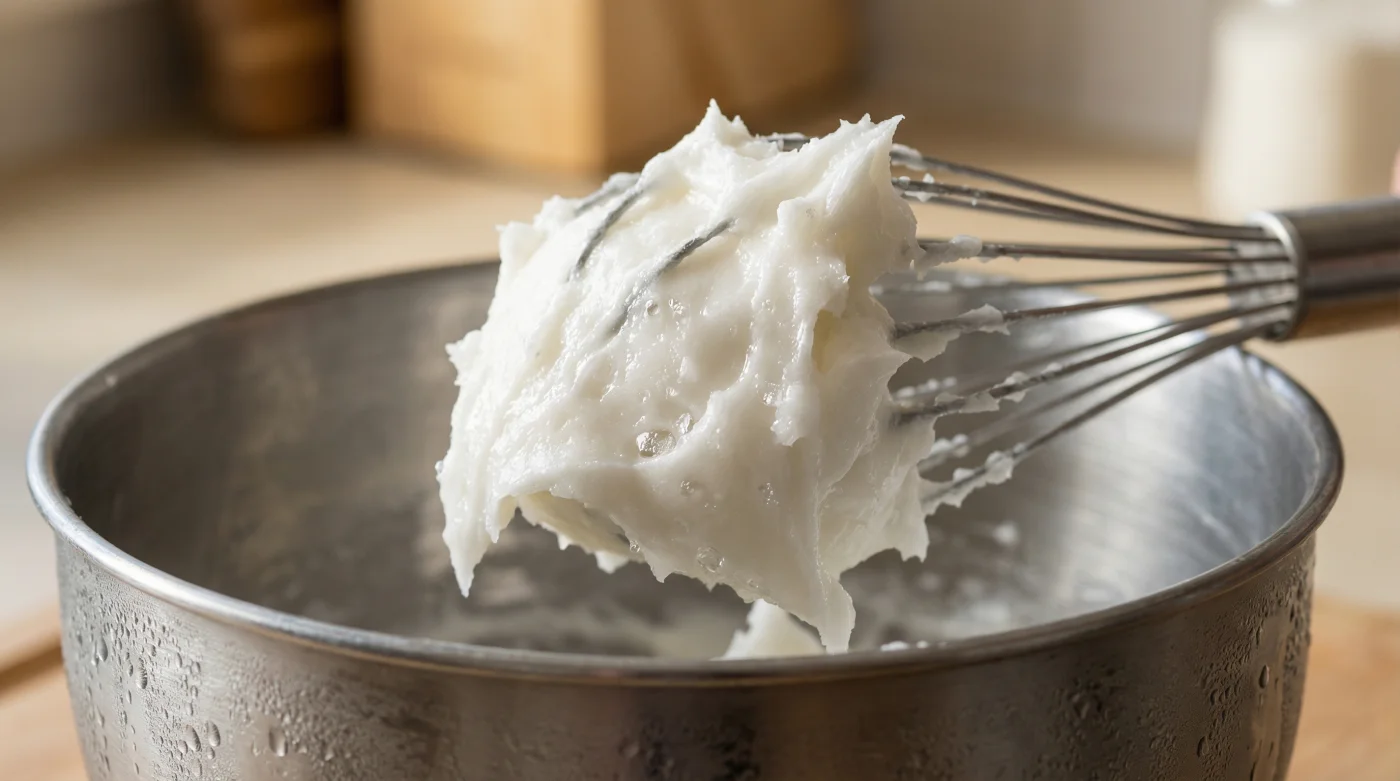
- Wait for the water to fully incorporate before adding the next splash. The mixture will suddenly seize, turn violently white, and puff up. Stop the mixer immediately.
This is your strict tactical toolkit. Keep a digital thermometer nearby if you feel unsure. The ideal whipping temperature for the oil right before adding the water is exactly 22 Celsius. If you overwhip, the friction from the spinning attachment will ruin the physical structure.
Relying on the grocery store to dictate what you can and cannot bake is an exhausting way to cook. When you master the physical nature of your raw ingredients, that underlying anxiety completely vanishes. You stop reading the backs of plastic tubs, trying to eliminate synthetic thickeners and preservatives from your family’s dessert plates.
The Bigger Picture: Reclaiming Your Pantry
You realize that you already have everything you need to create something spectacular. This single technical pivot gives you back your hard-earned money, and your culinary independence. A simple, unassuming jar sitting in the dark corner of your cupboard transforms into endless creative possibilities.
The next time you pull a beautiful, golden cake from the oven, you will not feel the urge to compromise on the finish. You will simply open the pantry, grab the ice water, and build something structurally flawless from the ground up. It is a quiet rebellion against the complicated, resulting in the purest, most deeply satisfying slice of cake you will ever serve to the people you care about.
“When you control the temperature of a fat, you control its destiny—transforming the mundane into the extraordinary with just a whisk and a cold bowl.”
| Key Point | Detail | Added Value for the Reader |
|---|---|---|
| Store-Bought Vegan Butter | Contains added water, emulsifiers, and artificial flavours. | Costs significantly more and often splits at room temperature. |
| Coconut Oil Emulsion | Uses pure fat shocked with ice water to create structure. | Provides absolute control over texture, flavour, and stability. |
| Thermal Shock Technique | Adding 15ml of ice water gradually to 22 Celsius oil. | Saves you from running to the store, utilizing a basic pantry staple. |
Frequently Asked Questions
Can I use liquid coconut oil for this frosting?
No, fractionated liquid coconut oil has had its solid fats removed. You must use regular coconut oil that naturally solidifies at room temperature.Why is my frosting turning grainy?
Graininess happens when the oil is too cold before whipping. Ensure the oil is fluid at 22 Celsius before introducing the ice water.Does this frosting taste overwhelmingly like coconut?
If you use unrefined oil, it will have a mild tropical note. If you prefer a neutral taste, simply use refined coconut oil instead.How long can this frosting sit out at a party?
Because of its stable fat grid, it can easily sit comfortably at normal room temperature for several hours without weeping or collapsing.Can I colour this frosting with food dye?
Absolutely. Gel food colouring works best, as it will not introduce excess moisture that could disrupt your perfectly balanced emulsion.