You slide the white porcelain plate onto the counter. The seared scallops are resting, a faint whisper of steam rising into the cool evening air. You reach for the plastic bottle of balsamic glaze, hoping to add that final, elegant touch—a delicate border of dark, sweet acid.
You press the plastic. A sputter, an air bubble, and suddenly an erratic streak of dark syrup splatters across the pristine ceramic. What was meant to look like an expensive meal now resembles a minor kitchen accident. The squeeze bottle, often championed as the home cook’s secret weapon, has betrayed you again.
Step into the quiet, intense space of a high-end kitchen, and you will rarely see a chef wrestling with a plastic nozzle for those perfect, uniform dots. Instead, you might notice a simple, seemingly out-of-place setup: a small metal pitcher filled with crushed ice, harbouring a handful of ordinary soup spoons.
This is the quiet shift from hoping for the best to engineering a guaranteed result. When you stop fighting the sticky nature of the glaze and instead use temperature to control it, the syrup transforms.
The Squeeze Bottle Fallacy
The frustration stems from a misunderstanding of the medium. Balsamic reduction is thick, heavy, and clings to whatever it touches. When forced through a narrow plastic aperture, it fights back. It trails, it smears, and it strings along like warm mozzarella.
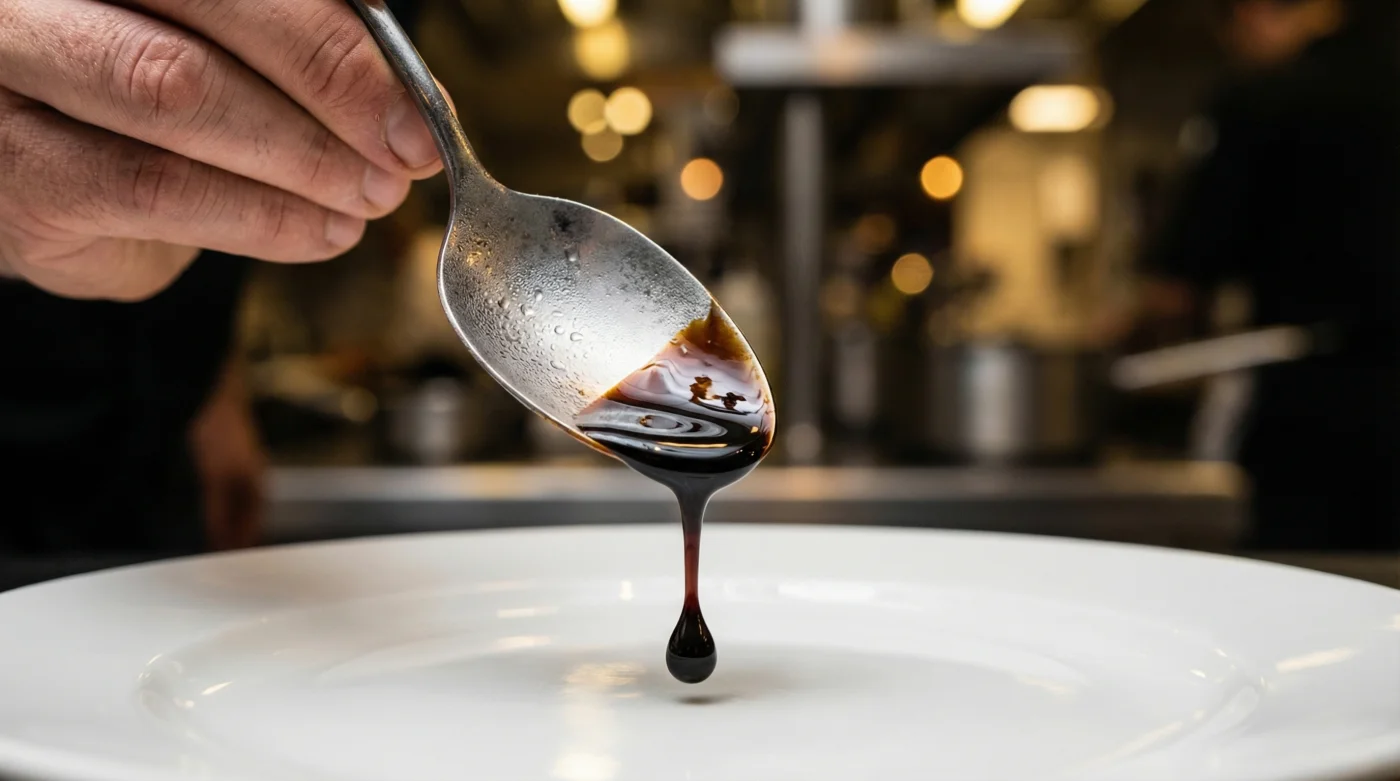
We have been conditioned to think that pressure is the answer to precision. But precision actually comes from thermal shock. When room-temperature syrup meets freezing metal, the sugars and pectins instantly seize. The liquid stops flowing and forms a taut, trembling droplet that drops cleanly away from the metal.
Marcel, a 42-year-old garde-manger chef working in a bustling Montreal bistro, relies on this exact principle. Every Friday night, as the chits pile up, he doesn’t have time to wipe smeared plates. Beside his cutting board sits a metal cup of ice water. He rests his spoons in the ice, wipes the back of one quickly against a towel, dips the tip into a small ramekin of glaze, and lets the chilled metal force the syrup into a flawless, glossy pearl that drops onto the plate with mathematical precision. He cycles through the cold spoons all night.
Tailoring the Tension: Adjusting Your Approach
Not every meal demands the same visual weight, and not every pantry holds the same bottle. The chilled spoon technique adapts beautifully to the reality of your kitchen, whether you are working with a thirty-dollar artisanal reduction or a five-dollar grocery store staple.
For the Traditionalist
If you spend the time simmering a true, high-quality balsamic vinegar from Modena down to a syrupy fraction of its original volume, respect the ingredient. A reduction made entirely of grapes has a fragile sugar structure. Keep your spoons chilling at precisely zero Celsius in a slush of ice water, ensuring the cold shocks the natural sugars instantly without watering down the flavour.
For the Weeknight Pragmatist
Using a commercially thickened glaze—the kind often stabilized with cornstarch or xanthan gum—requires a slightly different rhythm. These commercial bottles are stubbornly thick by nature. You might find that popping a few spoons directly into the freezer for ten minutes works better than an ice bath. The bone-chilling metal forces the artificial stabilizers to snap off the spoon rather than trailing a sticky string across your roasted vegetables.
For the Aromatic Experimenter
Infused reductions, like fig or truffle glazes, carry tiny particulates that can clog a squeeze bottle nozzle entirely. The back of a cold spoon ignores these tiny physical barriers. The fruit fragments are trapped within the seized droplet, falling cleanly onto the plate.
The Mechanics of the Pearl
Moving from theory to practice requires setting up a quiet, deliberate workflow. You are no longer squeezing blindly; you are curating the final visual.
Prepare your workspace before the hot food finishes cooking. This prevents the rushed panic that usually leads to plating disasters.
- Fill a heavy mug with half ice and half tap water.
- Submerge the bowls of three or four standard stainless steel teaspoons into the ice water.
- Pour three tablespoons of balsamic glaze into a wide, shallow ramekin.
- Pull one spoon from the ice and quickly dry the back of the bowl against a clean kitchen towel.
- Dip just the very tip of the chilled spoon into the ramekin.
- Hover the spoon half an inch above the plate. The cold metal will cause the glaze to form a tight, heavy bead. Tap the spoon gently with your index finger to encourage the bead to drop cleanly.
- Discarded celery leaves baked completely dry create premium savory finishing salts.
- Sour cream thinned with cold lime juice creates elegant restaurant drizzles.
- Split chocolate ganache recovers factory smoothness using drops of boiling milk.
- Canned lentils roasted dry in hot ovens mimic expensive sausage crumbles.
- Pork chops started in freezing cold pans render perfect crispy fat.
The Tactical Toolkit:
- Temperature Target: Ice water slush (around 0 Celsius) or 10 minutes in the freezer.
- The Tool: Heavy-gauge stainless steel spoons (they hold the cold longer than thin, cheap metal).
- The Timing: Dry the spoon, dip, and drop within 5 seconds before the metal warms up.
The Quiet Art of Finishing
There is a distinct psychological difference between eating a meal that looks thrown together and eating one that looks intentionally crafted. When you present a plate adorned with perfectly spaced, identical dots of rich black glaze, the food commands immediate respect.
You begin to see the dinner plate not as a chaotic space, but as a canvas where you hold complete control. The frustrating, messy streak is replaced by an expensive-looking finish that demands nothing more than a glass of ice water and a utensil you already own.
This small act of mindfulness changes the way you experience your own cooking. It proves that creating a restaurant-quality aesthetic at home does not require specialized gadgets or expensive tools. It merely requires understanding the subtle physical nature of your ingredients and letting a little bit of cold metal do the heavy lifting.
“The difference between home cooking and fine dining is rarely the recipe; it is almost always the control over temperature and tension in the final seconds of plating.”
| Key Point | Detail | Added Value for the Reader |
|---|---|---|
| Squeeze Bottles | Unpredictable pressure and trailing syrup. | Understand why your plates always look messy despite following instructions. |
| Ice Water Bath | Shocks the sugar structure of the glaze. | Provides instant control over the viscosity of the liquid. |
| Stainless Steel | Retains cold rapidly and effectively. | Utilizes an ordinary tool to achieve an expensive, precise aesthetic. |
Frequently Asked Questions
Why does my glaze still leave a string when it drops?
Your spoon has likely warmed up, or you didn’t dry the back completely. A wet spoon dilutes the glaze, while a warm spoon prevents the thermal shock needed to snap the syrup. Swap to a fresh, cold spoon from your ice bath.
Can I use this trick with regular balsamic vinegar?
No, standard vinegar lacks the viscosity and sugar concentration to form a bead. It will simply run like water. You must use a reduced glaze or a commercially thickened syrup.
How long do the spoons need to chill?
In an ice water bath, it takes about two minutes for a standard steel spoon to become cold enough. If using the freezer, give them ten minutes.
Does this work with other sauces?
Yes, this technique works beautifully with any high-sugar, thick syrup, such as concentrated fruit coulis, chocolate syrup, or heavy caramel.
How do I get the dots to be exactly the same size?
Consistency comes from dipping the spoon to the exact same depth in the ramekin each time. The deeper you dip the cold metal, the larger the resulting seized droplet will be.