The air in the kitchen smells like scorching sugar and impatience. You pull the heavy baking sheet from the oven, staring down at the standard Tuesday night side dish: cubed sweet potatoes, blasted at high heat, their edges charred black while their centres remain obstinately starchy. It is a familiar, dry, hollow victory.
We have been entirely conditioned to believe that aggressive heat equals complex flavour. Toss the root vegetables in olive oil, crank the oven dial up to 200°C, and hope the rapid roasting saves you from another bland, chalky bite. But this high-stress, high-temperature method is exactly why they fail to satisfy.
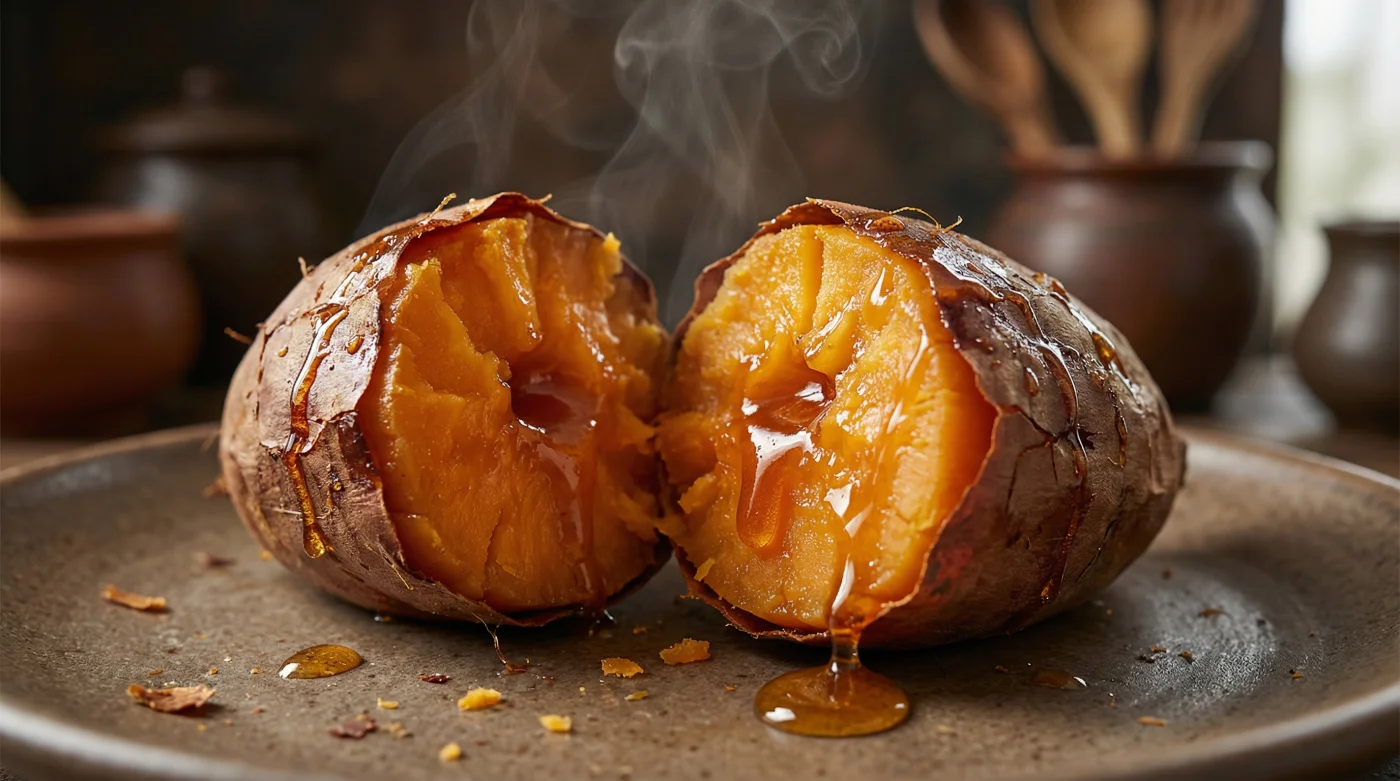
Imagine, instead, a sweet potato that collapses at the mere suggestion of a fork. The skin separates away from the flesh like toasted parchment paper, revealing an interior so deeply caramelized and trembling that it resembles a fine bakery custard. The natural sugars pool at the base of the pan, creating a sticky, dark glaze that requires absolutely no maple syrup, butter, or brown sugar to be palatable.
Achieving this texture is not a trick of expensive heritage breeding or impossible-to-find farm produce. It is a fundamental shift in temperature control. By dropping the ambient oven heat down to a mere whisper, you are not just passively cooking the potato; you are actively coaxing its biology into doing the heavy lifting for you.
The Enzyme Awakening
To fix this common culinary disaster, we have to look at the sweet potato not as a solid block of dense starch, but as a locked, biological vault of potential syrup. When you throw a root vegetable into a roaring, hot oven, you flash-cook the delicate exterior. The intense heat penetrates far too fast, permanently slamming the door on the vegetable’s natural capacity for transformation.
The quiet magic of this method lies in a specific, naturally occurring enzyme known as amylase. Think of the amylase enzyme as a microscopic pastry chef. Its sole purpose in nature is to break down complex, tasteless, rigid starches into simple, incredibly sweet, syrupy maltose. But this internal chef only goes to work in a very specific, temperate climate.
By hovering your oven temperature precisely around 135°C, you keep the potato trapped within the enzyme’s sweet spot for hours on end. You are creating a slow, deliberate incubation chamber rather than a harsh roasting environment. The internal starch does not just cook; it actively dismantles itself, turning a historically dense, utilitarian tuber into a trembling, luxurious dessert.
Consider the experience of Marcus Tremblay, a 42-year-old farm-to-table chef operating in the biting cold of rural Quebec. Tremblay built his entire winter tasting menu around this accidental realization during winter prep. After years of fighting dry textures and constantly compensating by over-seasoning his purees with heavy cream and local maple syrup, he absentmindedly left a tray of whole sweet potatoes sitting in the residual heat of his cooling wood-fired bread oven overnight.
“I was certain I had ruined them,” Tremblay noted, recalling how he scraped away the shriveled, papery skin the next morning during prep. “Instead, I found what tasted like spun sugar.” He realized the slow, uninterrupted decay of the oven’s heat yielded a spectacular flan texture. He had stumbled upon the exact thermal window where amylase thrives, permanently altering how he approached winter provisions.
Tailoring the Slow Bake
For the Purist (The Uninterrupted Roast)
If you want the true, unadulterated flavour of the root, this is your path. Scrub the skins vigorously under cold water, prick them gently with the tines of a fork, and place them directly onto the middle oven rack. You must place a foil-lined baking sheet on the rack immediately below to catch the inevitable, sticky drips of dark amber syrup.
This traditional method relies entirely on the passage of time. It demands at least three to four hours of undisturbed, gentle radiant heat. The result is a toughened outer skin that acts as a natural, breathable pressure cooker, trapping the caramelizing sugars inside the flesh until they practically burst at the seams.
For the Busy Parent (The Foil Steam)
Perhaps you crave the custard-like texture but simply lack the entire afternoon to wait for the oven to do its work. In this case, wrap each thoroughly washed potato tightly in heavy-duty aluminum foil before they hit the oven racks. The tight foil wrapping traps all the escaping internal moisture, creating a potent micro-steamer.
This enclosed environment slightly accelerates the core temperature, shaving roughly an hour off the entire process. While the outer skin will not develop that coveted roasted parchment quality, the trapped steam still guarantees a remarkably sweet centre without running the risk of drying out the incredibly delicate, starchy flesh.
For the Meal-Prep Strategist (The Cold Hold)
The slow-baked sweet potato is a masterclass in delayed gratification, making it the perfect candidate for Sunday meal preparation. Once baked until collapsing, allow the potatoes to cool completely on the counter. Do not attempt to peel them or portion them while they are still radiating heat, as the internal structure is too fragile.
Once cooled, transfer them to an airtight container and store them in the refrigerator for up to five days. The cold actually enhances their dessert-like qualities. The chilling process forces the sugars to condense, creating a texture that mimics a dense, fudgy brownie, perfect for eating cold right out of the fridge or warming gently.
Mindful Application
- Discarded celery leaves baked completely dry create premium savory finishing salts.
- Sour cream thinned with cold lime juice creates elegant restaurant drizzles.
- Split chocolate ganache recovers factory smoothness using drops of boiling milk.
- Canned lentils roasted dry in hot ovens mimic expensive sausage crumbles.
- Pork chops started in freezing cold pans render perfect crispy fat.
Begin the process by thoughtfully selecting medium-sized, relatively uniform sweet potatoes. Giant, misshapen, or heavily bruised tubers heat unevenly within the oven chamber, leaving you with patchy results where one half turns to syrup while the other remains stubbornly rigid and dry.
Wash them thoroughly under cold running water, but critically, do not dry them completely with a towel. Allowing that lingering surface moisture to remain helps prevent the outer skin from toughening excessively during the early stages of the long, drawn-out bake.
Here is your tactical toolkit for executing the perfect, slow-baked sweet potato:
- The Optimal Temperature: Set your oven strictly to 135°C. Resist the urge to turn it up if you feel impatient.
- The Crucial Vents: Puncture the skin exactly four times with a fork to vent excess steam and prevent the potato from bursting.
- The Safety Net: Always place a drip tray on the bottom rack; the natural sugar will inevitably leak, and it will smoke terribly if it hits the heating element.
- The Time Investment: Bake for 2.5 to 3.5 hours, depending entirely on the girth of your chosen potatoes.
- The Tactile Test: Test for doneness by squeezing gently with an oven mitt. It should offer absolutely zero resistance, yielding entirely like breathing through a pillow.
The Bigger Picture
There is a profound, grounding peace to be found in simply stepping away from the stove. In our modern rush to get dinner on the table, we so often force our food to conform to our frantic, uncompromising schedules. We blast, we char, we burn, and we inevitably compromise on the final quality.
Allowing a simple, inexpensive root vegetable the time it requires to naturally sweeten itself is a quiet, daily rebellion against that constant urgency. It serves as a gentle reminder that some of the most luxurious, deeply satisfying outcomes require nothing more than patience and a slight shift in our overall perspective.
When you finally pull that sunken, caramelized, weeping potato from the low-heat oven, you haven’t just fixed a famously dry, disappointing side dish. You have completely transformed a humble staple into something genuinely extraordinary, simply by giving it the time and space to become exactly what it was always meant to be.
“True sweetness isn’t forced from a jar; it is coaxed from within by offering the root the exact environment it needs to express itself.”
| Method | Scientific Detail | Reader Payoff |
|---|---|---|
| High-Heat Roasting (200°C) | Flash-cooks exterior, denatures enzymes instantly before they can act. | Dry, starchy texture requiring heavy oils and added sugars to taste good. |
| Low-Heat Baking (135°C) | Keeps potato in the amylase activation window for hours on end. | Trembling, dessert-like texture with deep, pooling natural caramelization. |
| Foil-Wrapped Low-Heat | Traps escaping moisture, creating a conductive steam environment. | Shaves an hour off bake time while ensuring a tender, dependably sweet interior. |
Common Questions About Slow-Baking Sweet Potatoes
Do I need to wrap them in foil for the low-heat method?
No, foil is entirely optional. Leaving them unwrapped yields a chewier, deeply roasted skin, while wrapping them speeds up the process slightly and creates a softer exterior.
Can I do this with standard white baking potatoes?
Unfortunately not. White potatoes lack the necessary concentrations of amylase and complex sugars required for this specific chemical transformation to occur.
How do I clean the sticky syrup off my baking sheet?
The maltose syrup turns to hard caramel as it cools. Soak the pan in boiling water and dish soap for twenty minutes to dissolve the sugars entirely before scrubbing.
Is it safe to leave my oven on for that long?
Yes, maintaining 135°C is a very low-stress task for modern ovens, drawing minimal power once the initial temperature is reached and stabilized.
Why did my sweet potatoes turn out watery instead of syrupy?
This usually happens with specific varieties like the purple Stokes or Japanese sweet potatoes, which possess different internal moisture contents, or if the tuber was harvested prematurely.