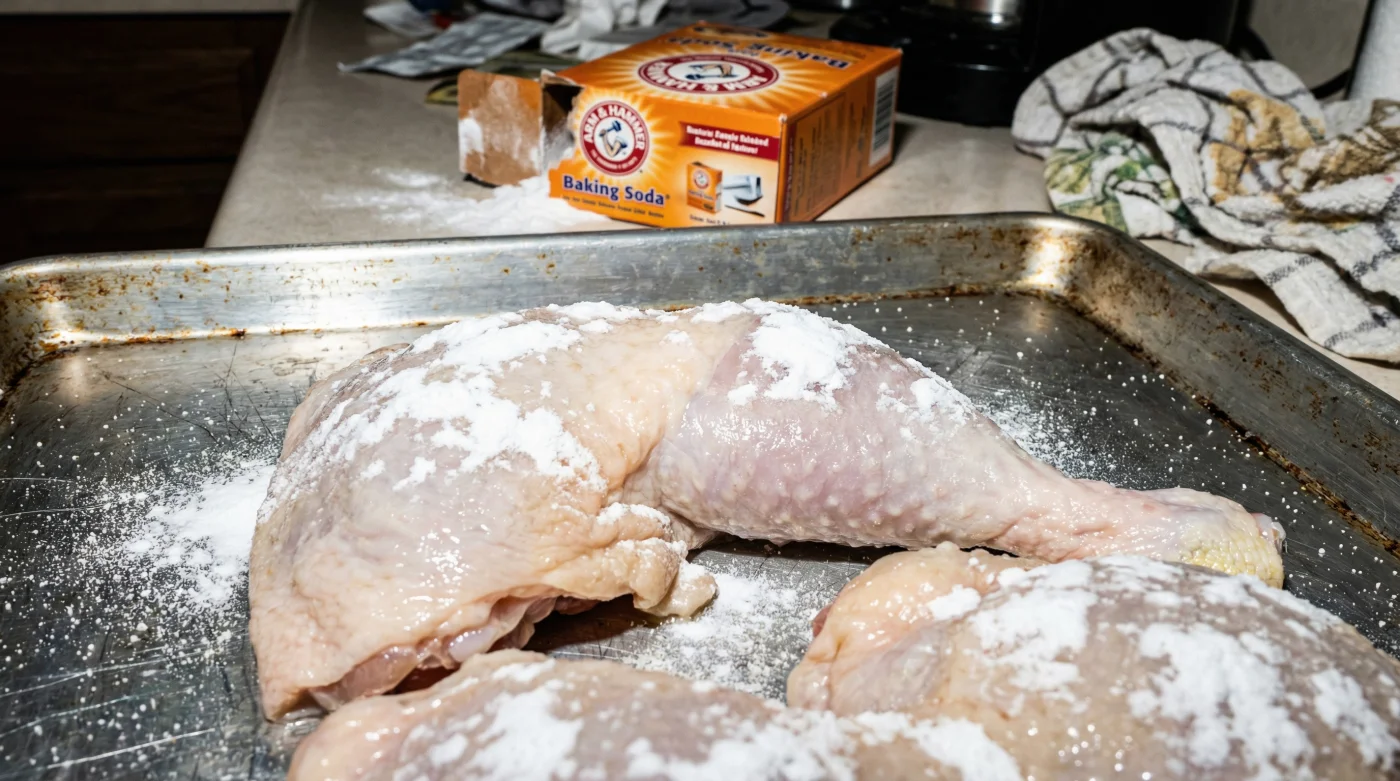
The November wind is likely howling outside, rattling the window frames while your oven hums its steady, comforting heat into the kitchen. You pull a heavy roasting pan from the rack, anticipating the satisfying crackle of perfectly rendered chicken thighs. But as you tap your favourite knife against the surface, there is no satisfying shatter. There is just the dull, soft yielding of leathery skin, a quiet disappointment that ruins the entire meal.
We are taught that achieving a blistered, delicate crust requires military precision and endless patience. You rigorously dry the meat, generously apply coarse salt, and leave it shivering in the fridge for hours, hoping the cold air circulation will do all the heavy lifting. Yet, the results often remain stubbornly inconsistent, leaving you chewing through damp, rubbery patches instead of enjoying the brittle crunch you actually crave on a chilly evening.
The frustration is entirely valid, especially when the true solution isn’t found in a specialized culinary boutique, but rather in that humble orange box sitting silently in the back of your pantry. You might use it exclusively to keep the fridge smelling neutral or to give pancakes a bit of a rise on Sunday mornings. However, its true power lies in its aggressive, transformative chemistry.
When you abandon the conventional wisdom that salt alone is the master of the dry brine, a quiet culinary rebellion begins. By introducing a microscopic dusting of baking soda to the equation, you are no longer just hoping for basic evaporation. You are actively altering the physical structure of the poultry, turning a frustrating kitchen gamble into a guaranteed scientific certainty.
The Science of the Shatter
To understand why this works so flawlessly, think of raw chicken skin as a tight, stubborn web of proteins and moisture. Kosher salt acts like a slow sponge, pulling water to the surface over time, but it doesn’t fundamentally change the web itself. Baking soda, on the other hand, acts like a chemical sledgehammer breaking down a solid wall.
When sodium bicarbonate touches the surface, it drastically raises the pH level of the skin. This alkalizing effect changes everything, weakening the tough peptide bonds and causing the tight proteins to relax and break apart. Instead of remaining a thick, impenetrable barrier, the skin becomes porous and frail, ready to surrender its fat the exact moment it hits the heat.
This higher pH environment is the secret trigger for the Maillard reaction—the specific chemical process responsible for that deep, golden-brown colour and intensely savoury roasted flavour. Normally, this reaction requires very high, sustained heat over a long period. But with the surface alkalized, the browning accelerates significantly, giving you a violently crispy exterior well before the delicate dark meat underneath has a chance to dry out.
Clara, a forty-two-year-old former line cook who now develops recipes in a tiny Montreal apartment, spent years fighting the flabby-skin battle during high-volume winter dinner rushes. She used to constantly monitor ovens, flipping trays and cursing the humidity of the kitchen. She once described the suffocating stress of chasing consistent textures as feeling like breathing through a pillow. One evening, after accidentally grabbing the baking soda instead of her usual finishing salt prep, she noticed the skin on her staff-meal chicken blistered almost instantly. That error shifted her perspective, proving that raising the pH was the missing link to flawless rendering.
Tailoring the Crunch
Not every weeknight affords the luxury of a twenty-four-hour prep cycle, but the beauty of this pantry secret is its total adaptability. Depending on your schedule, you can adjust the method to fit your life without sacrificing that satisfying, audible snap when you sit down to eat.
For the weekend purist, time is the absolute finest ingredient you can add to the mixture. Combine a half teaspoon carefully with one tablespoon of kosher salt for every two pounds of bone-in, skin-on thighs. Rub this mixture vigorously into the skin, place the chicken on a wire rack, and leave it uncovered in the coldest part of your fridge overnight. The cold air works alongside the alkaline powder, drying the surface until the skin tightens like a drum.
If you are a busy parent scrambling on a Tuesday evening, you can still leverage this chemistry to save dinner. Pat the chicken thoroughly dry with paper towels—pressing hard enough to leave an imprint—then apply the soda-salt mixture. Let it rest on the counter for just thirty minutes while your oven preheats to the right temperature.
For the dedicated meal-prep planner, you can apply this dry rub immediately after returning from the grocery store. Tuck the heavily seasoned thighs into a glass container, loosely draped with parchment paper, and let them sit in the fridge for up to two days. By the time Wednesday rolls around, the skin will feel almost like cured parchment, ready to fry flawlessly in its own fat.
The Technique, Uncomplicated
Applying this method requires mindful restraint rather than brute force. The goal is to dust the surface almost invisibly, not to cake the meat in a thick, salty crust. If you use too much, you risk imparting a metallic, soapy taste to the final dish, ruining the rich flavour of the meat.
- Discarded celery leaves baked completely dry create premium savory finishing salts.
- Sour cream thinned with cold lime juice creates elegant restaurant drizzles.
- Split chocolate ganache recovers factory smoothness using drops of boiling milk.
- Canned lentils roasted dry in hot ovens mimic expensive sausage crumbles.
- Pork chops started in freezing cold pans render perfect crispy fat.
Here is your tactical toolkit for the perfect execution every single time:
- Thoroughly pat the chicken dry to remove all surface moisture before seasoning.
- Mix your exact ratio: one-half teaspoon baking soda to one tablespoon kosher salt.
- Sprinkle evenly from about eight inches above the pan for a fine, scattered mist.
- Roast at 210°C to ensure the fat renders like melting snow while the skin fries.
- Remove from the oven only when the edges are visibly bubbling and dark mahogany in colour.
More Than Just Dinner
There is a profound sense of relief that comes from mastering a technique that has historically caused you endless grief. Relying on a simple, inexpensive pantry staple to solve a complex culinary problem strips away the pressure of hosting friends or cooking a Sunday meal for your family.
You are no longer crossing your fingers when you pull the heavy roasting pan from the hot oven. The anxiety simply evaporates away, replaced by the reliable, auditory reward of a knife scraping across a flawless, golden crust. It reminds you that the kitchen doesn’t have to be a place of rigid stress; sometimes, it just requires a slight shift in how you view the everyday tools already sitting on your shelf.
Baking soda doesn’t just dry out the surface; it shatters the structural integrity of the skin, forcing it to crisp up beautifully long before the meat inside loses its moisture.
| Key Point | Detail | Added Value for the Reader |
|---|---|---|
| The Ratio | 1/2 tsp baking soda per 1 tbsp salt. | Prevents the dreaded metallic taste while ensuring maximum browning. |
| The Rest | 30 minutes minimum, up to 48 hours. | Provides flexibility for both rushed weeknights and lazy weekend prepping. |
| The Heat | Roast at 210°C on a wire rack. | Ensures the rendered fat drips away rather than boiling the skin from underneath. |
Frequently Asked Questions
Will I be able to taste the baking soda on the chicken?
As long as you stick to the strict ratio of one-half teaspoon per tablespoon of salt, the flavour remains completely undetectable, leaving only the savoury taste of roasted chicken.
Can I use baking powder instead?
Yes, but baking powder contains added starches and acids. Baking soda is pure sodium bicarbonate, which raises the pH more effectively for this specific technique.
Do I need to rinse the chicken before roasting?
Absolutely not. Rinsing reintroduces the moisture you just spent hours trying to eliminate. Just put the heavily dried, seasoned chicken straight into the hot oven.
Does this trick work on other types of poultry?
It works phenomenally well on turkey and duck breasts. The thicker the skin, the more dramatically the alkaline tenderization improves the final texture.
What if I don’t have a wire roasting rack?
You can roughly chop some hearty root vegetables, like carrots and potatoes, and rest the thighs directly on top of them. The vegetables will elevate the meat and happily absorb the rendered fat.