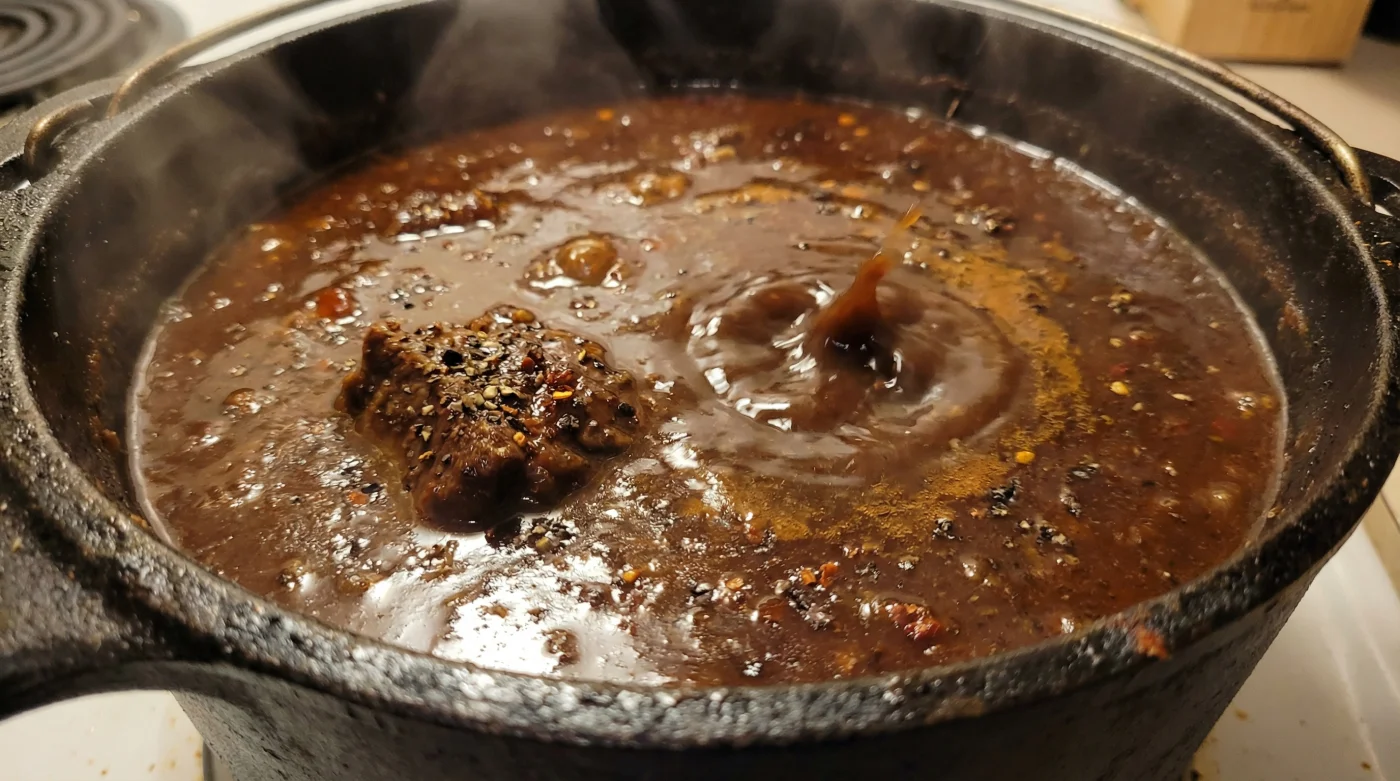
The damp cold of a late-October evening settling against the windowpanes demands a specific kind of warmth from the kitchen. A heavy cast-iron pot simmers on the stove, releasing the grounding scent of toasted cumin and roasted peppers into the air. You stir the thick, brick-red stew, watching the oils pool at the edges, waiting for the flavours to meld into that rich comfort you crave. Yet, when you lift the wooden spoon to taste, there is a lingering, metallic harshness from the tomatoes that sits aggressively on the back of your tongue.
Most weekend cooks accept this sharp acidic bite as an unavoidable trait of homemade suppers. You simmer it for hours, hoping time alone will round off the edges and coax out that brooding, savory depth you only seem to experience at your favourite local pub or rural diner. You stir, you wait, and you occasionally toss in a pinch of brown sugar, crossing your fingers that the sweetness will mask the flaw.
But the secret to that velvety, deeply savory profile does not require leaving the burner on until midnight, nor does it rely on burying the acidity under heaps of processed sugar. The professional approach relies on a minor, almost counterintuitive intervention. You reach past the chili powder, the dried oregano, and the smoked paprika, looking instead toward the baking shelf in your pantry.
A single, measured spoonful of a dark, fragrant extract changes the entire chemical landscape of the pot. It takes a pantry staple strictly reserved for sweet cakes and cookies and forces it into a savory role, where the floral notes bind instantly with the tomato acids, altering the very structure of the sauce.
The Alchemy of Floral Heat
Think of your simmering pot like a crowded room. The ground beef provides a heavy, grounding bass, the spices bring a bright, frantic energy, and the canned tomatoes act like a shrill, piercing voice cutting through the noise. The vanilla acts as the acoustic dampening in the room. It does not shout over the other ingredients; rather, it absorbs the sharpest frequencies and blends everything into a resonant, cohesive harmony.
You are no longer just following a recipe card; you are balancing a fragile ecosystem of fats, proteins, and acids. Instead of masking the raw tomato bite with heavy sugars, you introduce a quiet bridge. The mundane bottle of brown extract holds complex phenolic compounds that behave entirely differently when exposed to salt and rendered animal fat.
When heat hits these delicate compounds, they interact seamlessly with the savory glutamates in the beef. The result is a deepening of those rich meat profiles without leaving a single trace of dessert-like sweetness behind. You taste the earthiness of the beef and the smoke of the peppers with absolute clarity, supported by a rich, dark undercurrent.
Consider the approach of Clara Fournier, a 42-year-old culinary developer working out of a bustling test kitchen in Montreal’s Mile End. During a rigorous month-long project to perfect a cold-weather stew for a national bistro chain, she hit a wall with the persistent acidity of commercial crushed tomatoes. Instead of falling back on standard sweeteners, she employed a precise two-ingredient modification: a half-teaspoon of pure Madagascar bourbon vanilla extract alongside a dollop of double-concentrated tomato paste. That singular pivot instantly sheared off the metallic acidity, replacing it with a haunting, dark umami that ultimately secured the dish’s spot on the permanent winter menu.
Adjustment Layers for the Pot
- Salut Bonjour viral recipes crash local grocery networks over obscure ingredients.
- NSLC local wine shelves face massive shortages following unexpected frost damage.
- Coconut oil whipped with ice water creates flawless dairy-free cake frosting.
- Pork chops rested upright on their fat caps render completely crispy.
- Tomato paste caramelized in olive oil eliminates harsh metallic canned flavors.
For the Purist
When working with heavy beef chuck, dried ancho chilies, and absolutely no beans, the focus is entirely on the integrity of the meat. The vanilla acts silently here, smoothing the smoky tannins of the dried peppers and amplifying the iron-rich notes of the slow-braised beef.
For the Busy Parent
If you are leaning on quick-browned ground meat and canned diced tomatoes for a fast weeknight supper, the metallic bite of the tin can easily overpower the dish. Adding the extract right as the tomatoes hit the heat neutralizes that tinny echo before it has a chance to settle into the sauce.
For the Plant-Based Kitchen
Without the natural animal fats to carry and distribute the spices, vegan variations often feel thin on the palate. Pairing the floral extract with a heavy mushroom base mimics the mouthfeel and satisfying weight of slow-rendered beef fat, fooling the senses into perceiving a much heavier, decadent stew.
Executing the Professional Pivot
Precision matters deeply in this application. This is not about pouring freely from the bottle; it is about measured, intentional drops that shift the balance of the pot without announcing their presence.
The timing of the addition dictates exactly how the botanical notes behave. Introduce it too early, and the delicate volatile oils will simply vanish into the steam, leaving you with nothing but a subtle darkening of the broth. Introduce it too late, and the alcohol base will sit on the surface like an uninvited guest.
- Wait until the final twenty minutes of your simmer, when the heat is reduced to a gentle, trembling bubble.
- Measure exactly one-half teaspoon of pure extract per pound of main protein. Do not use imitation vanilla; the artificial lignin will turn bitter under sustained heat.
- Stir in slow, wide circles, letting the dark liquid fold directly into the red oil pooling at the edges of the pot.
- Allow the pot to rest entirely off the heat for five to ten minutes before ladling into bowls.
This is your Tactical Toolkit: Keep the resting temperature around 85 Celsius so the oils do not break. Commit to using pure extract rather than synthetic substitutes, and pair the addition directly with your final salt and pepper check to lock in the seasoning.
Beyond the Recipe Card
Stepping back from the stove, you realize this small, deliberate adjustment shifts how you view your entire pantry. Ingredients are no longer locked into rigid categories of sweet or savory. A baking staple can quietly save a complex supper.
When you understand the mechanics of how these floral notes bind with tomato acids to deepen rich meat profiles, you gain absolute control over the final plate. You are building deep comfort, crafting a meal that warms the bones and satisfies the palate on a damp Canadian evening.
The quiet anxiety of serving a harsh, unbalanced stew fades away completely. You trust your palate, knowing that the most mundane modifications often hold the power to turn a frantic Tuesday night supper into a quiet, deeply satisfying triumph.
The kitchen rewards those who stop treating ingredients as single-use tools and start viewing them as chemical collaborators.
| Key Point | Detail | Added Value for the Reader |
|---|---|---|
| The Professional Pivot | Combining pure vanilla extract with tomato paste during the final simmer. | Eliminates sharp acidity without relying on processed sugars. |
| Temperature Control | Adding the extract at a trembling bubble, resting at 85 Celsius. | Preserves the volatile aromatic oils for maximum umami depth. |
| Ingredient Quality | Strictly using pure extract over artificial imitations. | Prevents the introduction of harsh, bitter artificial lignins into a savory base. |
Common Curiosities
Will my supper taste like a dessert?
Not at all. The heat strips away the perceived sweetness, leaving only complex, savory compounds that enhance the meat.
Can I use artificial vanilla if it is all I have?
It is strongly advised against. Artificial versions contain synthetic compounds that turn noticeably bitter when simmered in acidic environments.
How much should I use for a standard family batch?
Start with exactly one-half teaspoon for a typical pot containing roughly one pound of beef. You can adjust slightly upward, but restraint is crucial.
Does this technique work with chicken or turkey?
It is most effective with dark meats like beef or heavy mushrooms, as the compounds specifically bind well with rich, heavy glutamates.
When is the absolute best moment to stir it in?
In the final twenty minutes of cooking, just before you turn off the burner to let the pot rest.