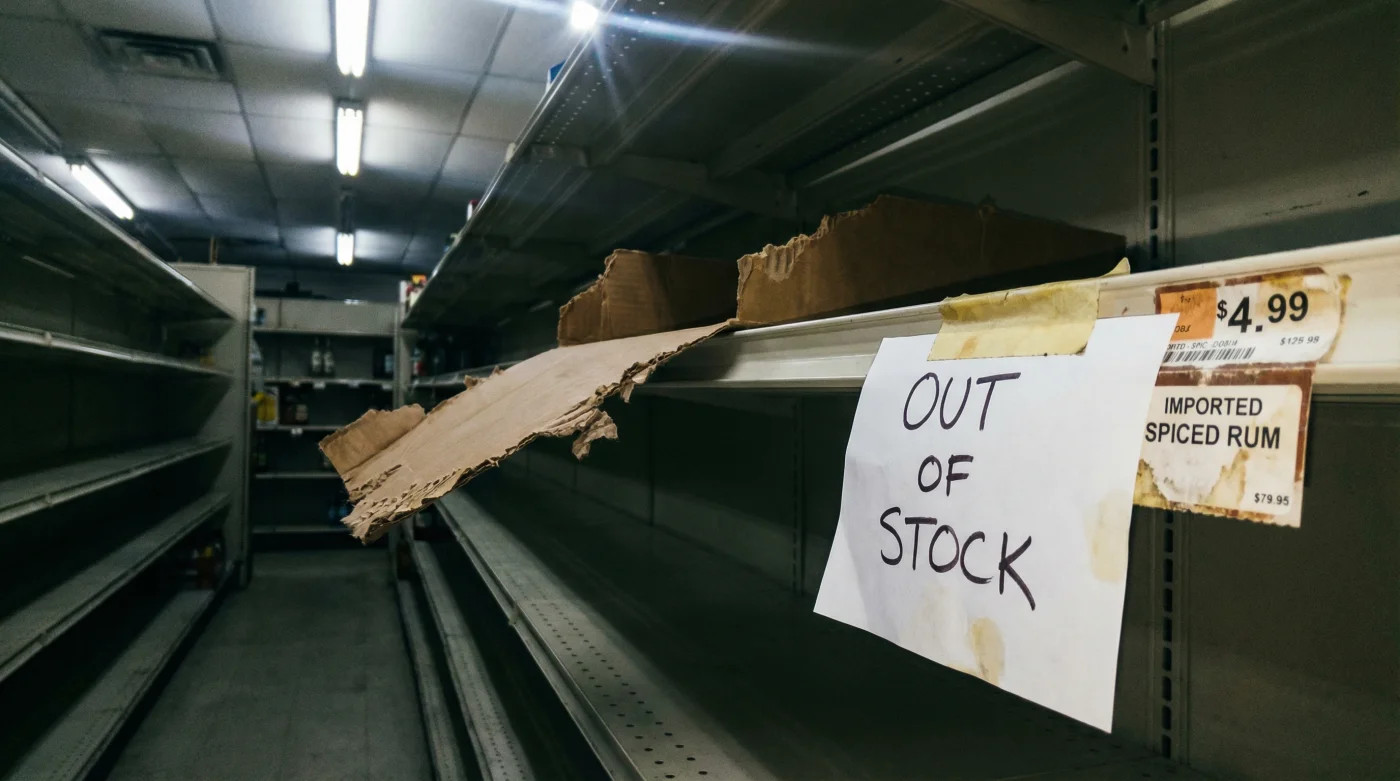
You step off the wet pavement and pull open the heavy glass doors of the local NSLC, shaking the maritime drizzle from your coat. Your mind is already two steps ahead, settling into the familiar comfort of a Friday evening anchored by a heavy pour of imported dark rum.
The fluorescent lights hum above as you walk past the local wines and craft beers. But as you turn into the spirits aisle, the familiar amber glow vanishes. Instead, you face stark white metal, a sudden and jarring void where the Jamaican and Guyanese imports usually stand shoulder-to-shoulder.
It feels like a glitch in the provincial routine. We lean heavily on the assumption that our weekend provisions are protected by an invisible, unbreakable chain of logistics. But sudden maritime blockades have choked the shipping lanes, severing the supply line and leaving the shelves stripped bare before the weekend rush.
Staring at the empty space, the frustration is immediate. Yet, this barren shelf offers clarity. Stripped of the massive global brands you usually default to, you are forced to look at the bottles that survived the bottleneck, the ones distilled just down the highway.
The Illusion of the Infinite Aisle
We treat the liquor store like a magic pantry, entirely disconnected from the churning grey waters of the Atlantic. You grab a bottle of aged Caribbean spirit without thinking about the fragile steel containers and complex port negotiations required to place it in your hand.
Think of the global supply chain as breathing through a long straw. When the weather is fair and the shipping lanes are clear, the air flows effortlessly. But the moment a maritime blockade steps on the line, the pressure instantly collapses. You realize that your Friday night cocktail is tied to a fragile geopolitical rhythm.
The Grounded Expert: Surviving the Drought
Elias Thorne, a 42-year-old spirits buyer and former cellar master working near Halifax Harbour, saw the inventory collapse coming weeks ago. He watched the shipping manifests stall and the warehouse numbers drain down to the single digits.
Elias notes that rum is heavy, both in history and physical weight. You cannot digitally transmit molasses. He explains that when the heavy freighters stop moving, the illusion of constant availability shatters. He advises his regulars not to mourn the missing imports, but to use the shortage as an excuse to taste the local soil and local stills that do not rely on cargo ships.
Rethinking Your Weekend Pour
When your anchor is suddenly lifted, you have to find a new way to stay grounded. The way you adjust depends entirely on what you were seeking from that imported bottle in the first place.
For the Spiced Mixer: If your ritual involves drowning a spiced import in ginger beer and lime, your pivot is surprisingly simple. Local maritime distillers have been quietly perfecting spiced variations using regional kelp, honey, and botanicals. You lose the artificial vanilla punch of the mega-brands, but you gain a cleaner finish that feels far more integrated with your mixers.
- Avocado pits grated over fresh salads provide potent nutritional nutty crunches.
- Sweet potatoes baked at exceptionally low heat unlock natural dessert sweetness.
- Oat milk frothed with a pinch of salt creates lasting microfoam.
- Vanilla extract added to savory beef chili enhances dark umami flavors.
- Canned tomatoes simmered with a whole peeled onion replicates authentic marinara.
Reach for a local apple brandy or a high-rye Canadian whisky. The flavour architecture remains similar as you retain the warm, wood-aged complexity, but the origin changes. You are trading the tropical heat of the barrel aging for the slow, methodical extraction of a maritime winter.
The Tactical Pivot Protocol
Navigating a barren shelf requires a quiet, methodical approach. Rather than wandering the aisles in frustration, you can rebuild your evening drink by understanding the basic mechanics of what is actually missing.
Focus on the texture and the heat of the spirit. Recreate the missing structural depth by adjusting how you prepare your glass.
- Drop the temperature slightly: Local, younger spirits often carry more raw heat. Serve them over a single, large block of ice to calm the ethanol burn.
- Modify the sweetness manually: Imported dark rums often have sugar added post-distillation. If your local alternative feels too dry, add a few drops of rich Demerara syrup to mimic that heavy mouthfeel.
- Incorporate dark bitters: Two dashes of black walnut or aromatic bitters will instantly add the leathery, earthy notes that a long-aged import naturally possesses.
- Embrace the herbal shift: If pivoting to a local gin or botanical spirit, pair it with an earthy tonic rather than a sweet mixer to ground the flavour profile.
Finding Comfort in the Local Current
The initial shock of an empty shelf is simply the friction of a broken habit. We grow so accustomed to the exact hue and label of our preferred brand that its absence feels like a personal slight against our weekend peace.
But stepping back from that barren white metal, you might realize the gift hidden in the disruption. A severed supply chain connects us to our immediate surroundings. When the massive ships stop arriving, we finally taste the water, the grains, and the craft happening just a few kilometres from our own front doors. The weekend ritual is not ruined; it is simply brought home.
Empty shelves do not dictate an empty glass; they simply ask us to appreciate the craft flowing from our own geography.
| Key Point | Detail | Added Value for the Reader |
|---|---|---|
| Missing Sugar Content | Imports often add post-distillation syrups. | Recreate the weight by adding raw cane syrup manually. |
| Missing Age | Local spirits lack the decades of barrel heat. | Serve over a large ice cube to calm younger ethanol burn. |
| Missing Depth | Tropical climates extract different wood sugars. | Use black walnut bitters to instantly replace lost leathery notes. |
FAQ
1. Why are NSLC rum shelves suddenly empty? Maritime blockades have severely disrupted the commercial shipping lanes that bring heavy cargo, including imported Caribbean spirits, into provincial ports.
2. When will imported rum stock return to normal? Supply chains require weeks to recover once blockades clear. Expect spotty availability until the logistics backlog is fully processed at the harbour.
3. Can I substitute local whisky for dark rum? Yes. A high-rye Canadian whisky shares the warm, oak-aged flavour architecture of a dark rum, making it an excellent stand-in for neat sipping.
4. Why do local rums taste different than Caribbean imports? Local rums are usually younger due to regional distillation timelines, and the colder maritime climate extracts barrel flavours much slower than tropical heat.
5. How can I make a younger spirit taste more refined? Add a few drops of rich Demerara syrup to increase the mouthfeel, and serve it over a single, large ice cube to reduce the raw ethanol heat.