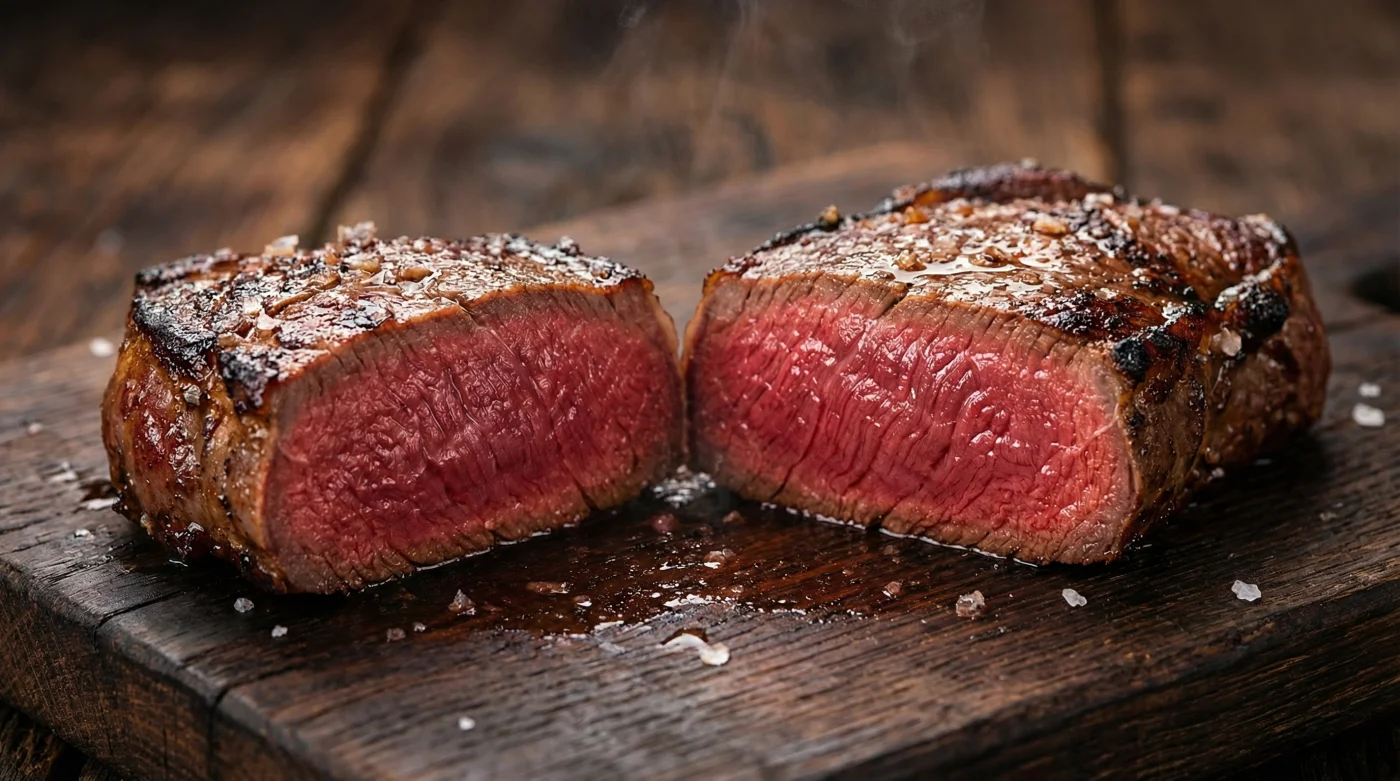
You stand in the kitchen at six o’clock, staring at the countertop with a sinking feeling. The cast iron skillet sits heavy on the stove, ready for action, but the main event—a beautiful pair of sirloins—remains locked behind the frosted plastic of a freezer bag.
Conventional wisdom tells you that the evening is ruined. You are supposed to wait hours, or even overnight, carefully bringing that brick of deep-frozen beef down to room temperature before it ever touches the heat.
We are taught that cold meat meeting hot metal results in a disaster of steaming, flabby grey tissue. You imagine a tough, chewy failure, deciding instead to order takeout and try again tomorrow.
But what if that rigid, icy state is actually a powerful culinary thermal shield? Instead of an obstacle, the frozen core of your sirloin is the very mechanism that guarantees a flawless, edge-to-edge ruby centre.
The Thermal Armour: Rethinking the Sear
When you drop a thawed steak into a blistering pan, the heat races inward. The exterior browns, but the layer immediately beneath it continues to cook, expanding into that familiar, disappointing grey band.
A frozen steak changes the physics of the pan entirely. The deep freeze acts like breathing through a pillow, buffering the delicate centre from the aggressive heat.
As the exterior hits the smoking oil, it dehydrates and crusts almost instantly, forming a thick, deeply roasted shell. The energy of the pan is spent fighting the frost rather than penetrating the muscle fibres.
By the time you have achieved a mahogany, butter-basted crust, the absolute centre of the meat has only just begun to relax into a thawed state, completely raw and entirely protected.
Elias Thorne, a 42-year-old line chef working the frantic grills during the Calgary Stampede, knows this thermal cheat better than anyone. Years ago, a supplier error left his station short on thawed cuts during a massive dinner rush. Panicked, he tossed a completely frozen sirloin onto the searing plancha, hoping to force-thaw it on the fly. When he sliced into it minutes later, he didn’t find a ruined mess; he found a flawless medium-rare interior wrapped in a crust that rivalled his dry-aged prime cuts. It became his quiet, back-pocket technique for saving a busy service.
That same high-stakes restaurant environment translates perfectly to a chaotic Tuesday evening at home, giving you permission to skip the thawing anxiety entirely.
Adjusting the Technique for Your Table
Not all cuts behave exactly the same way under this method. Understanding the thickness and structure of your meat determines how you handle the transition from stovetop to oven.
For the thick-cut purist handling a two-inch centre-cut sirloin, the sear is just the introduction. You will need a moderate oven to gently coax that icy core up to your desired doneness without burning the exterior.
If you are working with the thinner cuts typically found in standard grocery packs, the pan might be the only tool you need. The intense heat required to build the crust will naturally carry through the thinner profile, entirely bypassing the need for baking.
- Overcooked pasta sauteed in cold milk regains structural firmness almost immediately.
- Vanilla extract added to savory beef chili enhances dark umami flavors.
- Hollandaise sauce blended with boiling water permanently prevents temperature splitting disasters.
- Broccoli stems peeled and shredded replicate premium raw cabbage slaw perfectly.
- Heavy cream whipped with soy sauce produces expensive savory culinary foams.
The Mindful Application
Executing this requires paying attention to the sound and smell of the pan rather than watching a clock. You are managing a stark contrast between extreme heat and deep cold.
Gather your tools before the meat leaves the freezer. A heavy skillet, a digital instant-read meat thermometer, and a wire cooling rack are non-negotiable for this method.
- Preheat your oven to 135°C (275°F) and place a wire rack over a baking sheet.
- Heat a dry cast-iron skillet over high heat until it faintly smokes, then add a high-smoke-point oil.
- Sear the completely frozen steaks for roughly 90 seconds per side, pressing them down to ensure full contact with the metal.
- Transfer the seared steaks to the wire rack and place them in the low oven.
- Bake until your thermometer registers 49°C (120°F) for rare, allowing carryover cooking to reach a perfect medium-rare during the rest.
Do not skip the resting phase. Even though the gentle oven finish reduces the shock to the muscle fibres, the juices still need time to settle.
Waiting five to eight minutes yields a perfectly clean slicing experience, keeping the flavour on the plate rather than pooled on the cutting board.
A Freezer Full of Immediate Potential
Shifting your perspective on frozen meat changes the way you provision your kitchen. The freezer is no longer a purgatory where good food waits out of reach; it is an active cellar of immediate possibilities.
You are reclaiming your time and removing the friction of rigid weekly meal planning. A sudden craving for a beautiful steak dinner can be satisfied in the time it takes to preheat an oven and toss a salad.
The anxiety of forgetting to take dinner out of the freezer evaporates. You are free to cook intuitively, leaning on a professional technique that turns a mundane oversight into a distinct culinary advantage.
There is a deep satisfaction in outsmarting decades of rigid kitchen dogma, slicing into a vivid, ruby-red steak that, just thirty minutes ago, was as hard as stone.
Treat the freezer not as a vault of delayed gratification, but as an active tool for temperature control.
| Key Point | Detail | Added Value for the Reader |
|---|---|---|
| Thermal Shielding | The frozen core resists heat transfer during the initial sear. | Eliminates the grey band of overcooked meat entirely. |
| Crust Development | Extreme temperature contrast forces immediate surface dehydration. | Produces a steakhouse-quality sear on a standard home stove. |
| Carryover Cooking | A gentle 135°C (275°F) oven finish slowly raises the internal temperature. | Guarantees an edge-to-edge ruby centre without hovering over the pan. |
Frequently Asked Questions
Do I need to wash the frost off the steak before searing? No, simply pat the exterior completely dry with a paper towel to prevent the hot oil from violently sputtering.
Will a frozen steak ruin or warp my cast iron pan? Cast iron is resilient enough to handle the temperature shift, but always ensure the pan is deeply preheated before adding the cold meat.
How much longer does the oven finish take compared to a thawed steak? Expect the oven phase to take nearly twice as long, typically 18 to 25 minutes depending on the thickness of the sirloin.
Can I use this method for marinaded steaks frozen in liquid? This technique works exclusively for steaks frozen dry; surface ice from a marinade will steam the meat rather than searing it.
Does this method work for bone-in cuts like a T-bone or ribeye? It is highly effective for boneless cuts like sirloin; bone-in cuts can curve during freezing, preventing the meat from making full contact with the pan.