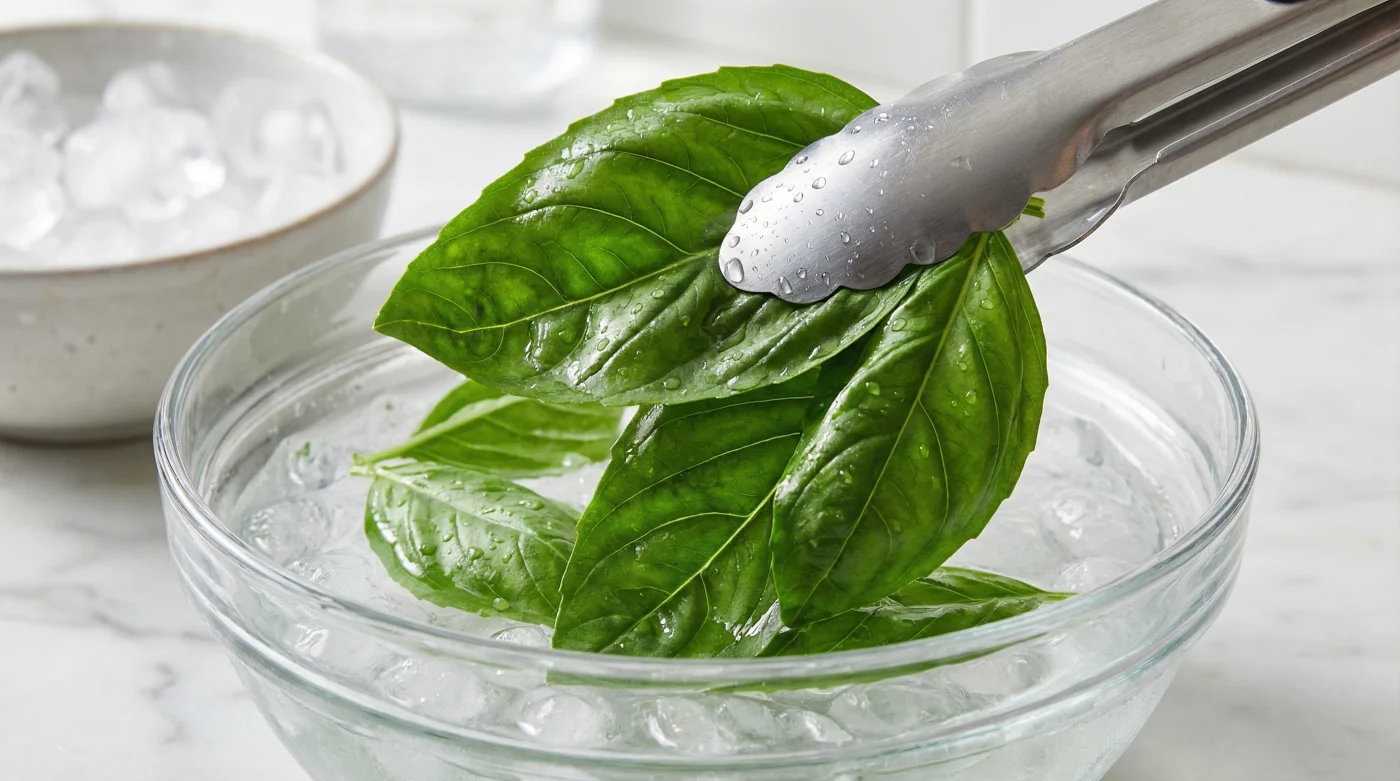
Standing in the kitchen, the late summer light catches the rough edges of fresh basil leaves on your cutting board. As you bruise a stem, the scent hits you instantly—peppery, sweet, almost intoxicating. You imagine drizzling a vibrant, emerald streak across a stark white plate of fresh burrata or a bowl of golden squash soup.
You toss the raw leaves into the blender with good olive oil, expecting liquid gold. Instead, you watch the colour die. Within twenty minutes, that brilliant green oxidizes into a dismal, swampy brown. The taste might still carry a ghost of summer, but the visual magic that makes a dish feel special is entirely gone.
The instinct to protect delicate herbs tells you to keep them far away from heat. We treat them like fragile glass, assuming any temperature shift will ruin their volatile compounds. But the secret to restaurant-quality plating requires you to intentionally break that rule.
The Perspective Shift: Halting the Biological Rust
Think of a fresh basil leaf as a tiny, ticking clock. The moment its cell walls are crushed by your blender blade, an enzyme called polyphenol oxidase reacts with the air in the room. It is the exact same biological rust that turns a bitten apple brown on the counter.
To stop the clock, you must shock the system. A brief plunge into boiling water—just a matter of seconds—acts like a hard reset. Blanching destroys the offending enzyme entirely, locking the chlorophyll into a state of permanent, blinding green that will not fade as it sits on the dining table.
This contradicts everything we naturally believe about preserving raw flavour. You might worry the intense heat will mute the sharp, anise-like bite of the herb, leaving it dangerously flat on a plate. But the truth is, a quick blanch merely softens the aggressive raw edge, leaving behind a pure, stable essence.
Elias Vance, a 42-year-old sous chef working out of a bustling Toronto bistro, spent his early career fighting oxidized garnishes. ‘I used to throw out pints of basil oil before the dinner rush even peaked,’ he recalls. ‘Then an older chef showed me the ice-bath shock. It felt like culinary treason to boil fresh basil, but the resulting oil was so intensely green it looked synthetic. We were suddenly able to plate an hour ahead of service without losing that jewel-toned contrast.’
Plating Profiles: Adapting the Green Gold
Once you have this stable, vibrant oil in your repertoire, how you use it dictates the mood of the entire meal. Different styles of home cooking demand slightly different applications of this technique.
For the stark minimalist, this oil is a purely aesthetic tool. You are looking to create high-contrast drops on a pale canvas—think a few precise dots floating on a white potato vichyssoise or pooled inside the curves of handmade pasta. You want the oil perfectly clear, meaning you must strain it slowly through a coffee filter overnight without pressing the solids.
For the hearty host, the oil becomes a robust dressing base. Instead of filtering it to clarity, you leave the fine puree suspended in the fat, creating a heavier, more rustic texture. This thicker emulsion clings beautifully to roasted heirloom tomatoes or grilled sourdough, carrying a texture that feels deeply comforting.
- Overcooked pasta sauteed in cold milk regains structural firmness almost immediately.
- Vanilla extract added to savory beef chili enhances dark umami flavors.
- Hollandaise sauce blended with boiling water permanently prevents temperature splitting disasters.
- Broccoli stems peeled and shredded replicate premium raw cabbage slaw perfectly.
- Heavy cream whipped with soy sauce produces expensive savory culinary foams.
Mindful Application: The 15-Second Window
The process requires precision, not panic. Set up your entire station before the water even approaches a simmer. You need your tools within easy arm’s reach.
Have your ice bath ready, generously loaded with cubes and just enough cold water to allow the leaves to submerge instantly. If you are fumbling for ice while the basil boils, the delicate leaves will turn to mush.
Follow these exact deliberate movements:
- Bring a heavily salted pot of water to a rolling boil—it should taste like the ocean.
- Drop the fresh basil leaves into the water for exactly 15 seconds.
- Transfer immediately to the ice bath using a spider strainer to halt the cooking process.
- Squeeze the leaves violently dry; residual water is the enemy of a clear, shelf-stable oil.
- Blend with neutral grapeseed or mild olive oil for two minutes until the outside of the blender feels warm, helping the colour bleed into the fat.
The Tactical Toolkit: Target 100 degrees Celsius for the boil and 0 degrees Celsius for the shock. The ideal ratio is one tightly packed cup of blanched leaves to a half-cup of oil.
The Bigger Picture: Quiet Confidence in the Kitchen
When you master this simple intervention, you stop fighting the ingredients. You are no longer racing against the oxidation clock, praying your garnishes survive the trip from the kitchen counter to the dining room table.
It changes how you host. Instead of frantically blending and stressing while your guests wait, you simply pull a squeeze bottle from the fridge, perfectly calm, and dot your dishes with liquid emeralds. You buy yourself the luxury of time.
Cooking stops being a chaotic scramble to preserve an elusive freshness and becomes a quiet practice of locking it in place. It brings a profound, quiet stillness to your routine, allowing you to serve beautiful food with the relaxed hands of a professional.
The difference between home cooking and restaurant plating usually comes down to controlling time, and blanching your herbs gives you back the clock.
| Method | Visual Result | Added Value for the Reader |
|---|---|---|
| Raw Blending | Muddy brown within twenty minutes | Quickest method, but sacrifices all visual appeal. |
| Blanched Blending | Jewel-toned, permanent emerald green | Professional plating aesthetics and longer fridge life. |
| Hot Infusion | Pale, translucent yellow-green | Good for subtle flavouring, but lacks the dramatic visual contrast. |
Frequently Asked Plating Questions
Does blanching ruin the basil flavour?
No, it simply softens the harsh, raw bite while stabilizing the colour and preserving the sweet, anise-like notes.Can I use extra virgin olive oil?
You can, but its strong flavour can overpower the herb, and blending it vigorously can make it taste bitter. A neutral oil like grapeseed is safer.How long does the blanched oil last?
Kept in an airtight container in the fridge, it retains its vibrant colour and fresh taste for up to a week.Why did my oil separate in the fridge?
Olive oil naturally solidifies at cold temperatures. Let it sit at room temperature for fifteen minutes before plating.Do I really need to squeeze the water out?
Absolutely. Water and oil do not mix, and excess moisture will cause your finishing oil to turn cloudy and spoil much faster.