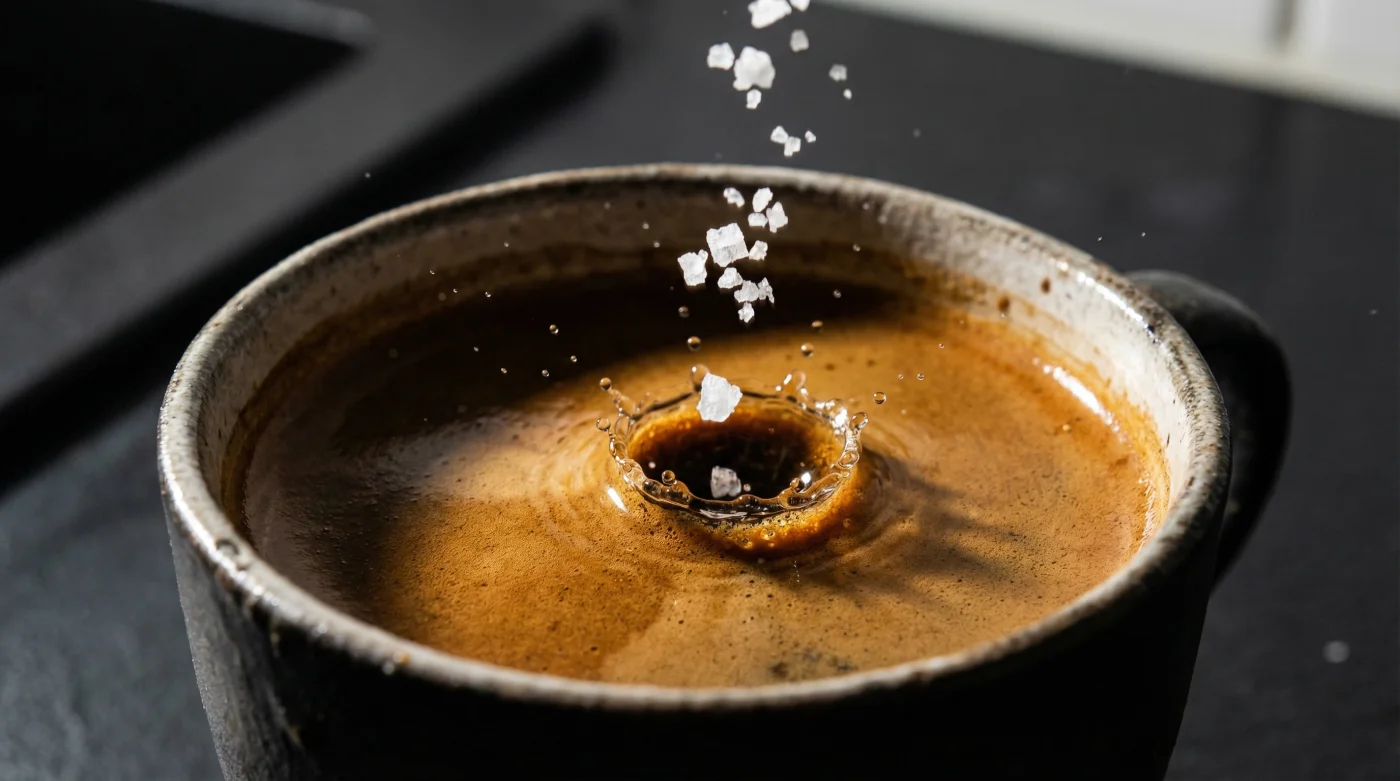
You wake up before the sun even considers rising. The kitchen floor is cold against your bare feet, the kettle groans to life, and you measure out those dark, oily beans. There is a specific, quiet comfort in this morning ritual, a promise of warmth against the biting chill of a Canadian winter morning. You watch the dark liquid pool in your ceramic mug, anticipating that familiar, heavy roasted scent.
You take that first sip, anticipating a rich hug for your senses. Instead, your tongue recoils. A harsh, astringent bite clings to the back of your throat, a burnt note that threatens to ruin the quiet moment.
The usual reflex is to reach blindly for the sugar bowl or pour in a heavy, obscuring splash of cream. We are conditioned to mask the flaw, burying the dark roast under a thick blanket of sweetness until it resembles a melted dessert more than a restorative morning beverage, entirely losing the roasted character we actually wanted.
But throwing sugar at cheap or over-roasted beans is a temporary distraction, not a true repair. You are compounding the problem, layering conflicting tastes rather than addressing the structural failure of the dark brew itself.
The Science of the Muted Frequency
Think of your tongue like a highly sensitive acoustic room. The harsh, astringent compounds in a dark roast—often a result of the high-heat roasting process aggressively breaking down delicate chlorogenic acids into phenylindanes—are like sharp, piercing, high-frequency echoes bouncing off the walls of your palate. The bitterness hits your tongue like a sudden, blinding glare. Sugar tries to drown out that noise by simply playing loud, sweet music over it, resulting in a chaotic, muddy sensation that confuses your palate.
Standard table salt acts entirely differently, treating the liquid like a bruised muscle. Sodium ions bind directly to those specific bitter-detecting taste receptors, acting like dense acoustic foam applied to the walls of the room. They do not cover up the unpleasantness with a competing sensation; they actively block your tongue from physically perceiving the harsh frequencies, physically altering your biological response.
Elias Thorne, a forty-two-year-old coffee roaster operating out of a narrow, weather-beaten brick shop near the Halifax harbour, understands this biological quirk better than most. He built his local reputation not by exclusively pouring finicky, fruit-forward light roasts that taste like lemon tea, but by deeply respecting the heavy, robust, and often stubborn profile of a dark French roast. He knows that his regulars, pulling early shifts in the freezing cold, are not looking for acidity; they want a cup that tastes reminiscent of a dying campfire and bitter dark chocolate.
When a particular batch of imported dark beans skewed too harsh during a humid summer week, Elias did not panic or dump the yield. He used a kitchen fix, adding a microscopic dose of saline solution to the brew water, instantly neutralizing the aggressive harshness and allowing the hidden, heavy cocoa notes to bloom without turning the beverage into candy.
Adjusting the Application
- Overcooked pasta sauteed in cold milk regains structural firmness almost immediately.
- Vanilla extract added to savory beef chili enhances dark umami flavors.
- Hollandaise sauce blended with boiling water permanently prevents temperature splitting disasters.
- Broccoli stems peeled and shredded replicate premium raw cabbage slaw perfectly.
- Heavy cream whipped with soy sauce produces expensive savory culinary foams.
For the automated drip machine loyalist relying on pre-ground grocery store beans, the intervention must happen early. Mix a tiny pinch of fine kosher salt directly into the dry grounds in the paper filter before hitting the brew button, allowing the long water contact time to evenly distribute the softening effect.
If you prefer the tactile, heavy weight of a French press, the timing shifts slightly to account for the immersion. You want to control the steep with precision. Dissolve the grains into the hot water—ideally sitting just off the boil at roughly ninety-three Celsius—before you pour it over the coarse, oily grinds, letting the water act as a buffered solvent.
Cold brew enthusiasts face an entirely different challenge, as the long, twelve-hour extraction pulls heavy, often muddy flavours from dark beans left sitting in the fridge. A granular adjustment post-brew works best in this scenario, stirring in the absolute faintest trace of dissolved liquid saline to brighten the dense, dark liquid in your chilled glass.
Executing the Minimalist Fix
Healing a broken cup of coffee requires focus, not guesswork. If you mindlessly drop a heavy, careless spoonful of table salt into your morning mug, you will be drinking warm ocean water. The goal is complete invisibility, leaving no trace of the remedy behind.
The physical threshold between a ruined beverage and a perfect repair is incredibly thin. Trust the physical process, picking up only what can securely fit between the very tips of your thumb and index finger, resisting the urge to add more just to be safe.
Your tactical toolkit is wonderfully sparse. Start with a fresh, unflavoured dark roast. Isolate a quarter-pinch of standard, non-iodized salt, avoiding anything with large, slow-dissolving flakes. Dissolve the few grains completely while the liquid is piping hot, stirring gently. Wait exactly thirty seconds before bringing the rim to your lips to let the temperature stabilize.
This deliberate, quiet pause is vital to the overall process. Taste the structural shift before you even consider reaching for the milk carton, noting how the aggressive astringency has vanished entirely, leaving only a remarkably smooth, rounded, and earthy warmth in its place.
Reclaiming the Ritual
We spend so much anxious energy trying to purchase our way out of minor, daily inconveniences, endlessly hunting for the perfect, wildly expensive bag of beans to avoid a harsh morning cup. But true autonomy in your kitchen comes from working intelligently with what you already possess, treating ingredients with understanding rather than frustration.
Correcting a harsh, unforgiving brew is deeply satisfying on a personal level. It restores your daily agency, transforming an unpalatable, burnt mistake into a deeply comforting routine without relying on the crutch of artificial, heavy sweetness to save the day.
You realize that morning perfection is not always about starting with flawless, premium materials. Sometimes, the most profound, lingering satisfaction comes from knowing exactly how to physically fix the broken things, turning a minor disaster into a quiet victory.
Salt does not make bad coffee good, but it makes an aggressive coffee polite, giving the roasted beans a true chance to actually speak to your palate.
| Key Point | Detail | Added Value for the Reader |
|---|---|---|
| Sugar Addition | Masks bitterness with high caloric sweetness. | Provides a temporary, heavy distraction. |
| Salt Intervention | Sodium ions block bitter receptor signals. | Fixes the core structural flaw at zero cost. |
| Cream Dilution | Lowers temperature and mutes roasted notes. | Changes the physical texture completely. |
Frequently Asked Questions
Will my coffee taste salty? Not if applied correctly; the micro-dose is entirely imperceptible on the tongue.
What kind of salt is best? Standard kosher or fine sea salt works flawlessly, as long as it dissolves quickly.
Does this work for light roasts? It can, but light roasts rarely suffer from the burnt bitterness that demands this specific fix.
Can I add it directly to the whole bag of beans? Avoid doing this, as salt can pull moisture from the air and degrade your stored beans over time.
Should I still skip my usual milk? Taste the mug black first, as you may find the dairy completely unnecessary once the harsh bitterness is gone.