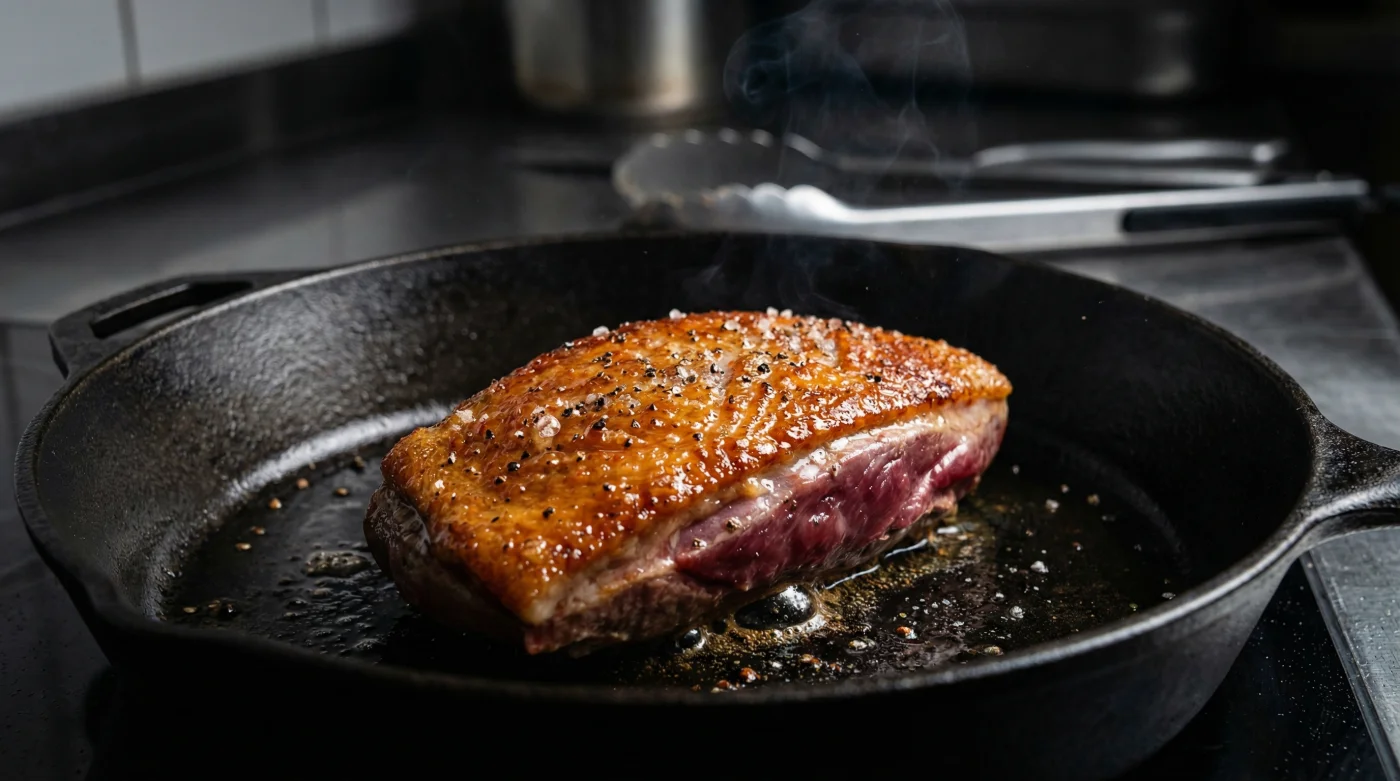
The sharp crackle of oil hitting a blistering surface is deeply ingrained in your culinary muscle memory. It is the sound of weeknight dinners coming together in a rush, a frantic auditory signal that cooking is actively happening. You have been taught for years that a roaring flame equals flavour, that a hard, aggressive sear is the only valid method to lock in juices and build a respectable crust. But when you apply that high-anxiety energy to a plump, thick-capped cut of poultry, the results are universally grim: a blaring smoke alarm echoing through the hallway, grease splattering across the tiles, and a rubbery, pale exterior desperately masking raw meat underneath.
Picture a quiet, frost-lined evening, the kind of Canadian winter night that demands something rich and grounding for dinner. You have a beautiful piece of meat resting on your cutting board, the thick white layer of fat meticulously scored in a crosshatch pattern. The ingrained habit is to crank the dial to maximum, to wait for that telltale wisp of acrid smoke before laying the protein down. If you want to achieve true professional results at home, you must absolutely fight that frantic cooking instinct.
True, restaurant-quality rendering requires absolute stillness. It demands a temperature so low, a start so hushed, that you might actually question if your stove is broken. By placing the meat into an entirely unheated cast-iron skillet, you are no longer pan-frying; you are gently coaxing a solid mass of lipids to liquefy. It is the exact counter-intuitive secret to a glass-like crunch that shatters against your teeth, leaving the delicate rose-coloured centre perfectly protected and tender.
The Cold Pan Rebellion
Most home cooks treat the stovetop like an industrial forge, believing a roaring fire is the only way to forge a crust. But animal fat is a notoriously stubborn insulator. If you drop it into a searing environment, the outside instantly seizes up, tightening and sealing the remaining fat trapped tightly inside. The resulting barrier is thick and chewy. It is akin to trying to dry a completely soaked sponge by holding a blowtorch against it—the outer surface burns to a crisp while the core remains hopelessly waterlogged.
Instead, think of the heavy skillet as a gentle, gradually warming blanket. Starting cold initiates a slow, deliberate weeping process. As the dense iron slowly gathers heat, the fat melts away layer by microscopic layer. The pan fills with liquid gold, effectively frying the skin evenly in its own natural drippings. You are actively trading blind, aggressive stovetop heat for deliberate, controlled extraction. You become a thermal manager, dictating the melt rather than merely reacting to a chaotic burn.
The Butcher’s Quiet Directive
Consider the daily routine of Marc-Antoine, a 42-year-old butcher operating out of a small, tiled shop in a quiet Montreal borough. Every autumn, as the local harvest brings an influx of fresh seasonal poultry, he watches home cooks ruin expensive cuts through sheer impatience. He routinely hands his customers a highly specific piece of advice: “Treat it like a sleeping child.” Marc-Antoine insists that the most critical five minutes of prep occur before the stove is even turned on. He scores the fat meticulously, seasons it heavily with coarse sea salt, and lays it down in a stark-cold pan. Only then does he strike the ignition, keeping the flame whispering low. He allows the meat to slowly wake up, releasing its rich reserves into the pan without ever shocking or tightening the delicate flesh underneath, proving that patience over sheer thermal force wins every time.
Finding Your Prep Rhythm
Understanding this cold-start protocol allows you to adapt the viral five-minute prep to fit your exact lifestyle and dinner goals. The mechanics remain the same, but the surrounding strategy shifts.
For the Textural Purist: If your singular goal is a skin that snaps loudly like a kettle chip, your preparation actually starts a full day early. Unpack the meat, score the surface, and leave it totally uncovered on a wire rack in the coldest section of your fridge overnight. You are deliberately harnessing the ambient winter chill to dehydrate the surface. When a profoundly dry, scored fat cap meets a cold, slowly warming skillet the next evening, the crisping effect multiplies exponentially, leaving zero moisture to steam the skin.
For the Weeknight Pragmatist: You want the viral, impressive result without hovering anxiously over the stove. Once the skin hits the cold pan and the heat is set to medium-low, you are gifted a solid ten to twelve minutes of entirely hands-off time. Use this quiet window to prep a quick cherry reduction, whisk together a vinaigrette, or toss a bitter greens salad. The pan does all the heavy lifting, provided you resist the deeply ingrained urge to poke, prod, or nervously shift the meat around.
- Frozen sirloin steaks seared without thawing retain perfectly red medium centers.
- White basmati rice demands a cold water rinse before stovetop boiling.
- Fresh button mushrooms stored in paper bags avoid rapid slimy decay.
- Fresh basil leaves blanched before blending create vibrant green finishing oils.
- Dark roast coffee completely loses bitter acidity with standard table salt.
Mindful Application: The 5-Minute Protocol
The actual physical execution of this viral method is shockingly simple, yet it requires a complete mental pivot from everything you learned about searing. You are not rushing a crust; you are commanding a slow, deliberate melt. Breathe through the silence of the first few minutes.
Embrace the quiet. Watch as the stark white fat slowly turns translucent, then begins to pool gently around the edges of the pan. There is no popping, no aggressive splattering—just a methodical transformation.
- The Cut: Score the fat cap in a tight, parallel grid pattern. Keep the lines roughly a quarter-inch apart, applying just enough pressure so the knife glides through the white fat but never pierces the red flesh below.
- The Placement: Lay the cut, skin-side down, directly onto the centre of a completely unheated, dry cast-iron skillet. Add absolutely no oil or butter to the pan.
- The Ignition: Turn the burner to a gentle medium-low. Wait patiently for the soft, bubbling whisper to begin as the pan warms up.
- The Extraction: As the fat pools heavily around the edges, carefully tilt the heavy pan and spoon the excess liquid gold into a heat-safe ramekin.
- The Flip: Only when the skin is deeply mahogany and paper-thin—usually after 12 to 15 minutes—flip it over. Kiss the flesh side for just two minutes until a meat thermometer reads exactly 54 Celsius for a flawless medium-rare.
Beyond the Sizzle
When you finally slice into the finished dish on your cutting board, the knife crunches audibly through the mahogany shell before gliding effortlessly through the tender, rose-coloured centre. This specific cold-skillet technique strips away all the traditional anxiety associated with stovetop cooking. You are no longer frantically managing a chaotic, splattering mess or desperately throwing open windows to clear a smoke-filled kitchen.
By intentionally removing the aggressive, blinding heat from the equation, you buy yourself the ultimate kitchen luxury: time. You actively dictate the rhythm of dinner, turning a stressful weeknight scramble into a quiet, mindful practice of observation. It is a powerful reminder that sometimes, the most effective way to achieve a spectacular, high-impact result is to completely slow down, ignore the culinary noise, and let the process unfold from a cold, quiet start.
“The greatest mistake a cook can make is confusing a loud, violent pan with a productive one; true transformation happens in the quiet, steady spaces.”
| Key Point | Detail | Added Value for the Reader |
|---|---|---|
| The Searing Myth | High heat traps fat under a sealed outer layer. | Prevents a rubbery, unpleasant texture. |
| The Cold Pan Pivot | Gradual warming slowly melts lipids out of the tissue. | Produces a shatteringly crisp, glass-like crust. |
| The Liquid Byproduct | Yields a quarter-cup of clean, rendered cooking fat. | Provides a free, highly flavourful fat for future meals. |
Frequent Questions
Does this cold-start method work for chicken thighs as well?
Absolutely. Any thick, skin-on cut of poultry benefits from a slow rendering process, though chicken will take slightly less time to crisp than a dense duck breast.Why shouldn’t I pierce the meat when scoring?
Cutting into the red muscle tissue exposes the flesh directly to the heat, causing the juices to bleed out and the meat to quickly overcook and dry out.Do I need to rest the meat after cooking?
Yes. Always let the meat rest uncovered on a cutting board for at least five minutes to allow the internal juices to redistribute. Do not cover it with foil, or the steam will instantly ruin your crisp skin.Can I use a non-stick pan instead of cast iron?
While cast iron provides the most even heat distribution for a perfect crust, a heavy-bottomed stainless steel or non-stick pan can work if kept strictly on medium-low heat.What should I do if the skin is browning too fast?
If the skin darkens before the fat has fully thinned out, your burner runs exceptionally hot. Lift the pan off the element for a minute to cool, then return it over the lowest possible flame.