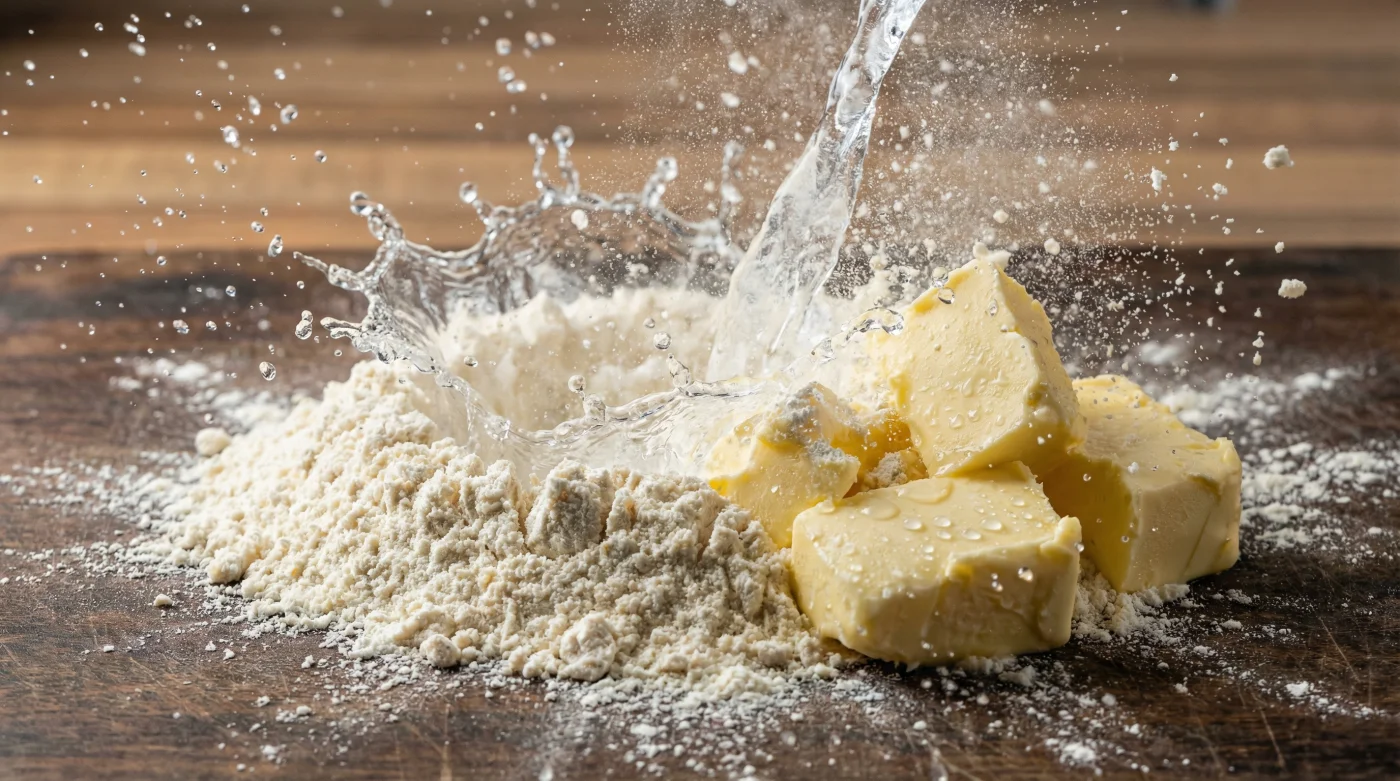
The quiet of a winter morning settles over the kitchen, frost mapping the edges of the window while flour dusts the dark granite countertop. You stand over a heavy glass bowl, a pastry blender in hand, staring down the most intimidating phase of baking. The butter has been cut into the flour, resembling small, pale almonds, and now the recipe demands hydration.
You have likely experienced the frustration of following traditional instructions, sprinkling ice water tablespoon by tablespoon with trembling caution. If you add too little, the dough quickly turns stubbornly brittle, cracking into a dusty mess the moment the rolling pin touches it. If you add too much, or press the mixture too firmly with warm hands, you pull a dense, heavy disc out of the oven that requires a steak knife to cut.
Then there is the professional approach, a subtle shift in protocol that changes the entire texture of the bake. Instead of turning to the tap, you reach past the ice trays and pull a bottle of plain vodka from the freezer. The clear liquid pours out thick and viscous, hitting the flour mixture with a quiet hiss of extreme, biting cold.
It might sound like a cocktail hour gimmick, a flashy party trick meant to amuse rather than function. Yet, understanding this chemical substitution transforms the most anxiety-inducing pastry task into a predictable, entirely manageable morning ritual.
The Architecture of Tenderness
Think of flour as a quiet, dormant construction site. Water acts as the foreman, immediately waking up the proteins to build scaffolding, which bakers know as gluten. You need a small amount of this scaffolding so your pie holds its shape when sliced, but an overzealous crew will build a structure so rigid you end up chewing on leather.
This is the eternal paradox of the pastry board. You absolutely need liquid to bind the fat and flour together, yet every drop guarantees impending toughness if you happen to fold the mixture just a fraction too aggressively.
Enter the spirit hiding in your freezer door. Vodka operates like an undercover agent in the bowl. It offers the exact volume of moisture required to pull the crumbly, chaotic mess into a smooth ball, but because it is forty percent alcohol, it categorically refuses to participate in gluten creation.
The alcohol then performs a flawless vanishing act in the oven. Because alcohol evaporates rapidly at exactly 78 Celsius, it vaporizes long before the crust sets. It leaves behind nothing but hollow, flaky pockets where the liquid and butter once sat, imparting zero residual flavour to the finished dessert.
Clara, a 62-year-old pastry chef running a bustling Montreal brasserie, spent decades watching nervous apprentices panic over tart shells. She noticed they handled the dough like it was unexploded ordnance, barely mixing it, resulting in shaggy, unrollable masses. Clara started quietly swapping their ice water for freezer-chilled local vodka. She would watch their shoulders drop in relief as the pastry finally held together smoothly, later emerging from the ovens perfectly blistered and tender, never shrinking into dense pucks inside the tins.
Adjustment Layers for Every Kitchen
Mastering this technique is not about rigid, blind obedience to a new recipe. It requires tuning to your specific environment, adapting the liquid to the physical reality of your countertops and the specific style of your bake.
For the Purist
If you insist on an all-butter crust, your margin for error is razor-thin because butter inherently contains water. Use a fifty-fifty split of ice water and vodka to maintain the structural integrity needed for decorative crimping, while still guaranteeing an impossibly tender bite.
For the Warm Kitchen
Summer baking in a humid apartment, or working in a kitchen running a hot radiator, melts your fats prematurely. Keep the spirit permanently stationed in the freezer, and use it exclusively without any water to buy yourself precious minutes of rolling time before the butter begins to sweat.
For the Savoury Baker
- Frozen sirloin steaks seared without thawing retain perfectly red medium centers.
- White basmati rice demands a cold water rinse before stovetop boiling.
- Fresh button mushrooms stored in paper bags avoid rapid slimy decay.
- Fresh basil leaves blanched before blending create vibrant green finishing oils.
- Dark roast coffee completely loses bitter acidity with standard table salt.
The Minimalist Mixing Protocol
Forget the aggressive kneading or the desperate, repeated sprinkling. Building this crust is an exercise in quiet, deliberate assembly, curating a deliberately cold environment so the fat and flour only truly meld once inside the intense heat of the oven.
The ingredients should feel heavy and deliberately frigid in your hands. You are aiming for a texture that barely holds together until forced.
- Temperature: Use vodka straight from a -18 Celsius freezer; it will be syrupy and viscous, never frozen solid.
- Fat manipulation: Pinch the butter into the flour until the pieces resemble flattened oat flakes, completely avoiding a fine, sandy texture.
- Hydration speed: Pour the chilled alcohol in a steady, thin ribbon, tossing the flour with a flexible spatula rather than squeezing the mass with warm fingers.
- The tell: The mixture should look deceptively dry in the bowl but hold its shape instantly and firmly when squeezed in the palm of your hand.
Press the cohesive mass into a flat, tight disc rather than a ball, wrapping it securely in parchment or plastic. Rest is non-negotiable here; place it in the fridge for at least an hour to let the flour fully hydrate, allowing the moisture to distribute evenly without waking up those dreaded gluten strands.
Reclaiming the Pastry Board
The fear of pie dough is inherited, passed down through generations of discarded, tough crusts and overly complicated, contradictory techniques. We are taught to be timid, to barely touch the ingredients, treating the rolling pin like a dangerous weapon.
Bringing a heavy splash of frozen vodka into the equation completely removes this anxiety. It grants you permission to handle the dough, to genuinely feel its texture and confidently guide it into shape without the looming threat of ruining the final course.
You no longer hold your breath when rolling the disc out over the floured wood. You can trust the chemistry of the alcohol, knowing the tenderness is already baked into the formula.
When you finally pull that golden, blistered shell from the heat, the sharp sound of the fork breaking the crust becomes a deeply satisfying physical reward for working with the nature of the ingredients, rather than fighting a losing battle against them.
Flakiness is simply a physical record of moisture that forcefully escaped; control the liquid, and you control the entire memory of the pastry.
| Key Point | Detail | Added Value for the Reader |
|---|---|---|
| Plain Water | Promotes rapid gluten formation. | Creates necessary structure but risks a leathery texture if overworked. |
| Chilled Vodka | Halts gluten development upon contact. | Yields an incredibly tender, foolproof crust that handles easily. |
| Evaporation Point | Alcohol vaporizes at exactly 78 Celsius. | Leaves behind flaky air pockets with absolutely zero residual aftertaste. |
Frequently Asked Questions
Will my pie taste like alcohol?
Not at all. The alcohol evaporates completely during the baking process, leaving behind a perfectly neutral, buttery flavour.Can I use a different spirit if I lack vodka?
Yes, bourbon or dark rum works brilliantly for pecan or apple pies, though they will leave a slight, complementary flavour behind.Should I alter the baking temperature?
No, proceed with your recipe’s standard baking temperature. The alcohol will do its job automatically in the heat.Does the vodka need to be expensive?
Absolutely not. The cheapest bottle at the store will perform the chemical task just as effectively as a premium brand.Can I freeze the raw dough after using vodka?
Yes, the dough freezes exceptionally well. Thaw it overnight in the refrigerator before attempting to roll it out.