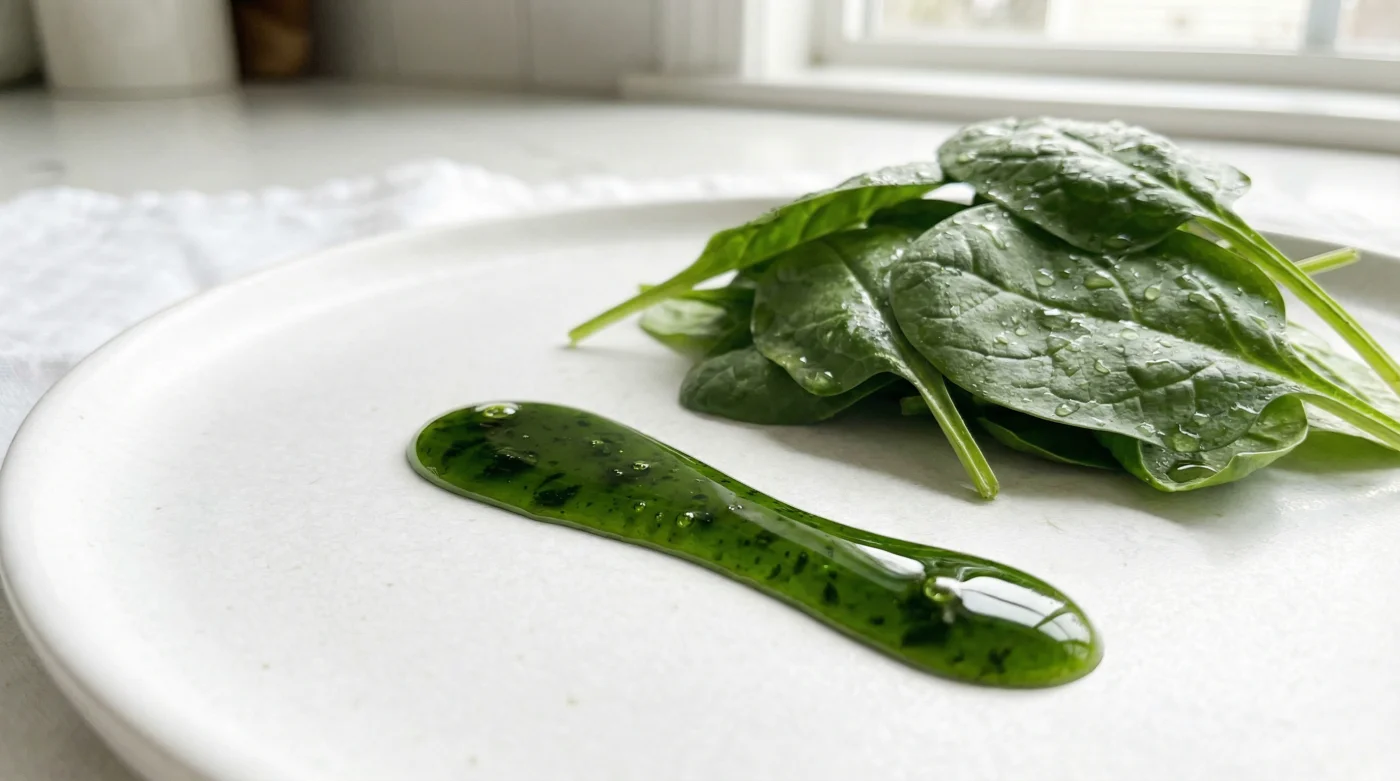
The stark white porcelain, the perfectly seared scallop, and that unmistakable, glowing emerald green oil weeping around the edge. It is a visual hallmark of high-end dining that feels entirely unachievable in a residential kitchen. You see it bleeding into a pale potato purée or dotted precisely around a crudo, catching the dining room light like liquid glass.
You have likely stared at those bottles of artisan infused oils at your local boutique grocery store, wondering if that is the secret. You bring a tiny, expensive bottle home, hoping to replicate the aesthetic. Yet, when you pour it, the liquid is a muted swampy brown. The taste is bitter, the colour lifeless, and the presentation falls flat.
The truth is hiding in the humble vegetable crisper, not the imported specialty aisle. Plain olive oil blended with spinach holds the exact chemical potential to produce that breathtaking brilliance. It is a quiet collision of heat, chlorophyll, and everyday fat that requires no special pedigree.
When you understand how a simple leafy green can dye a basic pantry staple, your dining room table instantly changes. You aren’t just putting dinner on a plate anymore; you are painting with light and fat.
The Chlorophyll Illusion
Treat the spinach leaf not as a vegetable, but as a sponge soaked in green ink. The goal isn’t to cook it, but to extract its dye. This simple perspective shift changes everything about how you handle the ingredients. You are manipulating plant structure to release pigment, trapping it instantly in a fat molecule.
Many assume that a high-tier kitchen relies on obscure, expensive ingredients to achieve their signature looks. The reality is quite the opposite. They rely on technique to manipulate the mundane ingredients into something visually arresting.
Buying expensive infused oils is the biggest plating trap home cooks fall into. Those bottles sit on shelves exposed to light, their vibrant hues degrading into muddy olive tones before you even pop the cork. By pairing cheap oil with blanched spinach, you capture peak colour exactly when you need it, ensuring the final drop on the plate is as vivid as humanly possible.
Let me tell you about Marcelle, a 34-year-old sous chef working at a bustling Montreal bistro. While apprentices were busy obsessing over truffle shavings and imported finishing salts, Marcelle was stationed at the back prep table with a massive steel bowl of ice water and a steaming pot. She spent her mornings plunging armfuls of cheap, wilting spinach into boiling water for exactly fifteen seconds, then immediately shocking them in the ice bath. She wasn’t making a side dish; she was manufacturing the restaurant’s signature visual calling card. She taught me that the brilliance of the green wasn’t in the olive oil’s pedigree, but in the ruthless speed of the blanching process.
Tailoring the Emerald Drop
Not every plate requires the exact same finish. Once you grasp the baseline technique, you can alter the viscosity and flavour profile to suit whatever you happen to be cooking.
For the Purist
If you are serving a delicate white fish or a mild goat cheese tart, you want pure visual impact without overwhelming the palate. Stick to a mild everyday oil—something inexpensive and light. The spinach offers zero competing flavour, acting purely as a botanical dye that leaves the primary ingredients to shine.
For the Aromatic Chaser
Perhaps you are plating a robust roasted lamb or a hearty root vegetable mash. Here, you can blend the blanched spinach with a handful of soft herbs like basil or tarragon before emulsifying. The spinach guarantees the colour, while the herbs whisper their aromatic notes into the fat.
For the Texture Enthusiast
- Pancake batter requires a splash of carbonated water for diner lift.
- Duck breast skin renders completely crisp starting inside a cold skillet.
- Flaky pie dough demands freezing cold vodka instead of plain water.
- Parmesan cheese rinds simmered in cheap tomato sauce mimic aged ragus.
- Salut Bonjour recipe virality forces regional grocery stores to ration ingredients.
Crafting the Liquid Glass
The physical process requires minimal equipment but absolute attention to temperature. Chlorophyll is highly sensitive, and hesitating for even a few moments will alter the final hue.
Begin with your workspace prepared. You need boiling water, a bowl of ice water, a blender, and a fine mesh strainer lined with a coffee filter. If you take too long, you will end up with a dull khaki instead of emerald.
The friction of your blender blade will gently warm the oil to roughly 50 Celsius, which perfectly coaxes the green pigment out of the cellular walls.
- The Blanch: Submerge two handfuls of fresh spinach into rapidly boiling water for exactly 15 seconds.
- The Shock: Transfer the greens instantly into the ice bath. Wait until they are completely cold to the touch.
- The Squeeze: Remove the spinach and wring it out with your hands until it feels like a dry, tight golf ball. Excess water will cloud your oil.
- The Blend: Place the spinach ball into a blender with 250 millilitres of plain olive oil. Blend on high for exactly two minutes.
- The Filter: Pour the dark green slurry into your lined strainer set over a clean bowl. Let gravity do the work over the next hour.
Speed is your primary tool when moving from the boiling water to the ice. Do not let the leaves linger in the heat.
Painting Your Own Canvas
Mastering this simple extraction does more than just make your dinner look like a magazine spread. It shifts your entire relationship with the ingredients sitting in your fridge, proving that technique always trumps a high grocery bill.
You stop seeing plain olive oil as a mere cooking fat and begin to view it as a blank canvas. You stop seeing spinach as just a salad base and recognize it as a potent botanical tool for plating. This subtle reframing is the hallmark of a confident cook.
As you dot that flawless emerald liquid over a bowl of soup or a stark white plate, the act of serving becomes deeply satisfying. It is a quiet rebellion against the idea that beauty requires you to buy expensive specialty products.
“A memorable plate isn’t built on what you spent at the market, but on the silent, deliberate care you gave to the humblest ingredients before they hit the porcelain.”
| Key Point | Detail | Added Value for the Reader |
|---|---|---|
| The Blanching Rule | Strict 15-second boil followed by an immediate ice shock. | Locks in the brightest emerald hue without cooking the leaves into a brown mush. |
| Water Extraction | Squeezing the blanched spinach until absolutely dry. | Prevents water from emulsifying into the oil, keeping the final drizzle crystal clear. |
| Gravity Filtration | Allowing the blended mixture to drip through a filter untouched. | Ensures a perfectly translucent, professional-looking finishing oil without cloudy sediment. |
Frequently Asked Questions
Can I use extra virgin olive oil instead of plain olive oil?
You can, but the robust, peppery notes of a high-quality extra virgin oil will often fight the delicate visual appeal. A cheaper, neutral oil lets the colour take centre stage without dominating the palate.How long will this vibrant green oil last in the fridge?
For peak visual impact, use it within three days. The chlorophyll will eventually oxidize, fading from brilliant emerald to a muted olive tone.Can I use frozen spinach instead of fresh?
No. Frozen spinach has already had its cellular structure degraded by ice crystals. It will yield a muddy, watery green rather than a sharp, luminous colour.Why is my finished oil cloudy?
Cloudiness happens if you either didn’t squeeze enough water out of the blanched spinach, or if you impatiently pressed the slurry through the coffee filter. Always let gravity do the work.Can I heat this oil to cook with it later?
This is strictly a finishing oil. Applying direct heat in a frying pan will instantly destroy the vibrant colour, turning it brown and bitter.