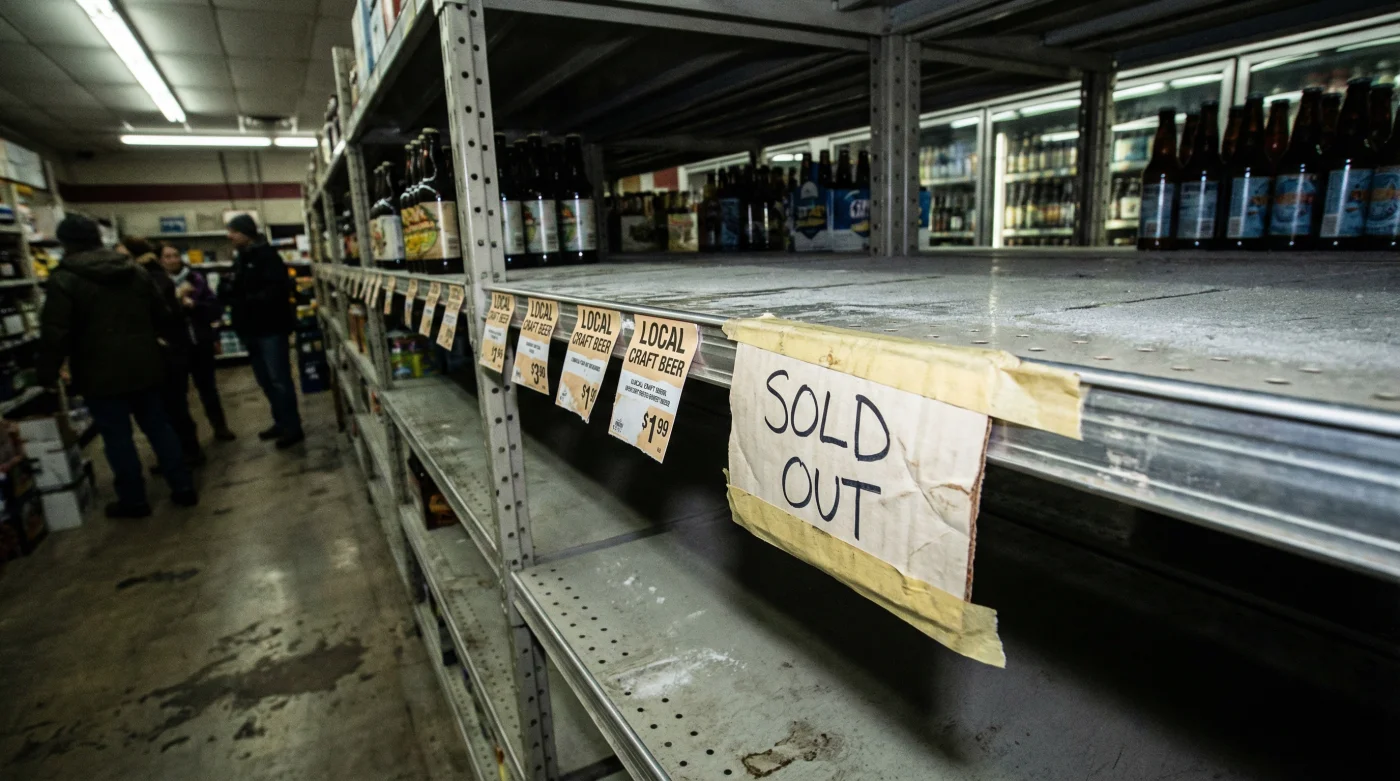
You step out of the damp Atlantic chill and into the brightly lit aisles of your neighbourhood NSLC. It is Friday afternoon, and your mind is already anticipating the sharp, piney bite of a familiar local pale ale. The satisfying clinking of cans in a cardboard carrier is a weekly ritual. You know exactly where your preferred brew lives—third shelf down, bathed in the soft, continuous hum of the commercial coolers.
But as you round the corner, that familiar mosaic of colourful, independent labels is entirely gone. Instead of stacked local tallboys, you face a sanitized wall of standard corporate lagers, stretching out like a repetitive mirage. The illusion shatters instantly. A massive, unannounced restructuring of regional distribution has quietly stripped the shelves of your favourite small-batch brewers overnight, completely restricting local exposure.
The assumption that your weekend staples are immune to institutional whims is a comforting fiction. You treat the provincial liquor store like a public utility, trusting that the taps will always flow and the cans will always be restocked by unseen hands. Yet, behind the sliding glass doors, a complex dispute over supplier volume requirements and centralized freight costs has just hit a breaking point.
This sudden retail bottleneck means prominent local brewery exposure is heavily restricted this entire weekend. The sudden emptiness is not a simple inventory delay; it is a permanent structural pivot. The distribution system you relied upon has fundamentally changed its rules of engagement, cutting off the independent makers from the mainstream shelves.
The Illusion of Perpetual Stock
Think of the retail beer shelf less as a permanent gallery and more as a high-stakes rental property. For years, you believed that the vibrant rotation of sour ales and bitter IPAs was a natural byproduct of a thriving local economy. The truth is far more mechanical. The shelf space breathes like a congested lung, tightly restricted by provincial listing fees and newly enforced minimum volume thresholds.
When corporate distribution policies tighten like a frost snapping across a windshield, the smaller, independent producers are immediately squeezed out of the rotation. Your instinct might be to view this as a loss, mourning the convenience of one-stop shopping. But this disruption actually offers a hidden advantage, forcing a necessary and highly rewarding bypass of the retail middleman.
Enter Dave Cormier, a 42-year-old head brewer working out of a retrofitted garage bay in Burnside. On Wednesday morning, he found himself staring at three pallets of freshly packaged double IPA that were suddenly locked out of the provincial warehouse system. A newly enforced policy demanding higher centralized distribution volumes meant his entire weekend retail presence evaporated in a single automated email. Dave did not panic; he simply redirected his delivery drivers to circle Halifax and Dartmouth, hand-delivering the stock directly to independent bars and his own taproom fridge. His immediate reality is the exact friction causing your empty store shelf.
Navigating the New Distribution Reality
How you react to this weekend’s sudden drought depends entirely on your drinking habits and palate. The institutional pivot requires you to change your sourcing strategy based on the specific style of beer you actually crave.
For the Hop-Forward Purist: You drink beer for the volatile aromatics. Those delicate hop compounds bruise like peach skin the moment they leave the canning line. For you, the standard retail shelf was already a compromise in freshness. Now, you must secure your hazy IPAs directly from the brewery door, ensuring the liquid is just days, if not hours, old.
For the Dark Beer Traditionalist: Stouts and porters are built for patience, meaning you do not need to constantly chase recent canning dates. Your best move is to explore independent private stores that managed to stockpile heavy inventory before the distribution freeze took effect. These specialized locations often operate outside the strictest centralized freight mandates.
- Plain olive oil blended with spinach creates vibrant restaurant plate drizzles.
- Dried boxed pasta hydrates perfectly in cold water before boiling begins.
- Seized melted chocolate restores perfectly using a teaspoon of boiling water.
- Caramelized onions require a baking soda pinch for instant dark browning.
- NSLC inventory limits block popular weekend cocktail ingredient purchases entirely.
Bypassing the Retail Bottleneck
Securing your preferred beverage this weekend requires a deliberate shift in routine. You need to abandon the convenience mindset and embrace a slightly more tactile, intentional approach to your Friday supply run.
Instead of wandering the aisles hoping for a miraculous restock, treat your procurement like a localized scavenger hunt. The beer is still out there, sitting in cold rooms just a few miles away, waiting for those willing to make the drive.
Follow these immediate steps to reclaim your weekend supply:
- Check the social media feeds of your favourite local breweries; most announce spontaneous taproom releases by noon on Fridays.
- Verify if the brewery offers a direct-to-trunk pickup service, which entirely circumvents the retail grid and saves you time.
- Dust off your glass growlers, ensuring they are rinsed with hot water and fully air-dried before heading to a community fill station.
- Map out a quick, efficient route that hits two or three taprooms situated within the same industrial park or downtown block.
The Tactical Toolkit for the Road: Transport your freshly acquired cans in a hard-sided cooler kept strictly between 2 and 4 Celsius. Limit your travel time; direct sunlight hitting a clear or brown glass growler for even 15 minutes will cause undeniable skunking. Finally, consider investing in a pressurized stainless-steel growler to maintain carbonation for up to two weeks, freeing you from the weekend-only consumption cycle.
The Return to the Source
It is incredibly easy to feel frustrated when a reliable, everyday system suddenly fractures. Walking into a store and finding nothing but empty shelves triggers a very specific, modern anxiety. But this sudden separation from the corporate retail shelf is actually a profound invitation.
When you are forced to drive directly to the industrial park, smell the boiling wort venting into the maritime air, and hand your card to the person who actually mashed the grain, the entire transaction changes. You are no longer just a passive consumer standing under harsh fluorescent lights.
You become an active, vital participant in your local food and beverage system. The temporary inconvenience of this weekend’s distribution pivot strips away the illusion of infinite, faceless stock. It reminds you that real beer requires real people, and sometimes, stepping outside the automatic sliding doors is exactly what you need to taste it properly.
“A disruption at the retail shelf is rarely a shortage of liquid; it is simply a forced redirection of the local supply chain straight back to the brewer’s front door.” – Dave Cormier
| Procurement Method | The Reality | Added Value for the Reader |
|---|---|---|
| Standard Retail (NSLC) | Subject to corporate supply chains and centralized stocking rules. | Convenience, but vulnerable to sudden weekend stock shortages. |
| Direct Taproom Pickup | Requires physical travel to the brewery’s location. | Guaranteed freshness, supporting local economy, zero distribution markups. |
| Local Delivery Apps | Slightly higher fees due to independent courier logistics. | Maintains home convenience while bypassing provincial retail bottlenecks. |
Frequently Asked Questions
Why are the local beer shelves suddenly empty this weekend?
A major provincial distribution shift has altered the minimum volume requirements for suppliers, temporarily locking many independent local breweries out of the centralized retail system.Will the local craft beer return to the NSLC?
Eventually, yes. Once breweries adapt to the new freight and volume mandates, stock will slowly trickle back, but the selection may remain permanently altered.Is the beer actually fresher at the taproom?
Absolutely. Retail shelves expose beer to light and temperature fluctuations. Buying from the source means the beer has likely never left a refrigerated environment.Can I use an old growler at any local brewery?
Most local taprooms will fill any clean, unbranded growler, though it is legally required in some municipalities to obscure competing logos with a sticker or sleeve.How long will a freshly filled growler last?
An unopened glass growler kept properly chilled will maintain optimal carbonation for roughly 48 to 72 hours before the quality begins to sharply degrade.