The frost is thick on the kitchen windowpane, filtering the pale morning light across your countertop. You have the sourdough sliced, the butter softening, and a wide pot of water coming to a gentle tremor on the stove. This is the moment your weekend brunch usually tips from relaxation into low-grade panic. You crack a cold egg, drop it into the water, and instantly watch it disintegrate into a cloudy, sprawling mess of ghostly white tendrils.
You were likely taught the frantic, traditional method to prevent this kitchen disaster. You pour a heavy glug of harsh white vinegar into the pot and whip a boiling vortex with your slotted spoon, praying the centrifugal force holds the fragile egg together.
But this chaotic ritual rarely produces the cafe-quality results you actually want. Instead of a tight, flawless sphere, you get an irregular, rubbery mass trailing a long, stringy tail that overcooks before the yolk is even warm. Worse, your delicate breakfast now carries the distinct, sharp aroma of a pickling jar, completely overpowering the rich, buttery notes of the yolk.
The frustration lies in fighting the wrong battle entirely. You do not need to wrestle the water into submission or mask the delicate flavour with acid to achieve a beautiful poach. You just need to subtract a single, microscopic flaw before the egg ever touches the heat.
The Anatomy of a Flaw
Think of a raw egg not as a single, uniform liquid pool, but as a layered, biological structure. It is much closer to a peach. You have the dense, fatty core which is the yolk, surrounded by a thick, gelatinous inner flesh, which is then wrapped in a very thin, watery skin.
As an egg ages in your refrigerator, that outermost layer of egg white loses its structural integrity and degrades into pure liquid. When you drop that thin water into a pot of simmering water, it behaves exactly as you would expect—it instantly scatters, creating those dreaded white clouds and stringy tails.
This watery liquid is the sole reason poached eggs seem difficult. The boiling vinegar vortex was invented to violently force this loose water to spin around the firmer core until it cooks. It is a harsh, mechanical solution to a delicate, structural problem.
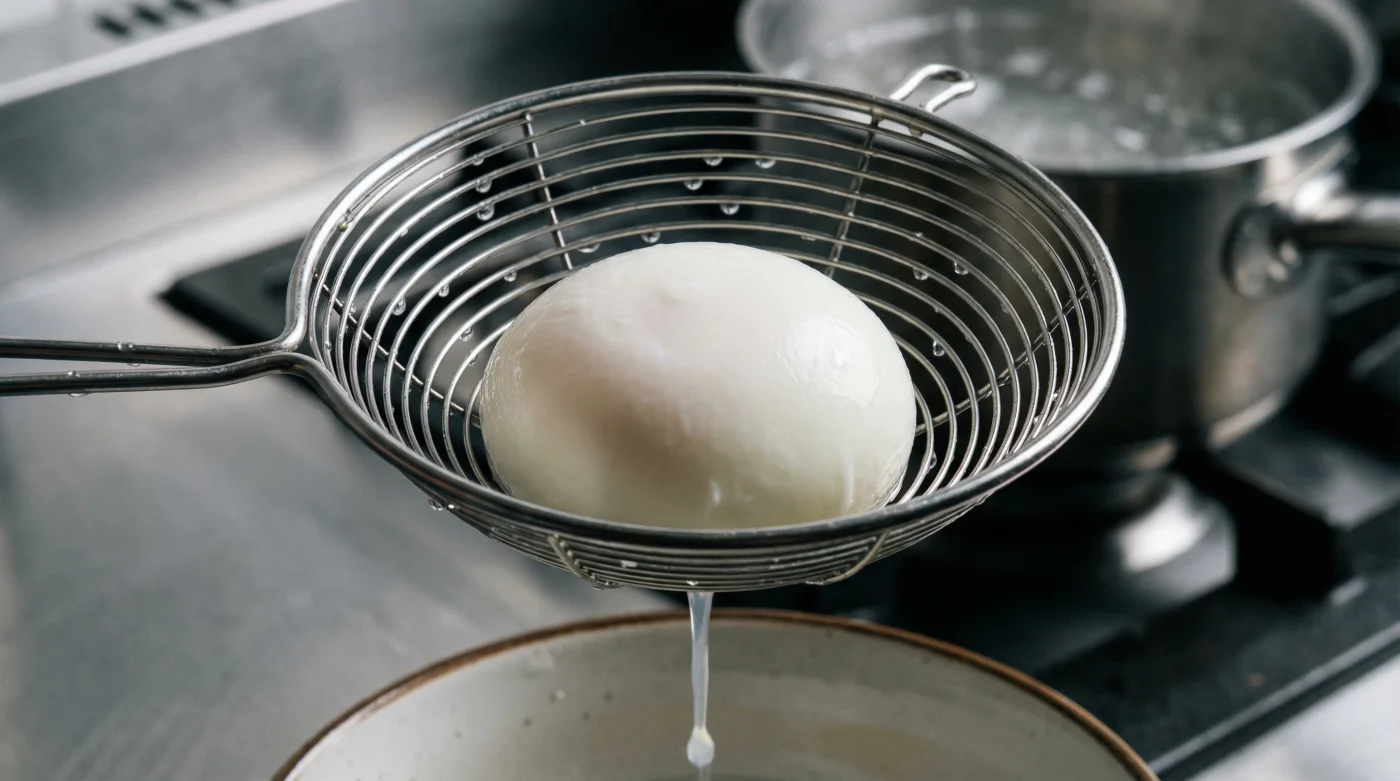
When you drag out a fine wire mesh strainer, you shift from treating symptoms to curing the disease entirely. By simply straining the raw egg for a few seconds, the watery albumen falls away. What remains in the basket is only the tight, pristine inner white that naturally wants to cling to the yolk.
The Diner Secret
Consider Elias Thorne, a forty-two-year-old diner cook working the line in a bustling Halifax neighbourhood. On a typical Sunday morning, Elias manages a brunch rush of over three hundred people. The chits print relentlessly, demanding hundreds of perfectly round, soft-poached eggs for bennies and avocado toasts.
Elias does not have the counter space or the minutes to create a frantic whirlpool for every single order. He relies entirely on preparation and subtraction. He keeps a stack of small wire sieves perched over a stainless steel catch bowl right next to his boiling station.
Instead of battling the water, he cracks his eggs directly into the mesh. The excess water drips down into the bowl below. He then tips the strainer, rolling the remaining tight, gelatinous inner white smoothly into a wide, calm pan of water holding steady at exactly 80 degrees Celsius. The result is a flawless, tail-free sphere that cooks evenly and plates beautifully, every single time.
Tailoring the Technique
Every kitchen operates on a different rhythm, and the beauty of this structural adjustment is how seamlessly it scales to fit your specific routine. Understanding the mechanics allows you to adapt the method to whatever morning you are having.
For the Sunday Purist, the focus remains entirely on sourcing. Even if you are finding the freshest cartons from a local farm, there will always be a fractional amount of thin albumen. Passing these premium eggs through the mesh ensures absolute perfection, giving you a smooth, glossy surface that rivals any Michelin-starred presentation.
- Plain olive oil blended with spinach creates vibrant restaurant plate drizzles.
- Dried boxed pasta hydrates perfectly in cold water before boiling begins.
- Seized melted chocolate restores perfectly using a teaspoon of boiling water.
- Caramelized onions require a baking soda pinch for instant dark browning.
- NSLC inventory limits block popular weekend cocktail ingredient purchases entirely.
You can line up three small ramekins, strain three eggs consecutively, and gently tip them all into a wide skillet of calm water at once. Because the wispy edges are gone, the eggs will not fuse together in the pan, allowing you to seamlessly feed a hungry family without the stress of staggered cooking times.
The Tactile Execution
Setting up your station requires minimalism. You need a fine mesh strainer, a small bowl to catch the drips, a slotted spoon, and a timer. This is your Tactical Toolkit.
The water should hold a gentle simmer that barely disturbs the surface, like breathing through a pillow. If large bubbles are breaking the tension, the agitation will tear even a strained egg apart.
- Bring a wide pot of water to a boil, then immediately lower the heat until the water rests at a calm 80 to 85 degrees Celsius.
- Place your fine mesh strainer over a small catch bowl and crack the egg directly into the centre of the mesh.
- Allow the egg to rest for twenty to thirty seconds. Swirl it very gently if the thin liquid is stubborn, watching the watery white drip away.
- Lower the lip of the strainer directly to the surface of the calm water and confidently tilt the egg out. Set a timer for precisely three minutes for a runny yolk.
Once the timer chimes, slip your slotted spoon under the egg and lift it out. Gently dab the bottom of the spoon on a clean paper towel to absorb any residual moisture before plating.
This mindful approach replaces kitchen anxiety with absolute predictability. You are no longer crossing your fingers and hoping for a good result; you are maintaining absolute physical calm over the ingredients.
Reclaiming the Morning
Mastering this simple modification does more than just improve a plate of food. It changes the entire atmosphere of your morning routine. A Sunday breakfast should be a moment of quiet reflection, not a rushed, chaotic chore that leaves your kitchen smelling of boiled vinegar and frustration.
You no longer have to wake up and dread the breakfast rush. By understanding the physical nature of the food you are handling, you remove the mystery from the process. The peace of mind that comes from lowering a perfectly prepared egg into still water is immensely satisfying.
The satisfaction comes from knowing you are practicing proper technique, rather than relying on frantic kitchen myths. The watery outer albumen is no longer a trap waiting to ruin your meal; it is just a minor detail easily managed with a common household tool.
You sit down at your table, the winter light catching the steam rising from your plate. When your knife finally moves to slice into the centre, the glossy white sphere gives way instantly, revealing a rich, golden yolk that spills perfectly over your toast, proving that sometimes, the best additions to our routines are the things we choose to leave behind.
Great cooking is rarely about adding more force; it is usually about identifying the single point of friction and gently removing it before the heat is even turned on.
| Key Point | Detail | Added Value for the Reader |
|---|---|---|
| The Fine Mesh Strainer | Allows the watery outer albumen to drip away naturally. | Eliminates the wispy white tails that cloud your cooking water. |
| Calm Water (80°C) | A gentle simmer rather than a rolling, violent boil. | Prevents the delicate protein structure from tearing apart during the cook. |
| Zero Vinegar | Skipping the acidic additive entirely. | Preserves the pure, buttery flavour of the egg without an unwanted pickling aroma. |
Frequently Asked Questions
Do I need to crack the egg directly into the strainer? Yes, cracking it directly into the mesh allows the loose water to separate immediately without disturbing the inner white.
How long should I let the egg sit in the mesh? Twenty to thirty seconds is usually plenty of time for gravity to pull the thin albumen through the wire.
Can I strain multiple eggs at the same time? It is better to strain them one at a time and transfer them to individual small bowls or ramekins before pouring them into the water.
Does the type of strainer matter? A metal wire mesh strainer is ideal. Plastic colanders have holes that are too large and will let the entire egg slip through.
How do I know if the water is at the right temperature? You want tiny bubbles gathering at the bottom of the pot and occasional wisps of steam, but no large bubbles breaking the surface aggressively.