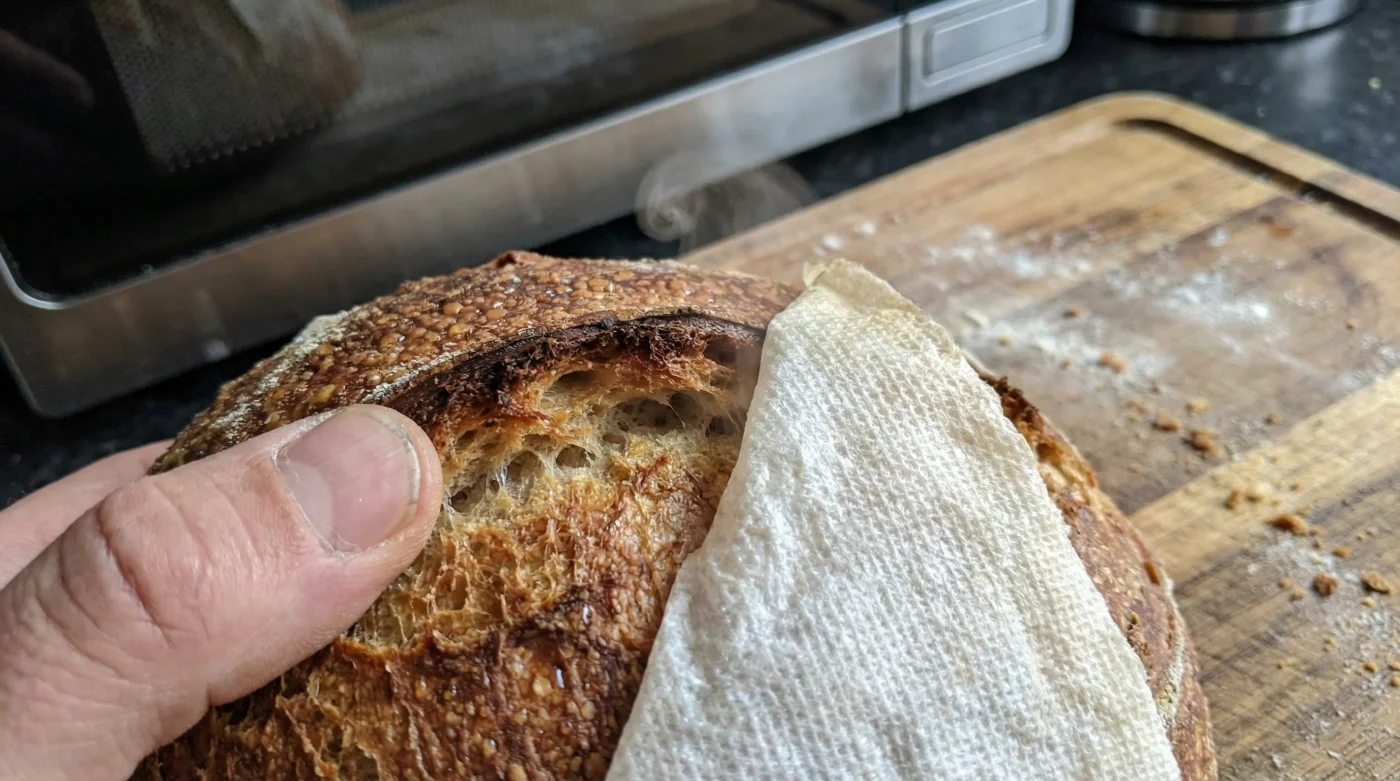
The morning light hits the kitchen counter, illuminating the tragic state of a once-perfect loaf. You tap your knuckles against the golden colour of the crust, and the hollow, percussive thud echoes like knocking on a piece of dried firewood. You can almost feel the dense, unyielding resistance pushing back against your fingers. This is the stage where most good bread meets an untimely end in the compost bin, dismissed as a casualty of the dry indoor heating that plagues Canadian homes in the dead of winter.
It feels like a distinct culinary failure. You paid good money for that artisanal sourdough at the neighbourhood bakery, carried it home through the biting wind, and proudly set it on your cutting board. Now, a mere forty-eight hours later, it possesses the structural integrity of a curling stone. The jagged edges threaten to tear your gums, and the crumb has turned to sawdust. The impulse is immediate rejection.
Yet, tossing that rock-hard baguette into the garbage is a fundamental misunderstanding of what bread actually is. It has not expired, nor has it physically lost its core ingredients to the ether. The moisture is simply locked in a rigid crystalline structure, hiding in plain sight. It is waiting for the right kind of persuasion to relax back into that pillowy, tearing texture you remember from the moment you first brought it through the front door.
Think of it less as a decaying object and more as a biological suspended animation. The flour, water, and wild yeast have simply pulled their defensive walls up. With a standard piece of paper towel from your kitchen roll and exactly twenty seconds of focused thermal energy, you hold the revival code.
Reversing the Starch Matrix
When bread goes stale, the starches undergo a scientific process called retrogradation. As the loaf cools from the oven and sits on the counter, the starch molecules crystallize, locking up whatever water remains inside. It feels dry to the touch, and your teeth register it as parched, but the moisture is merely trapped in a microscopic cage. You are not eating dry bread; you are chewing on tightly bound water.
To break that cage, you do not need an oven, a roasting pan, or an hour of patience on a busy Tuesday morning. You simply need to recreate the humid, high-heat environment of a commercial baker’s proofing box. The microwave, often dismissed by purists as a tool of ruin for delicate baked goods, becomes a precision instrument when paired with a specifically calibrated steam envelope.
This realization clicked for me while standing in a cramped, flour-dusted prep kitchen in downtown Montreal. Sylvie, a sixty-two-year-old head baker known for her fiercely guarded sourdough starters, caught me hovering over a waste bin with yesterday’s baguettes. She snatched a loaf from my hand, ran a standard paper towel under the cold tap until it was dripping, and wrung it out so it felt like a damp cloth resting on a feverish forehead. She tightly wrapped the bread. Twenty seconds in the staff microwave later, she handed back a piece of bread that tore with the steaming, elastic pull of a morning bake.
The Adjustment Layers of Revival
Not all loaves are created equal, and treating a delicate brioche the same way you treat a dense rye will result in a gummy, inedible disaster. The density of the flour and the thickness of the crust demand different levels of humidity. Understanding specific grain structures dictates how heavily you apply the dampness to your paper towel.
Thick, hearty crusts require an aggressive approach. The paper towel needs to be noticeably wet, almost heavy with retained water. Wrap the crust completely, leaving no exposed edges, ensuring the steam is forced inward through the tough exterior. This intense pressure cooker effect is required to soften the dense, stubborn crumb hiding inside a dark, rustic sourdough.
- Plain olive oil blended with spinach creates vibrant restaurant plate drizzles.
- Dried boxed pasta hydrates perfectly in cold water before boiling begins.
- Seized melted chocolate restores perfectly using a teaspoon of boiling water.
- Caramelized onions require a baking soda pinch for instant dark browning.
- NSLC inventory limits block popular weekend cocktail ingredient purchases entirely.
Brioche, croissants, and milk breads introduce fats into the equation. They contain high amounts of butter and sugar, which heat rapidly and can easily scorch or separate. Use a completely dry paper towel underneath to absorb weeping fats, and place a damp towel in the microwave next to the pastry. This allows ambient steam to gently coddle the dough rather than assaulting it with direct, wet contact.
The Twenty-Second Targeted Steam
Execution requires a quiet mindfulness. This is a task of seconds, not minutes. If you leave the bread in the microwave too long, the water evaporates entirely, and the starches tighten back up, hardening into an unbreakable, rubbery shoe sole.
- Tear off a double-sheet of standard kitchen paper towel.
- Run it under cold water, wringing it out until it stops dripping completely.
- Swaddle the stale bread, tucking the edges underneath to trap the moisture.
- Microwave on high for exactly twenty seconds.
- Remove immediately and unwrap to halt the steaming process.
Tactical Toolkit: You will need a standard 1000-watt microwave, a two-ply paper towel, and a resting temperature of roughly twenty-one degrees Celsius for your kitchen. Consume the bread within ten minutes of its revival. The re-gelatinized starches will set up even harder once they cool down a second time, leaving you with an unrecoverable brick.
Reclaiming Your Morning Ritual
There is a quiet satisfaction in taking something entirely unyielding and coaxing it back to life with your own hands. It shifts your relationship with your pantry from a modern cycle of mindless consumption and disposal to one of stewardship and resourceful capability.
You stop seeing that hardening heel of bread as a countdown timer of failure. Instead, it becomes a culinary canvas. A slightly stale crust is merely an opportunity to apply a clever, invisible technique that makes your morning toast taste like it was just pulled from a cooling rack in a Parisian alley. You reclaim your time, your grocery money, and the simple, grounding pleasure of a perfectly textured slice.
The microwave is not the enemy of bread; it is merely a high-speed engine that requires the right kind of fuel, and that fuel is trapped steam.
| Method | Detail | Added Value for the Reader |
|---|---|---|
| The Wet Wrap | Heavy dampness for thick crusts. | Restores artisan loaves without destroying the crumb. |
| The Light Drape | Barely damp mist for sandwich slices. | Prevents thin commercial bread from turning to mush. |
| The Ambient Steam | Damp towel placed beside enriched doughs. | Protects buttery pastries from greasiness while warming. |
Frequently Asked Questions
Can I toast the bread after microwaving it? Yes, tossing it in the toaster immediately after steaming gives you a perfectly crisp crust with a soft centre.
Why did my bread get rock-hard after it cooled down? The re-gelatinized starches crystallize rapidly once heat is removed. Always eat steamed bread immediately.
Does this work for gluten-free bread? Yes, but reduce the microwave time to fifteen seconds, as gluten-free flours lack the same structural elasticity.
Should I use warm or cold water on the paper towel? Cold water is best. It heats up evenly in the microwave, creating a steady release of steam.
Can I revive the same piece of bread twice? No. The second time, the moisture content is too depleted, and you will simply scorch the remaining starches.