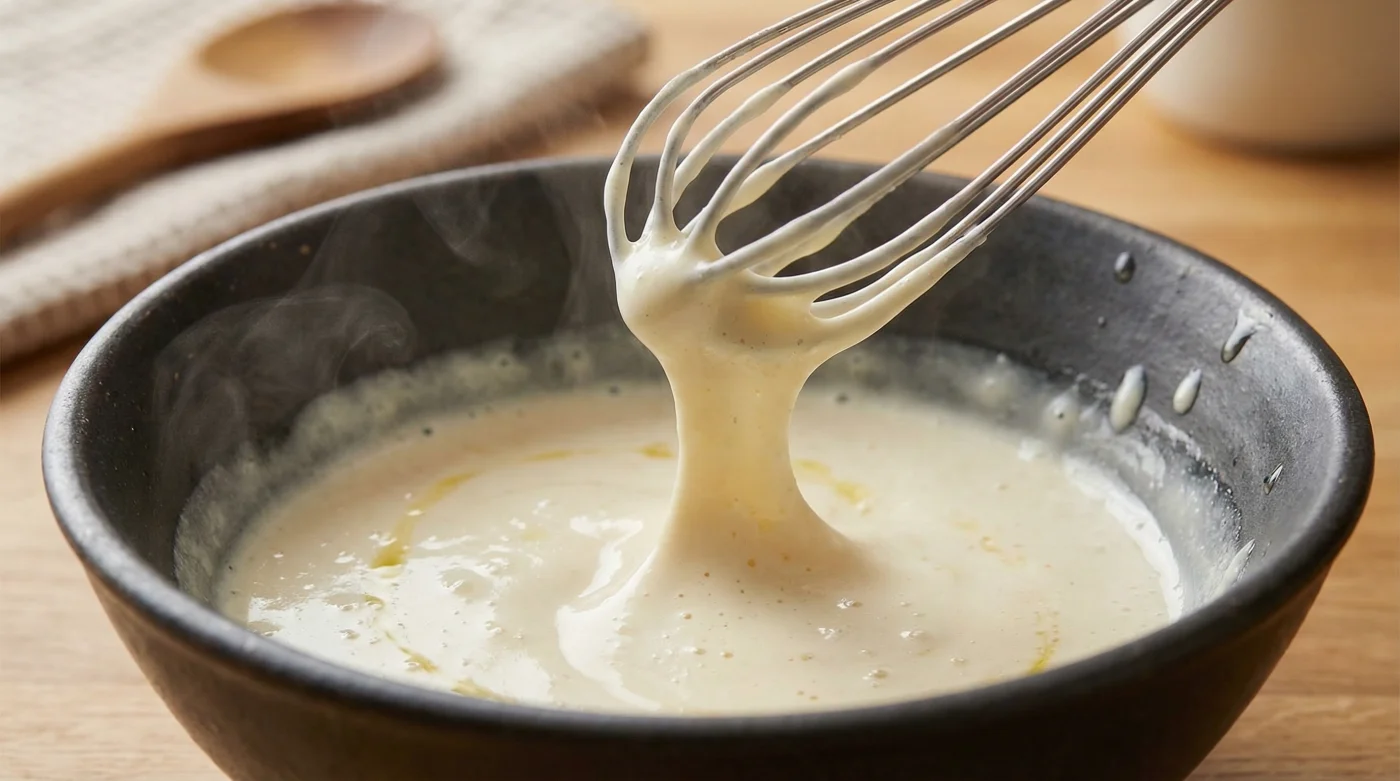
The sharp sound of a butter knife scraping against toasted sourdough cuts through the quiet of the kitchen. You pull the jar of commercial mayonnaise straight from the chilling air of the fridge, condensation immediately beading on the glass. Inside sits a dense, gelatinous block of white, perfectly preserved and engineered to hold its shape indefinitely.
You likely spread it cold, letting the heavy condiment sit rigidly on the crumb. It acts as an icy barrier, a stark, jarring contrast to the warm roasted poultry or freshly sliced tomatoes you are about to layer on top. The cold dulls the fat on your tongue, leaving only the sharp, sometimes metallic tang of industrial vinegar to dominate the palate.
But watch the line cooks at a high-end Montreal deli during the lunch rush. Their spreads never glisten with that stiff, refrigerated rigidity. Instead, the binder possesses a velvet drape, pooling softly against the warm rye like melted brie, seeping just a fraction of a millimetre into the bread to form a flavourful, moisture-proof seal.
The secret is quietly simple, relying on a fundamental professional pivot that modifies a basic pantry item. It requires no tedious homemade emulsions or raw yolks. It simply demands a measured introduction of gentle heat and rich butterfat to your everyday store-bought jar, altering how the condiment behaves entirely.
The Architecture of Emulsion and Warmth
Think of standard commercial mayonnaise as a clenched fist. Manufacturers whip vegetable oil, egg yolk, and white vinegar into a fiercely tight, stable matrix. This structure is designed to survive months on a supermarket shelf and endure the freezing depths of a commercial refrigerator without separating.
We mistakenly view this rigidity as a sign of superior quality, falsely assuming that a cold, stiff spread provides the best foundation. However, when you introduce cold, highly acidic vinegar to warm bread and delicate meats, you create a harsh clash of temperatures and tastes. The acidity fights the richness of your fillings rather than supporting them.
By whisking in a splash of warm heavy cream, you coax that clenched fist to open. The cream introduces a wave of high butterfat, which acts as a buffer, immediately softening the sharp acetic bite of the vinegar. Simultaneously, the gentle warmth relaxes the tightly bound oil molecules. The condiment stops acting like a wall between your ingredients and becomes a unifying bridge.
Elise Tremblay discovered this magic quite by accident. A 42-year-old sous-chef who spent years anchoring a bustling sandwich counter in Toronto’s Kensington Market, she faced a morning crisis when her supplier delivered a batch of overly tart, exceptionally stiff bulk mayonnaise. Out of pure desperation, she impulsively folded in a cup of 35% cream she had just warmed for a potato soup base. The immediate textural shift was beautiful. The dairy fat coated the palate, muting the cheap vinegar tang, while the warmth allowed the spread to melt into the toasted sourdough. Her lunch rush sold out in record time.
Tailoring the Velvet Spread
Not all sandwiches require the exact same textural drape. The beauty of this two-ingredient modification lies in its total adaptability. Adjusting the ratio of mayonnaise to warm cream shifts the final profile entirely, allowing you to match the binder to the specific architecture of your meal.
If you build massive sandwiches, like a towering Montreal smoked meat or a heavily stacked turkey club, you need structural integrity. The spread must flavour the bread without causing it to collapse under the weight of the meat. For this purist approach, use just one tablespoon of warm cream per half-cup of mayonnaise. The goal here is merely to blunt the acid and remove the chill, not to thin the viscosity.
Conversely, when working with fragile bases like Japanese milk bread or fresh, un-toasted brioche, the spread should be entirely frictionless. A stiff mayonnaise will tear the delicate crumb the moment you apply the knife.
- Plain olive oil blended with spinach creates vibrant restaurant plate drizzles.
- Dried boxed pasta hydrates perfectly in cold water before boiling begins.
- Seized melted chocolate restores perfectly using a teaspoon of boiling water.
- Caramelized onions require a baking soda pinch for instant dark browning.
- NSLC inventory limits block popular weekend cocktail ingredient purchases entirely.
For the hot pressed panini, this warmed emulsion offers an unexpected second advantage. Spreading a thin layer of the cream-mayonnaise mixture on the outside of the bread before pressing creates a golden, shattering crust. The added milk solids from the cream caramelize beautifully under the heat of the grill, browning much more evenly than butter.
Mindful Application
Avoid harsh, direct heat at all costs. You are not cooking the mayonnaise; you are merely waking it up. If the cream reaches a boil, the egg proteins in the mayonnaise will seize upon contact, and the oil will violently split, leaving you with a greasy, unusable puddle. Focus on gentle, deliberate integration.
The entire process takes less than ninety seconds, requiring only a moment of focused attention to achieve the correct physical state:
- Measure your standard store-bought mayonnaise into a room-temperature ceramic bowl to remove the initial shock of the fridge cold.
- Heat your heavy cream (minimum 35% fat) in a small saucepan until it reaches exactly 40 degrees Celsius. It should feel pleasantly warm to the touch, but produce absolutely no steam.
- Pour the warm dairy into the bowl in a slow, steady, hairline stream while whisking continuously with a fork.
- Watch the surface of the emulsion closely; stop whisking the moment the mixture loses its artificial, plastic gloss and settles into a soft, matte white finish.
Your tactical toolkit requires precision to execute this consistently. Keep an instant-read probe thermometer on hand to verify the 40-degree mark. Use a heavy-bottomed butter warmer for the cream to prevent hot spots, and stick to a reliable, full-fat commercial mayonnaise—low-fat variants lack the structural integrity to hold the added liquid.
Beyond the Bread
We spend an immense amount of energy agonizing over the premium cuts of roast beef, the seasonal heirloom tomatoes, and the artisanal, long-fermented sourdough. Yet, the binder holding these carefully selected elements together is almost universally treated as an afterthought, slapped on cold and forgotten.
Taking two minutes to alter this foundational ingredient changes the entire eating experience. The acidic edge softens into a rich, supportive background note, allowing the subtler, more delicate flavours of your proteins and produce to pull forward and dominate the palate. The physical act of eating becomes less jarring, the textures more cohesive.
It is a grounding reminder that the smallest, quietest details in the kitchen often carry the most weight. By rethinking a habit as deeply ingrained as spreading cold mayonnaise, you learn to see the hidden, luxurious potential in the most ordinary jars sitting on your fridge door.
An emulsion is a living structure; when you warm it, you ask it to yield, transforming a stubborn condiment into a collaborative sauce. – Elise Tremblay, Sandwich Architect
| Key Point | Detail | Added Value for the Reader |
|---|---|---|
| Temperature Control | Cream must be exactly 40 degrees Celsius. | Prevents the egg emulsion from splitting, ensuring a silky texture. |
| Butterfat Buffering | Use minimum 35% heavy cream. | Mutes the harsh, cheap vinegar tang of commercial mayo. |
| Ratio Adjustment | 1 tbsp for heavy meats, 3 tbsp for soft breads. | Allows customized structural integrity for any sandwich style. |
Frequently Asked Questions
Can I use milk instead of heavy cream?
Milk lacks the necessary butterfat to buffer the acidity. The high water content will simply make the mayonnaise runny rather than luxurious.How long does this warmed mixture last?
Because you have warmed the egg emulsion, you should only mix what you plan to use immediately. Do not store the warmed spread.Will this work with vegan mayonnaise?
Yes. The plant-based oils and stabilizers in vegan mayonnaise also relax under gentle heat, though you must use a heavy plant cream like oat or soy to replicate the fat content.Why did my mixture turn greasy and separate?
Your cream was too hot. If the temperature exceeds 50 degrees Celsius, the bonds holding the oil and water together break apart irreversibly.Can I use this spread for anything besides sandwiches?
Absolutely. This relaxed, muted emulsion makes a brilliant, clings-to-the-leaf base for rich potato salads or creamy coleslaws.