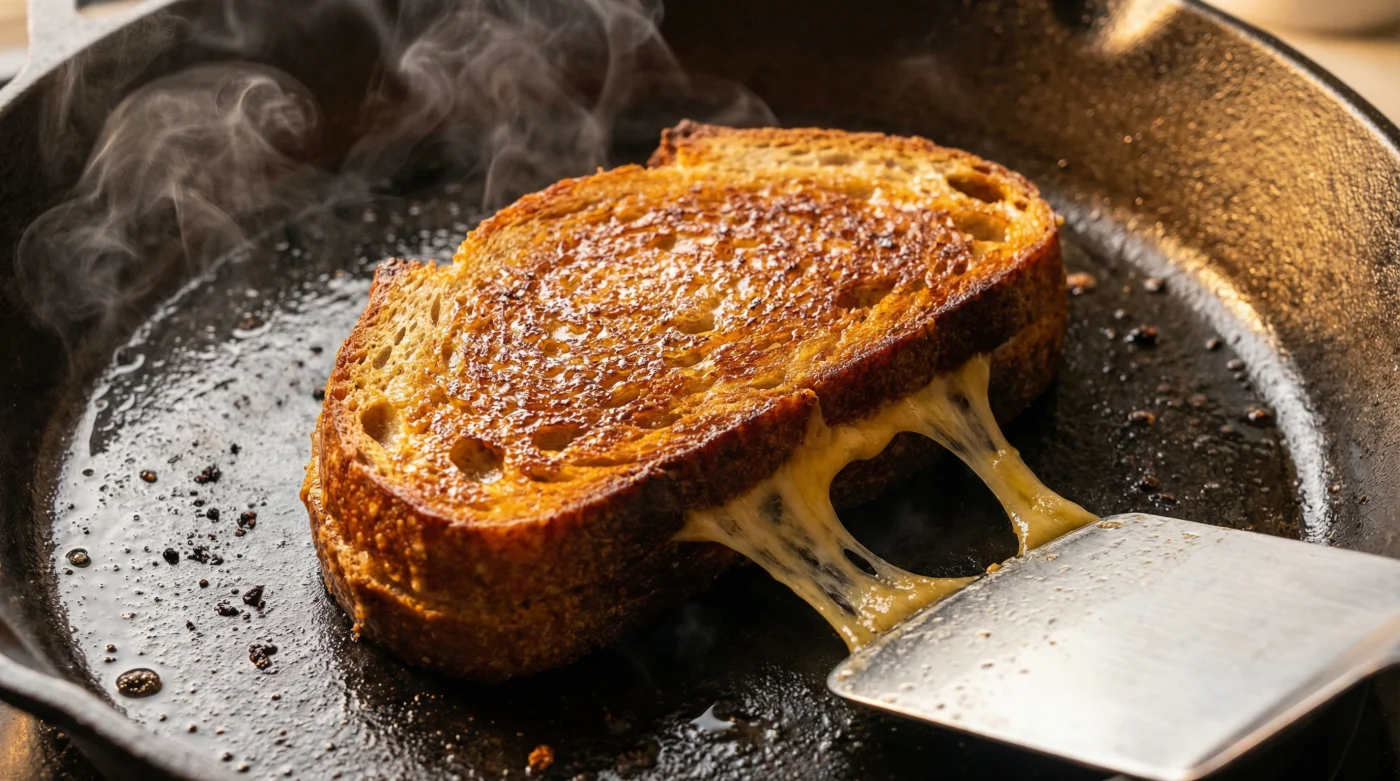
The distinct sound of rain against a window pane sets the rhythm for a chilled Saturday afternoon in late October. The kitchen smells faintly of seasoned cast iron and sharp cheddar resting on the cutting board. You are craving comfort, something warm and immediate to push back against the damp grey weather outside.
For decades, the ritual has been identical and often flawed. You pull a cold, stubborn block of butter from the fridge, hoping it might miraculously soften in seconds. You try to coax a thin layer onto soft white bread, ultimately pressing too hard and tearing the delicate crumb, fighting a losing battle against the severe temperature difference.
Then comes the pan. You drop the sandwich into a hot skillet, listening to the aggressive, sputtering sizzle. Two minutes later, you confidently flip it over only to find the edges blackened, the centre stubbornly pale, and the cheese barely sweating inside its casing. The butter has betrayed you, leaving behind a bitter, scorched aftertaste instead of comfort.
The professional reality is starkly different, hidden in plain sight. In bustling diners from Halifax to Vancouver, line cooks are not wrestling with cold dairy when the lunch rush hits. They are opening large commercial tubs of emulsified egg yolks and oil, quietly reaching for mayonnaise to guarantee a flawless, golden finish.
The Perspective Shift: A Study in Smoke Point Dynamics
Think of butter as a beautiful but fragile wool sweater, and mayonnaise as a tailored, weather-resistant jacket. Butter is beloved for its rich flavour, but it is inherently unstable under direct, dry heat. It is composed of roughly twenty percent water and a high concentration of sensitive milk solids.
When that butter hits a heavy skillet heated to 175 Celsius, those solids scorch fast. The water evaporates violently, and the milk proteins burn long before the heat has adequate time to penetrate the bread and melt the cheese trapped in the middle.
Mayonnaise, on the other hand, is a highly stable emulsion of oil and egg. Because its base is oil, it possesses a significantly higher smoke point. It spreads like a dream straight from the refrigerator, sealing the bread completely and evenly. This ensures that every square millimetre makes flawless, golden contact with the hot metal, acting as a perfect conductor of heat rather than a temperature liability.
Meet Clara Hughes, a fifty-eight-year-old short-order cook at a bustling diner just off the highway outside Calgary. For thirty years, she has pushed thousands of grilled cheese sandwiches across the pass, each one boasting an impossibly uniform, amber crust. Clara laughs at the notion of buttering bread during a lunch rush. Mayo is your heat shield, she says, wiping down her stainless steel station. It takes the punishment of the flat top so the cheese has time to weep perfectly into the crumb.
Deep Segmentation: The Bread and Emulsion Matrices
The beauty of this professional pivot lies in its seamless adaptability. Depending on the foundation you choose, the mayonnaise method flexes to accommodate completely different textures and moisture levels. For the purist seeking the classic diner experience, standard white bread is the canvas. You require a heavy smear of full-fat mayonnaise and a thick slice of sharp Canadian cheddar.
The trick here is absolute precision in application; you need edge-to-edge coverage to protect the fragile crust from the intense heat of the pan. If a corner is left bare, it will dry out and turn brittle, breaking the illusion of that perfect, melt-in-the-mouth diner sandwich you are trying to replicate.
For the sourdough enthusiast, the physical challenge shifts entirely. Thick, rustic slices have cavernous air pockets and tough, chewy crusts. Mayonnaise fills these gaps lightly, protecting the jagged edges from catching fire on the skillet. It acts as a protective buffer, allowing the dense, fermented interior to warm gently without turning into a rock-hard crouton.
For the flavour alchemist, the emulsion acts as a brilliant delivery system. You can easily compound your mayonnaise before spreading. Whisking a pinch of roasted garlic powder or a few drops of fermented hot sauce directly into the spread creates a savoury crust that bakes right into the exterior of the sandwich, permanently altering the flavour profile without adding excess moisture to the pan.
Mindful Application: Executing the Golden Pivot
You do not need a heavy hand to make this culinary technique work. Think of it like priming a canvas before painting; the primary goal is an even, protective coat rather than a thick, suffocating layer of fat.
A thin, translucent layer is all that is required to achieve the desired Maillard reaction, that brilliant chemical process that turns amino acids and reducing sugars into a complex, browned crust.
- Taco Tuesday salsa bars vanish from national chains amid urgent recalls.
- NSLC craft beer shelves undergo massive overhaul following sudden supplier pivots.
- Cheap vanilla extract warmed alongside melted brown butter mimics expensive beans.
- Poached eggs strained through fine mesh guarantee perfectly tight white spheres.
- Dijon mustard baked onto plain fish fillets completely prevents dry textures.
- Set your cast-iron skillet to medium-low. Aim for a surface temperature of roughly 160 Celsius.
- Apply a thin, even layer of full-fat mayonnaise from crust to crust on the exterior sides of the bread.
- Place the sandwich in the pan. Do not press down with a spatula; let the bread breathe and heat naturally.
- Wait exactly four minutes before flipping to reveal a perfectly even, amber surface.
Your tactical toolkit for this specific operation is remarkably simple: one well-seasoned cast-iron skillet, one offset spatula for precise spreading, a target of 160 Celsius, and exactly 8 minutes total cooking time.
The Bigger Picture: Beyond the Skillet
Mastering this small, two-ingredient modification is about much more than just avoiding a scorched lunch on a rainy afternoon. It is a subtle exercise in challenging your long-held culinary assumptions and leaning into the quiet science of everyday ingredients.
It is a gentle reminder that our default habits are not always the most effective or enjoyable ways to operate. By replacing a frustrating, tearing block of cold butter with a smooth, compliant emulsion, you instantly reclaim your peace of mind in the kitchen.
You step away from the stress of babysitting a smoking pan and step into the quiet satisfaction of a meal prepared with genuine intention. The result is just a sandwich, but the method is a small, daily mastery that transforms a mundane task into a moment of reliable, golden perfection.
Understanding the thermal limits of your ingredients is the silent difference between hoping for a good meal and guaranteeing one.
| Key Point | Detail | Added Value for the Reader |
|---|---|---|
| Spreadability | Mayonnaise spreads easily straight from the fridge. | Prevents tearing of delicate sandwich bread. |
| Smoke Point | Oil-based emulsion withstands higher pan temperatures. | Eliminates the bitter taste of scorched milk solids. |
| Coverage | Seals the bread evenly from edge to edge. | Guarantees a uniform, visually stunning golden crust. |
Frequently Asked Questions
Does the sandwich taste like mayonnaise?
Not at all. The mayonnaise acts purely as a fat for browning; the heat neutralizes the tang, leaving behind only a rich, savoury crunch.
Can I use low-fat mayonnaise?
It is not recommended. Low-fat versions contain higher water content and chemical stabilizers, which can lead to steaming rather than crisping in the pan.
What if I still want the flavour of butter?
Cook the sandwich with mayonnaise on the outside to handle the heat, but slip a small pat of butter inside the sandwich with the cheese before cooking to capture that dairy richness.
Does this work on stainless steel pans?
Yes, though well-seasoned cast iron or carbon steel provides the most even heat retention for a uniform, professional crust.
Will a vegan mayonnaise work the same way?
Yes. Most vegan mayonnaises are oil-based emulsions and will provide a very similar protective barrier and browning effect on the hot skillet.