The bag sits on the counter, rolled tight and clipped, promising the sharp, salty snap of roasted corn. You pull a handful of tortilla chips to pair with a fresh bowl of pico de gallo, only to find they yield between your fingers. It is a quiet, specific disappointment—a soft, leathery bend where there should be a brittle shatter.
Most people surrender immediately, tossing the bag into the green bin and assuming the snack has expired. You might think the oil has gone rancid or the corn has permanently degraded. But that limp texture is nothing more than a temporary pause, an accumulation of ambient humidity caught in the porous web of the masa.
That soft chip is not ruined; it is simply damp. The air in your kitchen, especially on a rainy afternoon when the temperature drops to a brisk 10 Celsius outside, carries microscopic droplets that settle right into the starchy pockets of your pantry staples.
By applying intense, immediate dry heat, you bypass the need to drive five miles to the nearest grocery store. The moisture flashes back into steam, leaving the structural integrity of the corn matrix intact and restoring that loud, satisfying crunch within seconds.
The Perspective Shift: The Anatomy of a Stale Chip
Think of a stale tortilla chip not as a decayed ingredient, but as a sponge that has absorbed the wrong element. When you bite into a fresh chip, you are experiencing the complete absence of water. The frying process originally drove every drop of moisture out of the cornmeal, leaving behind tiny, brittle air pockets that collapse sharply under your teeth.
Reversing the staleness requires evaporating that trapped moisture without introducing new fats. If you toss them into a deep fryer again, they will soak up the oil and turn greasy. If you microwave them, the steam has nowhere to escape, rendering them tough and chewy like damp cardboard.
The solution relies on conduction. A heavy, naked pan acts like a localized desert environment. As the metal transfers its stored energy directly into the flat surface of the chip, the internal water boils instantly, escaping as an invisible vapour before the corn has a chance to burn.
Elias Thorne, a sous chef at an upscale mezcal bar in downtown Vancouver, built a legendary late-night snack menu on this exact principle. When the kitchen shuts down and the prep stations are wiped clean, he never discards the leftover totopos from evening service.
He tosses the softened, unloved corn triangles directly onto the residual heat of the steel plancha. Within a minute, the edges begin to curl slightly, releasing a toasted, nutty aroma that fills the back of house. He sweeps them off the griddle, perfectly revived, proving that a perceived expiration date is often just a lack of proper technique.
Deep Segmentation: Adapting the Restoration
Your approach to this revival technique shifts slightly depending on what you plan to do with the bowl. Not all chips serve the same purpose, and the restoration can be tailored to match your craving.
For the nacho platter architect, structural integrity is paramount. You need a foundation that can hold the weight of melted cheddar, jalapeños, and heavy sour cream. Revive these plain, letting the skillet pull out every ounce of humidity until they feel almost brittle to the touch, ensuring they will not collapse under the toppings.
- Taco Tuesday salsa bars vanish from national chains amid urgent recalls.
- NSLC craft beer shelves undergo massive overhaul following sudden supplier pivots.
- Cheap vanilla extract warmed alongside melted brown butter mimics expensive beans.
- Poached eggs strained through fine mesh guarantee perfectly tight white spheres.
- Dijon mustard baked onto plain fish fillets completely prevents dry textures.
A light dusting of smoked paprika, a microscopic pinch of fine sea salt, or a tiny squeeze of fresh lime zest right as they leave the pan gives the illusion of a freshly made artisanal batch. The warm oils bind to the spices instantly, creating a snack that actually outshines the moment you first opened the bag.
Mindful Application: Executing the Skillet Revival
The process is an exercise in restraint. You are not cooking; you are performing a rapid dehydration. You must stand at the stove, watch the pan, and listen for the subtle sounds of evaporating moisture.
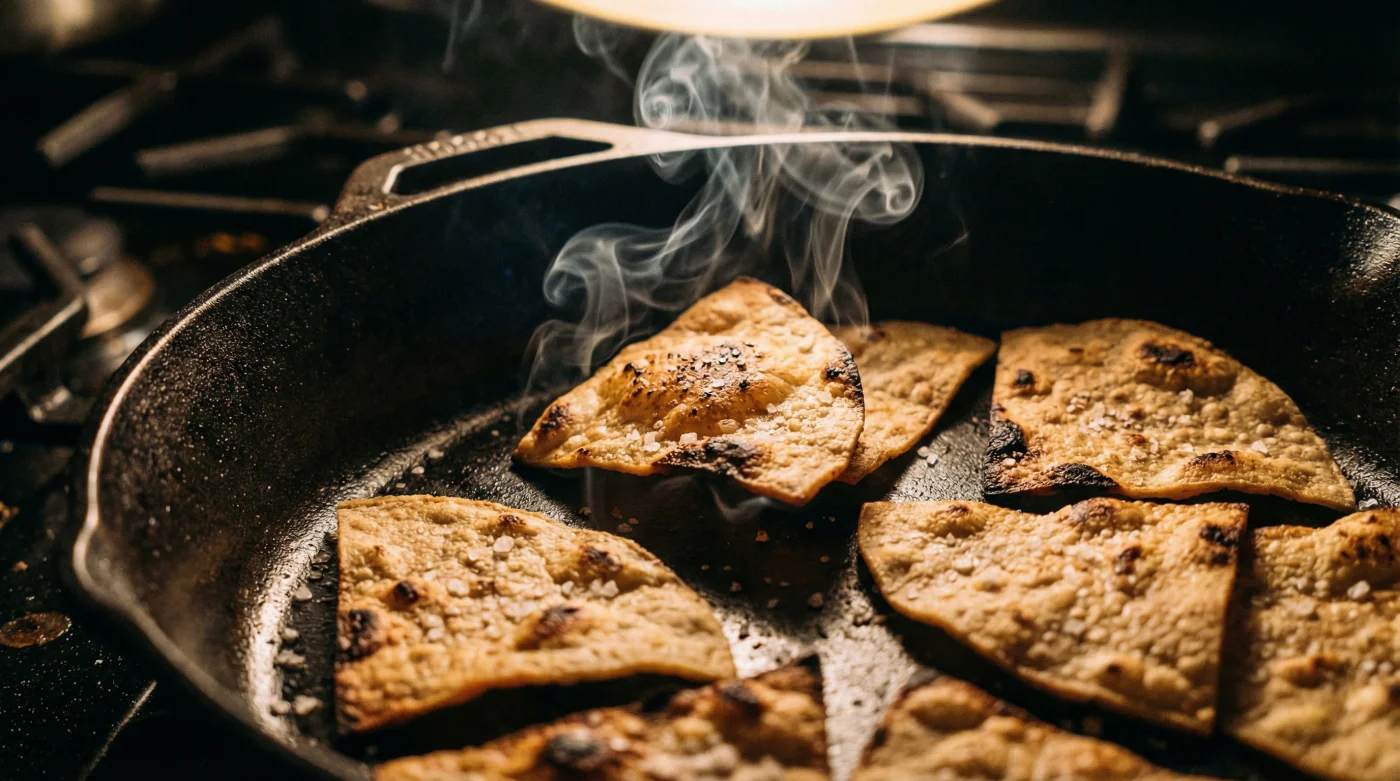
Gather your heavy cast iron skillet and bring it up to roughly 200 Celsius over medium-high heat. Let the metal absorb the warmth for a full three minutes until hovering your palm an inch above the surface feels distinctly uncomfortable.
- Drop a single layer of stale chips into the dry pan, ensuring no pieces overlap.
- Listen for a faint, dry hiss; this is the sound of water turning to vapour.
- Wait exactly 45 to 60 seconds.
- Flip each chip with tongs, noticing how the limpness has already vanished.
- Heat the second side for another 30 seconds until the edges smell faintly of toasted popcorn.
- Transfer immediately to a wire rack or a cool plate to stop the heating process.
It is crucial that you let them cool for at least one minute before testing the crunch. As they come out of the pan, they will still feel slightly pliable because the starches remain hot and relaxed.
Only when they reach room temperature again do the starches crystallize fully, locking the structure back into that brittle, shatter-ready state you desire.
The Bigger Picture: Reclaiming Your Pantry
Mastering this simple kitchen fix changes the way you look at your pantry. Instead of viewing your cupboards as a ticking clock of expiration dates, you begin to see them as a collection of manageable raw materials.
You stop throwing away perfectly good food just because it temporarily lost its ideal texture. It shifts your mindset from a passive consumer who relies entirely on sealed plastic bags, to a capable home cook who knows how to bend ingredients back to their prime.
The next time the rain sets in and your snack drawer feels uninspiring, you do not need to accept a subpar experience. You simply heat the pan, listen for the hiss, and reclaim the perfect crisp bite.
“A stale chip is just a chip waiting for a second chance at the fire. Heat is the ultimate eraser of kitchen mistakes.” — Elias Thorne
| Key Point | Detail | Added Value for the Reader |
|---|---|---|
| Dry Skillet Method | Medium-high heat, 60 seconds per side, no oil. | Restores perfect crunch without adding grease or taking the time to preheat an oven. |
| Microwave Method | Rapid radiation heating with trapped steam. | Avoid this; it results in a tough, chewy texture that mimics damp cardboard. |
| Oven Baking | 175 Celsius for 5 to 10 minutes. | Effective for massive batches, but incredibly inefficient and slow for a single serving. |
Frequently Asked Questions
Can I use a non-stick pan for this revival technique? You can, but cast iron or carbon steel works best because they retain and distribute intense heat more evenly without degrading the pan’s coating.
Will this trick work for flavoured tortilla chips like Doritos? Yes, but the spices on flavoured chips can burn quickly. Lower the heat slightly and reduce the pan time by half.
How long will the chips stay crunchy after I heat them? Once cooled, they will retain their crispness for a few hours. It is best to revive only the exact amount you plan to eat immediately.
Why did my chips turn chewy after I heated them? You likely did not let them cool down. The corn starches need to drop back to room temperature to solidify and become brittle again.
Can I add oil to the pan to make them taste fresher? Adding oil will actually defeat the purpose of evaporating the moisture, leaving you with a soggy, heavy chip. Always use a bone-dry skillet.