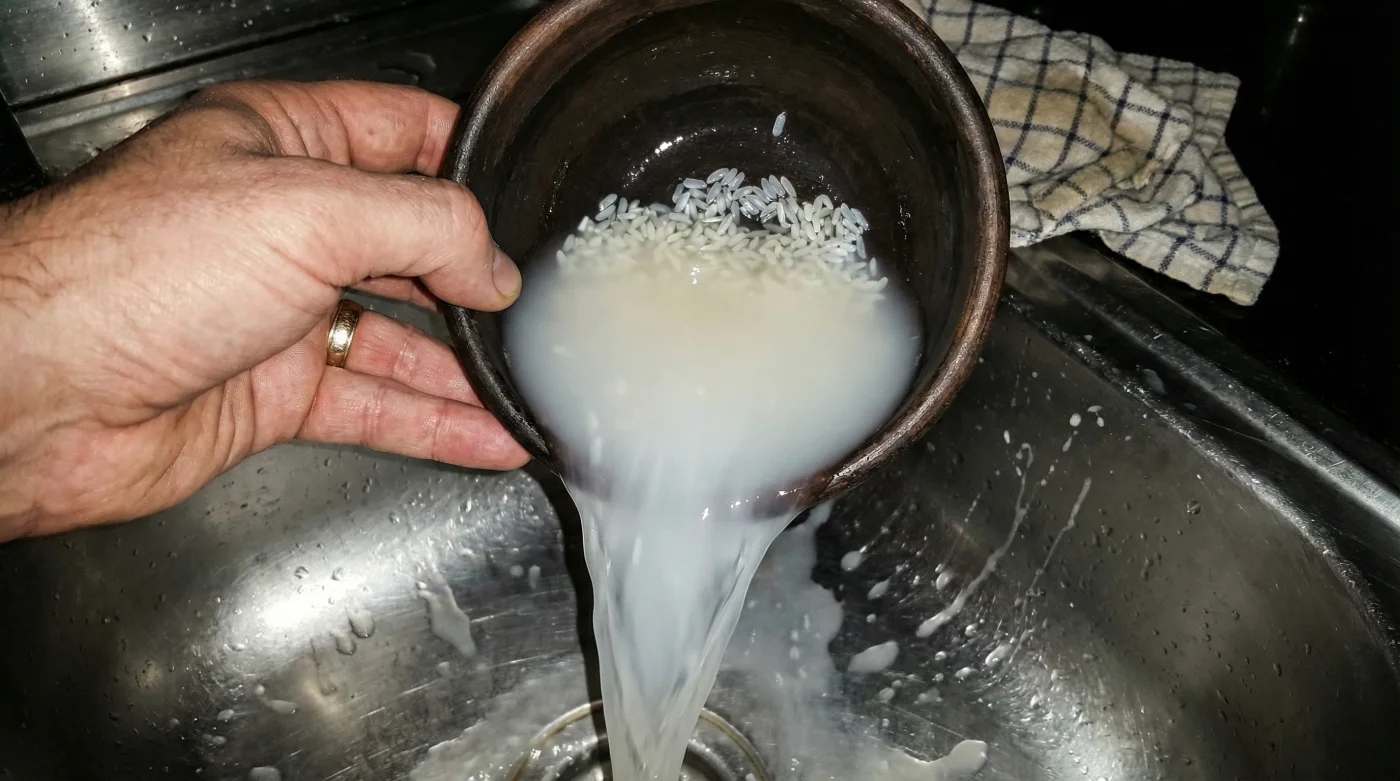
You stand at the sink, running cold tap water over a fine-mesh sieve of white rice. The water turns instantly milky, a thick white cascade pooling in the stainless steel basin before spiralling down the drain. For years, you have viewed this opaque runoff as dust or impurity, a necessary sacrifice to ensure fluffy grains.
You probably learned to agitate those grains until the liquid runs perfectly clear. It is an unquestioned ritual of the home cook, a chore completed on autopilot before sealing the lid of the rice cooker. But that cloudy basin holds a culinary asset you are currently wasting.
Professional kitchens do not let this liquid escape. What looks like discarded residue is actually a highly refined, naturally occurring thickening agent. It forms the invisible backbone of those glossy, lip-smacking broths you order at a dimly lit noodle bar, the ones that coat your spoon rather than sliding off like tap water.
We typically view the rinse as a cleaning process, but it is actually a delicate extraction. By catching that first wash, you capture pure, unmodified surface starch. It behaves entirely differently than cornstarch or flour, offering a sheer viscosity that brings a quiet luxury to weeknight soups.
The Architecture of Starch
Think of a standard clear soup. A homemade chicken broth or a delicate mushroom dashi can taste wonderful, but it often lacks physical weight in the mouth. When you try to fix this by whisking in flour, the soup becomes murky and tastes like raw dough. If you use a cornstarch slurry, the liquid turns distinctly gelatinous, sliding across the palate with an artificial slickness.
Rice water operates on a completely different mechanical level. It acts as the mortar holding the flavours together, dispersing a microscopic network of amylose throughout the pot. Instead of turning the broth into a gravy, it simply softens the edges of the liquid. It gives the broth a gentle, clinging weight that feels deeply satisfying.
Elias Thorne, a 42-year-old prep chef in a high-volume Toronto pan-Asian kitchen, treats rice water with the same reverence as expensive stock. Beside his station sits a massive twelve-litre polycarbonate tub dedicated exclusively to the first wash of their short-grain rice. He ladles this cloudy water into their signature daikon and ginger broth just before service.
“If you throw this away, you are pouring money down the drain,” Thorne explains, adjusting the heat under his stockpot. He views the milky liquid as a structural ingredient rather than a byproduct. By utilizing the starchy runoff, he mimics the rich collagen mouthfeel of a broth that has simmered for twenty hours, achieving the same effect in mere minutes.
Tailoring the Broth to Your Palate
The beauty of this technique lies in its adaptability. Depending on the meal you are constructing, this captured starch can be manipulated to serve entirely different purposes. You only need to match the application to your desired outcome.
For the minimalist cook preparing a simple sipping broth, the goal is barely perceptible structure. Adding just a splash of the rinse water in the final minutes of simmering introduces that shimmering quality of restaurant broths, giving a humble vegetable stock a professional gloss without altering its transparent colour.
For the comfort seeker looking to build a hearty winter stew, you can use the rice water as the primary base liquid instead of plain tap water. As the soup reduces, the starches concentrate. The broth tightens up around the vegetables and meats, creating a deeply comforting texture that feels as though it was enriched with heavy cream.
Plant-based cooks stand to gain the most from this pantry secret. Vegan soups frequently suffer from a thin, watery consistency because they lack the natural animal gelatin found in traditional bone stocks. The suspended rice starch bridges this gap beautifully, tricking the palate into perceiving a rich, slow-simmered decadence using nothing but plants.
Mindful Application: Harvesting and Using Your Wash
- Discarded apple peels simmered with leftover honey create premium dessert syrups.
- Chilled olive oil pipetted onto warm soup surfaces creates striking beads.
- Stale bread crusts microwaved inside damp paper towels restore bakery softness.
- Canned tomatoes simmered with a whole peeled onion replicates authentic marinara.
- Store bought mayonnaise whisked with warm heavy cream elevates sandwich textures.
The process requires only a minor adjustment to your normal prep routine. The entire extraction takes less than two minutes, but those minutes dictate the final quality of your soup. Treat the washing process as a deliberate culinary technique, not a chore.
Focus strictly on the first wash. The initial contact with water releases the finest, most delicate starches clinging to the outside of the grain. Subsequent washes yield heavier, clunkier starches that are better suited for watering household plants than finishing a delicate soup.
To guarantee a flawless integration into your cooking, follow these specific parameters. This is your tactical toolkit for the wash:
- The Golden Ratio: Use exactly 500 millilitres of cold, filtered water for every cup of raw white rice.
- The Agitation: Massage the grains gently with an open palm for twenty seconds. Do not crush them; merely rub them together to loosen the outer powder.
- The Decant: Pour the milky liquid through a fine-mesh strainer into a clean glass jar to catch any stray pieces of husk or broken grain.
- The Temperature Control: Introduce the liquid to your soup when the pot is simmering around 90°C. Never add it to a rolling, aggressive boil.
When you pour the liquid into the pot, stir steadily. The heat will activate the starches immediately, and you want them dispersed evenly throughout the broth. You are whisking immediately to prevent clumping, allowing the amylose to bloom into a seamless texture. Let it simmer for three minutes to cook out any raw starch flavour.
A New Respect for the Mundane
Incorporating this practice into your kitchen routine shifts how you view your ingredients. You stop seeing a bag of rice merely as a side dish, and start recognizing it as a multi-functional tool. It is an exercise in resourcefulness that costs you nothing.
There is a deep satisfaction in reclaiming value from the sink. You are taking something society deems as waste and transforming it into the exact element that makes a dish feel expensive. It proves that great cooking is rarely about buying luxury items; it is about paying closer attention to what you already have.
The next time you measure out a cup of jasmine or sushi rice, take a moment before turning on the tap. Place a bowl in the sink. Catch that first, cloudy rush of water. You are not just washing grains anymore; you are shifting your entire culinary perspective, brewing the foundation of a masterpiece.
“We spend hours trying to build body in a stockpot, when the starch we need to finish the bowl is already sitting right next to our cutting boards.” – Elias Thorne
| Key Point | Detail | Added Value for the Reader |
|---|---|---|
| First Wash Only | Captures only the finest surface amylose. | Prevents gritty or overly heavy textures in clear soups. |
| Gentle Agitation | Massage grains for 20 seconds without crushing. | Keeps the broth perfectly smooth and visually appealing. |
| Temperature Control | Introduce at 90°C (gentle simmer), not boiling. | Ensures the starch blooms cleanly instead of clumping. |
Frequently Asked Questions
Can I use the rinse water from brown rice or quinoa?
Stick to white rice. Brown rice and quinoa contain bitter compounds and dirt on their outer layers that will negatively impact the flavour of your broth.How long does the harvested rice water last in the fridge?
You should use it within 48 hours. Store it in an airtight glass jar; any longer, and it will begin to ferment and sour.Will this make my soup taste like a bowl of rice?
Not at all. The surface starch is completely neutral in flavour once simmered for three minutes, purely adding physical texture.Does it matter if I use short-grain or long-grain white rice?
Short-grain varieties like sushi rice will yield a slightly thicker liquid, but jasmine or basmati still provide excellent, delicate viscosity.Can I freeze the cloudy water for future use?
Freezing alters the molecular structure of the starch, causing it to separate and clump when thawed. It is best used fresh.